11 Tools Tested for Lawn Care and Landscape ContractorsYour Attractive Heading
Originally published April 16, 2026. Updated May 26, 2026: added ServiceTitan, Service Fusion, and NiceJob sections; corrected LeadTruffle and CompanyCam pricing; updated recommended stack with verified May 2026 pricing across all 11 tools.
Not sure which tools fit your shop?
Answer seven quick questions and get a stack matched to your trade, size, and budget — every pick traces to our published testing, and several of our recommendations earn us nothing. Try the free Tool Finder →
Which landscaping business software and AI tools actually pay for themselves — and which ones are just repackaged software with an AI badge slapped on.
Landscaping is a multibillion-dollar industry in 2026 — and it’s in the middle of a labor crisis that isn’t getting better. Recruiting and retention have become the dominant business risk for landscape contractors heading into 2026, per NALP industry surveys and trade press coverage. The math is brutal: rising labor costs, shrinking labor pools, and margins getting compressed from both ends.
AI tools aren’t going to solve the labor shortage. But the contractors who use them well are reclaiming 15–20 hours a week of administrative time, recovering tens of thousands of dollars annually in missed leads, and submitting 3–5 times more bids per estimator. The difference in 2026 between a landscaping company that’s growing and one that’s treading water increasingly comes down to how much of its back-office work is still being done manually.
This is the honest, no-hype guide to the eight AI tools actually worth a landscaping contractor’s time in 2026 — from lawn care solo operators to mid-size hardscape crews. Tested against real-world use cases, with honest limitations and pricing where available.
Pricing, features, and platform capabilities verified as of May 2026. Individual results vary by business size, region, and implementation.
The Real Operational Problem AI Solves for Landscapers
Before talking about tools, look at where the hours actually go. A typical 5-tech residential lawn care operation can lose 25-30 hours a week to administrative tasks that don’t directly produce revenue — customer scheduling, quote prep, invoicing, route planning, job documentation. Industry-typical estimates put the time savings from a well-implemented AI tool stack at 15-20 hours per week, freeing up the equivalent of half a full-time employee.
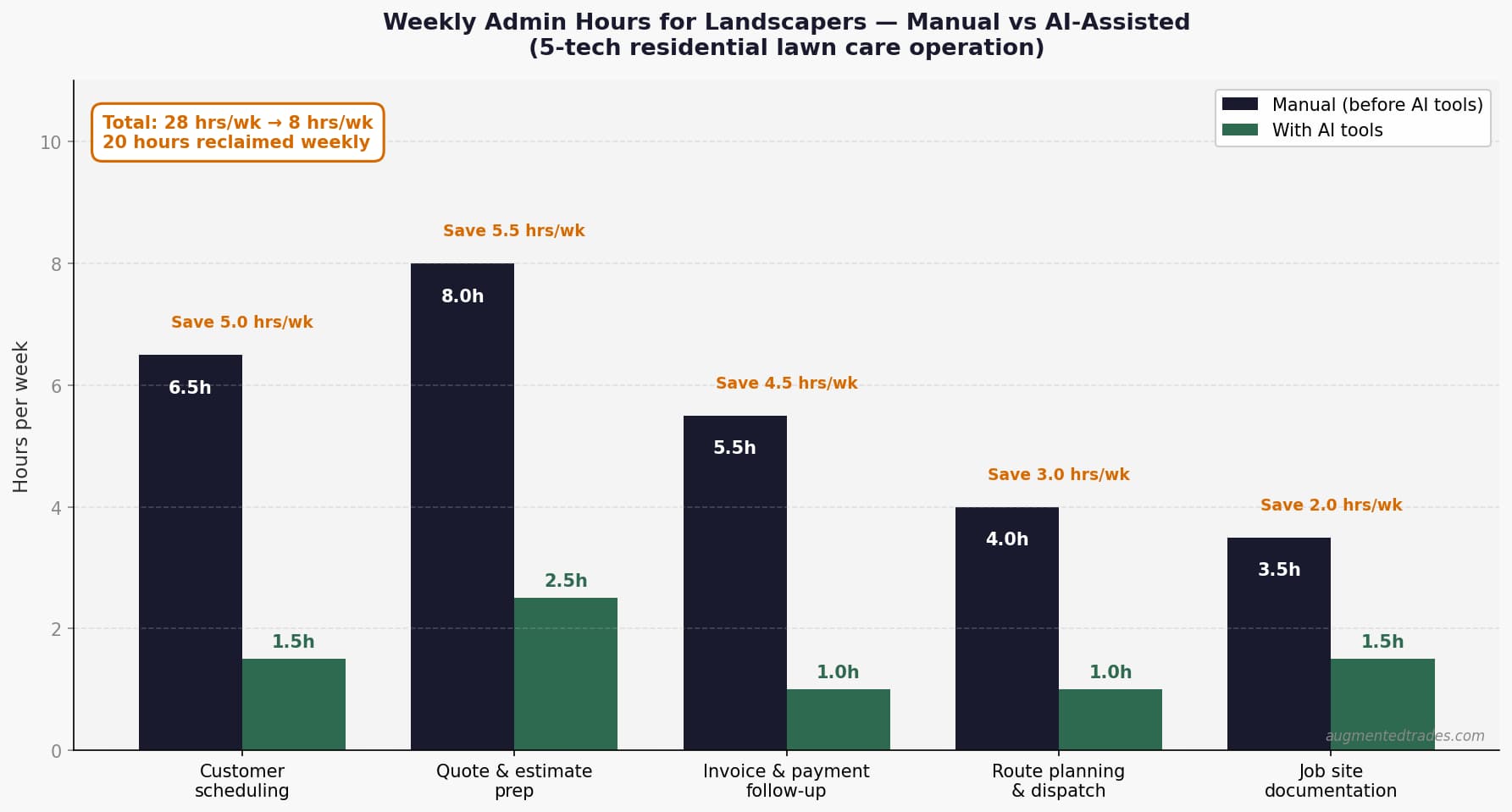
Weekly admin hours for a 5-tech landscaping operation before and after implementing AI tools. Time estimates based on contractor-reported data.
The time reclaimed each week isn’t theoretical — it’s time your best employee (usually the owner) can spend on estimating, customer relationships, or actually being out on the job. For a landscape contractor running a typical maintenance book, automated reminder and renewal flows can meaningfully reduce lapsed-contract rates. Even a 5-10% improvement in renewal rates against an existing maintenance customer base typically generates several thousand dollars in protected annual revenue, depending on average contract value and existing renewal performance.
1. Jobber — Best All-Around FSM for Residential Landscapers
Jobber is built for service-based contractors who need scheduling, quoting, invoicing, and customer communication in a single platform. For landscaping specifically, it handles the recurring-visit workflow well — weekly mows, biweekly maintenance, monthly hardscape consults — without needing a dedicated office staff. Setup takes a few days, not weeks, and the mobile app works reliably for crews in the field.
The highest-ROI features for landscapers specifically: automated maintenance reminders, the client hub for quote approval and online payments, and AI-assisted quoting that suggests line items based on past jobs. For a landscape contractor running 150 maintenance customers, the automated reminder and renewal flow typically recovers $4,000–$8,000 in lapsed seasonal contracts each year — without a single manual outreach.
What Jobber Does for Landscapers Specifically
• Route-aware scheduling — Smart scheduling with drag-and-drop routing — optimizes drive time between properties, increasing jobs per crew per day
• Online booking — Customers self-book spring cleanups, fall cleanups, and recurring maintenance through a branded online form, meaningfully reducing inbound call volume for shops that implement it
• Automated reminders — Sends service-due notices via text or email for maintenance customers, recovering lapsed contracts without manual outreach
• Client hub — Customers approve quotes, pay invoices, and request additional services online — eliminates the weekend payment chase
Honest Limitations
• Reporting is functional but shallow — you see jobs and revenue, but not crew-level profitability or job-type margin analysis
• Marketing automation is basic — good for review requests and reminders, not full drip sequences or seasonal campaigns
• Not specialized for landscaping — no built-in plant database, no property mapping, no weather-aware scheduling
Pricing: Core $49/mo, Connect $139/mo (Individual), Grow $199/mo (Individual). Team plans run $199-$399/month for 5-10 users; Plus $699/month for 15 users.
Best for: residential landscapers 1–15 crews focused on maintenance, basic installs, and recurring service revenue.
2. Housecall Pro — Best for Landscapers Who Need Stronger Marketing Automation
Housecall Pro covers the same FSM core as Jobber but pushes significantly harder on marketing automation. For landscapers doing more than just maintenance — those selling hardscape, outdoor lighting, irrigation, or seasonal cleanups — the automated review requests, email/SMS marketing, and postcard campaigns produce measurably more repeat business than Jobber’s simpler tools.
The AI-powered customer acquisition features are where Housecall Pro differentiates most in 2026. It’s genuinely better than Jobber at turning a one-time hardscape customer into a repeat maintenance customer through targeted campaigns. For landscaping companies where 30–50% of gross revenue comes from repeat clients, this matters.
What Housecall Pro Does for Landscapers Specifically
• Targeted marketing campaigns — Automated email/SMS sequences by customer segment — maintenance customers get different messages than one-time installs
• Review generation — Sends follow-up links at the right time in the customer journey, dramatically improving Google review volume
• On-My-Way texts — Tech arrival notifications with photo and name — reduces customer anxiety and improves trust, particularly for new customers
• In-app upsell — Technicians can sell add-ons at the job site (mulch refresh, seasonal cleanup, irrigation check) with mobile estimate tools
Honest Limitations
• Price jumps quickly with team size — the MAX tier required for meaningful automation runs $329/month, plus per-user fees on team plans
• Map-based location tracking only refreshes every few minutes, not real-time, which can frustrate dispatch workflows
• Phone support is limited on lower tiers — most support runs through chat, which can be slow
Pricing: Basic $79/mo, Essentials $189/mo, MAX $329/mo (monthly billing). Annual billing reduces these to $59, $149, and $299 respectively. Annual contract available for discount.
Best for: landscapers focused on hardscape, outdoor lighting, or high-touch service with strong repeat revenue potential.
3. LeadTruffle — Best for Landscapers Losing Revenue to Missed Calls
Here’s the problem nobody talks about in landscaping: a meaningful share of service calls come outside business hours — weekend storm damage, after-hours maintenance requests, evening customer voicemails. For a landscape company without a dedicated answering service, those calls go to voicemail or get missed entirely. Speed-to-lead research from companies like LeadConnect and Velocify has consistently shown that voicemail-based leads convert at meaningfully lower rates than leads answered live within 5 minutes — often by a factor of 5x or more.
LeadTruffle is an AI-powered answering and qualification service that handles inbound calls, qualifies leads, and books appointments directly into your calendar — 24/7. For landscapers specifically, it catches the revenue that would otherwise disappear: the Saturday afternoon call from a homeowner who wants their yard mowed next week, the evening voicemail about a tree that fell on a patio, the Sunday inquiry about spring cleanup pricing.
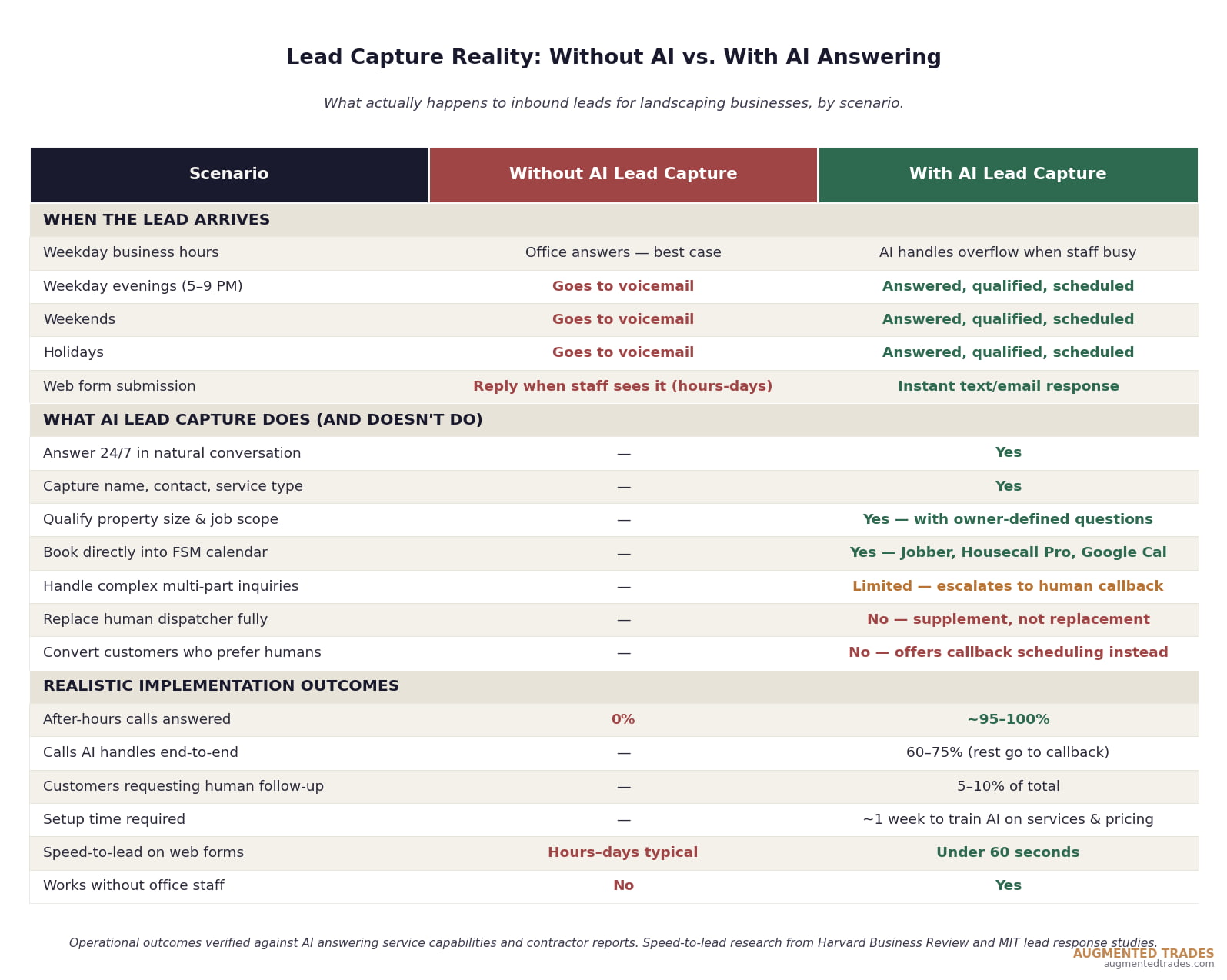
Annual revenue lost to missed calls for landscaping businesses by size, and the portion typically recoverable with AI lead capture. Based on 35–45% of service calls arriving outside business hours.
What LeadTruffle Does for Landscapers Specifically
• AI voice agent — Handles inbound calls 24/7 with natural conversation, captures service details, and routes urgent issues appropriately
• Lead qualification — Asks the questions a real office person would — property size, service type, preferred timing — so you don’t waste time on unqualified leads
• Calendar integration — Books qualified appointments directly into Jobber, Housecall Pro, or Google Calendar without manual intervention
• Web form follow-up — Responds instantly via text or email when a customer submits a web form — speed-to-lead is the single biggest conversion factor
Honest Limitations
• Setup requires about a week to train the AI on your specific service types, pricing, and qualification criteria
• Works best as a supplement to human staff during business hours, not a full replacement
• Some customers still prefer speaking to a human — the AI handles this by offering callback scheduling, but expect a small share of callers to request a human follow-up
Pricing: $229/mo Essential / $399/mo Growth / $629/mo Scale with $299 onboarding
Best for: landscapers losing revenue to after-hours calls, missed voicemails, or slow web form response times.
4. CompanyCam — Best for Landscape Documentation and Before/After Sales
If you do hardscape, landscape installation, or any project where before/after photos matter, CompanyCam is not optional. Every photo is time-stamped, location-tagged, and organized under the correct project automatically. For landscapers, this solves three problems at once: customer dispute protection, sales presentation material, and team accountability.
The AI features added in 2025–2026 — automatic photo tagging, before/after suggestions, and project timeline generation — turn what was already a solid documentation tool into something that actively drives sales. A landscape contractor showing a homeowner a one-click before/after timeline of a similar project closes more hardscape bids than one pulling random photos from their camera roll.
What CompanyCam Does for Landscapers Specifically
• Organized photo documentation — Every photo and video is time-stamped, GPS-tagged, and filed under the right customer automatically — no manual organization
• AI before/after — AI suggests before/after pairs from your photo library, generating professional presentation material in seconds
• Client sharing — Share project photo albums with customers in real-time — they see progress as it happens, which dramatically reduces customer anxiety on multi-day projects
• Dispute protection — When a customer claims work wasn’t done, you have time-stamped photo proof — this has saved contractors tens of thousands in disputed invoices
Honest Limitations
• The core documentation features are what you’re really paying for — the project management layer is thinner than a dedicated FSM tool
• Requires team discipline to use consistently — the tool only works if crews actually take photos at the right moments
• Pricing tiers can feel steep for solo operators who don’t need the team features
Pricing: $79/mo total for 3 users on annual billing, or $99/mo monthly, Premium $129/user/mo, Elite $199/user/mo. Additional users $29-34/mo each. Annual billing offers approximately 25-30% savings on per-user costs.
5. FieldCamp — Best AI-Native Dispatch for Landscape Teams
FieldCamp is newer to the market than Jobber or Housecall Pro, but it’s built AI-first rather than retrofitted onto a legacy platform. For landscape contractors who want modern AI workflow automation and have budget for premium FSM tools, FieldCamp fits a real gap between traditional mid-tier platforms and ServiceTitan’s enterprise complexity.
The AI-powered command center — which reroutes crews automatically when jobs run over, weather changes, or new priority calls come in — is the feature that most justifies the investment. For landscape operations where a single rain delay can cascade into three days of rescheduling chaos, intelligent automatic rerouting saves real hours of dispatch work every week.
What FieldCamp Does for Landscapers Specifically
- AI command center — Automatically reassigns jobs and reroutes crews when conditions change — storm delays, equipment breakdowns, priority calls
- Weather-aware scheduling — Built-in weather integration flags jobs that should be rescheduled before crews roll out
- Digital job checklists — Crews follow digital checklists for each property type — critical for consistency across teams, especially with newer employees
- Workflow automation — Automates repetitive workflows between field and office without requiring Zapier or custom integrations
- Job cost and profit-per-job tracking — Captures labor, mileage, and expenses per job and rolls them up into job cost, profit, and profit-per-hour, so crews can see margin before the job closes
- AI Agents marketplace — Prebuilt AI agents you can install and configure for tasks like dispatch, follow-up, and invoicing, running on schedules or triggers
Honest Limitations
- Newer platform — smaller user community than Jobber or Housecall Pro, fewer third-party integrations currently
- Premium pricing tier — meaningfully more expensive than entry-level Jobber or Housecall Pro, so the AI-native value has to justify the cost
- AI features are billed separately on usage, which adds variable cost on top of the base subscription
- Mobile app is solid but not yet as polished as the more mature FSM platforms
Pricing: Pro $249/mo (3 users included, $83/mo per additional user). Growth $699/mo (10 users included, $70/mo per additional user). Scale $1,499/mo (20 users included, $75/mo per additional user). Enterprise pricing starts at $2,000+/mo with negotiated terms. Annual billing offers 20% off all plans. AI features billed separately on actual usage. 7-day free trial available, no credit card required.
Best for: Landscape contractors who want AI-native dispatch and workflow automation, with budget for premium FSM tools. The Pro tier fits 3-person crews; Growth fits 4-10 person operations; Scale fits 11-20 person mid-size operations.
6. ServiceTitan — Best for Established Landscape Operations at 20+ Crews
ServiceTitan is the most powerful FSM in the residential service category, and almost certainly overkill for landscape operations below 15-20 crews. If you have the headcount and office staff to implement it, the platform’s depth in reporting, dispatch optimization, and marketing attribution becomes the operational moat that separates regional landscape operators from local ones.
For landscape contractors specifically, ServiceTitan is most relevant for operations that have moved beyond pure maintenance work into mixed revenue: residential maintenance contracts, hardscape installation, outdoor lighting, irrigation service, and commercial maintenance. At that mix and scale, the platform’s marketing attribution stack — which ties every booked job back to its lead source — finally answers the question landscape operators rarely have hard data on: which marketing channels actually produce profitable jobs vs. just clicks.
The cost reflects the depth. Third-party reports place per-tech pricing at $245-$500/month across the Starter, Essentials, and The Works tiers, plus a one-time implementation fee of $5,000-$50,000+ depending on tier and shop size. A 20-crew landscape shop typically runs $4,900-$10,000/month all-in once implementation is amortized. ServiceTitan also requires an annual contract.
What ServiceTitan Does for Landscapers Specifically
- Pricebook Pro — dynamic pricing across your full service catalog with margin recommendations and upsell flags built in (maintenance add-ons, seasonal upgrades, hardscape additions)
- Marketing attribution to the booked-job level — see which lead sources actually produce profitable landscape jobs, not just clicks
- Dispatch optimization that factors in crew skill, geography, drive time, and customer history — increases jobs per crew per day at scale
- Membership/contract management — purpose-built for maintenance contract billing, renewal automation, and lifecycle management
Honest Limitations
- Implementation is a real project — typical rollout is 90-180 days with dedicated office staff time. Don’t budget less.
- Annual contracts mean if it doesn’t fit, you’re stuck for 12 months — materially different from Jobber, Housecall Pro, Service Fusion, or FieldCamp
- Below ~15 crews the depth is wasted — you’ll pay for features you can’t operationalize without dedicated dispatch and office roles
- Less landscape-specific than competitors — ServiceTitan’s heritage is HVAC and plumbing service; some landscape-specific workflows (route optimization for recurring maintenance, weather-aware rescheduling) are stronger in Jobber or FieldCamp
Pricing (verified May 2026, third-party sources): ~$245-$500/tech/month across Starter, Essentials, and The Works tiers. $5,000-$50,000+ one-time implementation. Annual contracts only. A typical 20-crew shop runs $4,900-$10,000/month all-in. ServiceTitan does not publish pricing publicly — confirm current numbers in your demo.
Best for: Established landscape contractors with 15+ crews, dedicated office and dispatch staff, mixed residential/commercial revenue, and the implementation runway to actually extract the platform’s depth.
7. Service Fusion — Best for Landscape Operations Growing Past 8 Crews
If per-user FSM pricing on Jobber or Housecall Pro is starting to compound at your headcount, Service Fusion’s flat-rate model often comes out 30-50% cheaper at the same effective feature level. The pricing model alone is the headline benefit: unlimited users on every plan, one flat monthly price regardless of whether you have 8 crew members or 25.
For landscape contractors specifically, this matters disproportionately. Landscaping has higher seasonal headcount swings than most trades — a 6-crew shop in winter becomes a 14-crew shop in spring. Per-user FSM pricing punishes that pattern; flat-rate pricing absorbs it. The platform also has the strongest QuickBooks integration in the category, which matters for landscape operations running both maintenance contracts (recurring revenue) and project work (job-level accounting) on the same books.
What Service Fusion Does for Landscapers Specifically
- Flat-rate pricing — Unlimited users on every plan, predictable cost as crews scale up and down seasonally
- Strongest QuickBooks integration in the category — eliminates double-entry between FSM and accounting, critical for landscape contractors with mixed maintenance and project revenue
- Dispatch and scheduling built for the trades — not retrofitted from generic CRM software
- ServiceCall.ai add-on (optional, paid) — VoIP with AI-routed customer call data, useful for high-call-volume operations
Honest Limitations
- Mobile app and offline mode lag behind Jobber and Housecall Pro — frustrating for crews working in poor-signal environments
- Reporting flexibility is more limited than Jobber’s
- GPS Fleet Tracking and ServiceCall.ai VoIP are paid add-ons, not included on base plans
- Less landscape-specific feature depth than purpose-built lawn care platforms
Pricing (verified May 2026): Starter $245/mo, Plus $382/mo, Pro $627/mo (monthly billing). Annual billing saves 15% across all tiers. All plans include unlimited users.
Best for: Landscape contractors growing past 8 crews where per-user pricing starts to compound, multi-trade operations (landscape + hardscape + irrigation), shops prioritizing predictable monthly cost through seasonal headcount swings.
8. NiceJob — Best for Automating Review Capture for Landscape Operations
Landscape contracting is review-driven in a way that’s hard to overstate. Homeowners hiring a landscaper for a $15,000 hardscape install, $30,000 outdoor living build, or recurring maintenance contract are spending real money to let someone work on their highest-visibility asset — the yard everyone in the neighborhood sees. That decision gets gut-checked against Google reviews before the phone call gets made. A 4.9-star contractor with 200 reviews beats a 4.6-star contractor with 18 reviews every time, even at higher prices.
NiceJob automates the review request after every closed job. It pulls the customer record from your FSM, sends a personalized review request via text or email, routes happy customers to Google or Facebook review forms, and intercepts unhappy customers into a private feedback channel before they post publicly. For landscape contractors where word-of-mouth and Google rank determine inbound lead flow, this is the layer that compounds quietly in the background.
The Pro tier adds AI-generated review replies and reputation marketing tools — the AI drafts professional responses to every review you receive (positive and negative) that you can approve in seconds, plus tools to surface your best reviews on your website and social channels.
What NiceJob Does for Landscapers Specifically
- Automated review requests via text/email after every closed job — no manual follow-up
- Native integration with Jobber, Housecall Pro, Service Fusion, FieldCamp, and QuickBooks — the request fires from job-complete data already in your FSM
- AI-generated review replies (Pro tier) — drafts responses to every review so you can approve in seconds
- Reputation marketing tools (Pro tier) — automatically surfaces your strongest reviews on your website and social channels, important for landscape contractors selling visual hardscape work
Honest Limitations
- Reviews-only — NiceJob does one thing well; it doesn’t replace any part of your FSM
- The Reviews-to-Pro step is a 67% jump in cost — only worth it once your review volume outpaces your time to write replies manually
- Effectiveness depends on integration setup — works best when triggered automatically from FSM job-complete data, which requires a short configuration
- Less effective for commercial-only operations — commercial landscape bids don’t run on Google review velocity the same way residential service does
Pricing (verified May 2026): Reviews $75/month, Pro $125/month. The $50/month step to Pro — a 67% jump — pays for AI-generated review replies and reputation marketing tools. Skip Pro until your review volume outpaces your time to respond manually.
Best for: Residential landscape contractors where Google reviews drive lead volume (maintenance, hardscape, outdoor living), and shops closing 25+ residential jobs per month who have stopped manually asking for reviews because they don’t have time. Less essential for primarily commercial operations.
9. Bobyard 2.0 — AI Takeoff Software for Commercial Landscape Contractors
This is the most newsworthy tool in this list — Bobyard launched version 2.0 on April 9, 2026. Per Bobyard’s published case studies, contractors using the platform report a reduction in takeoff time of approximately 65%, with some commercial estimators submitting 3-5x more bids per month. For commercial landscape contractors bidding $3 million to $20 million projects, that’s a genuinely transformative piece of software.
Bobyard is backed by a $35 million Series A led by 8VC (announced December 2025), with endorsements from Marty Grunder of Grunder Landscaping and Richard Sperber of Valleycrest (which became BrightView). The endorsements matter because these aren’t paid spokespeople — they’re serious landscape industry operators who have seen thousands of takeoff tools.
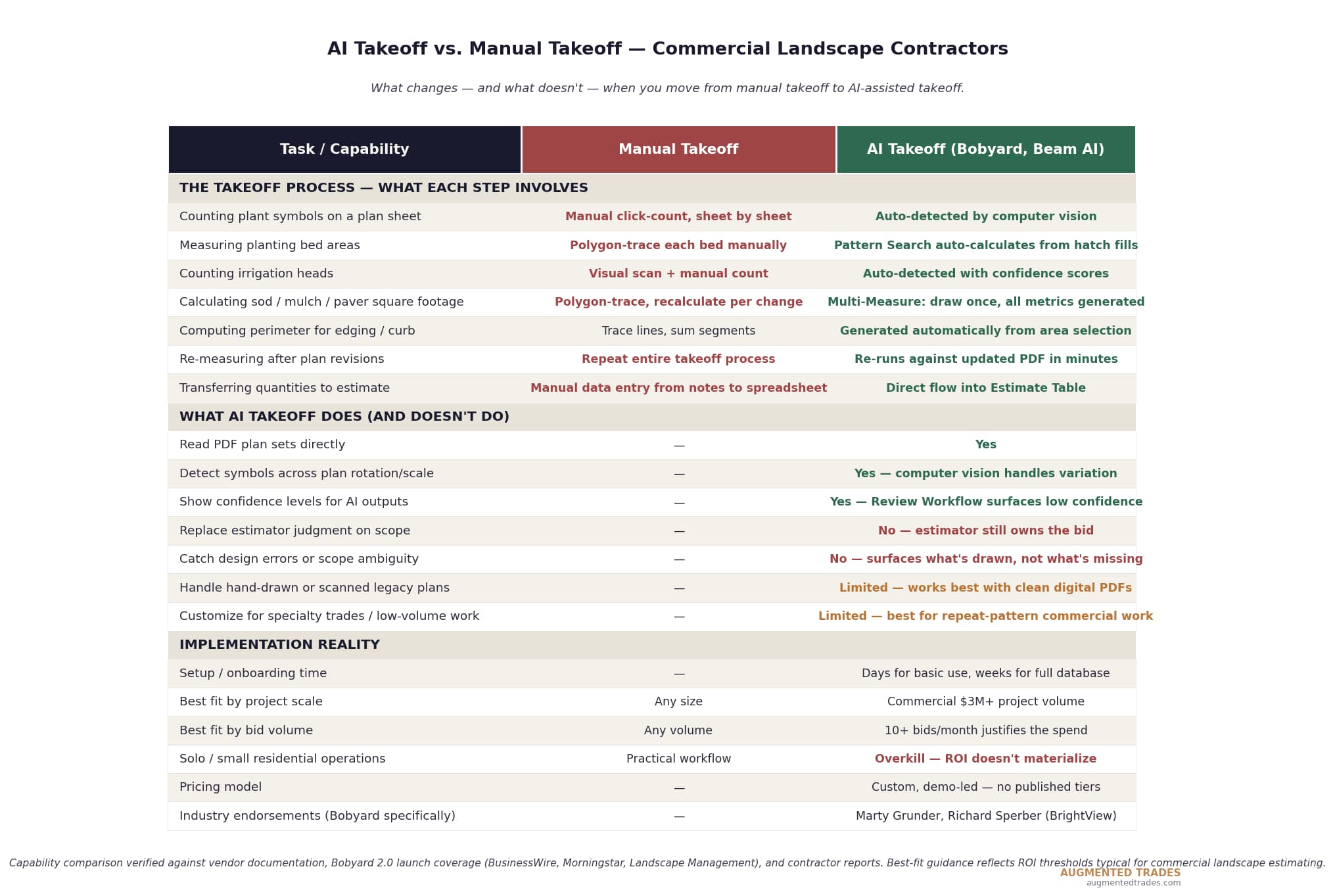
What changes — and what doesn’t — when commercial landscape contractors move from manual takeoff to AI-assisted takeoff. Capability comparison verified against vendor documentation, Bobyard 2.0 launch coverage, and contractor reports. AI takeoff augments estimator judgment rather than replacing it; best fit is commercial contractors with 10+ bids per month and project volumes above $3M.
What Bobyard Does for Landscapers Specifically
• Computer-vision symbol detection — Detects and counts planting symbols, irrigation heads, and hardscape elements directly from PDF plans
• Multi-Measure — Draw once and instantly get area, perimeter, and volume measurements — the 2.0 flagship feature
• Pattern Search — Defines hatch patterns (sod, pavers, mulch, pavement) and auto-calculates square footage without manual polygon work
• Estimating workflow — Takeoff data flows directly into estimate tables — no re-exporting, no manual entry, no version-control chaos
Honest Limitations
• Built for commercial landscape contractors handling mid-market and enterprise projects — overkill for residential maintenance operations
• Custom pricing — no published tiers, requires a demo call. Expect enterprise-level investment
• Best ROI requires a dedicated estimator who can push the tool to capacity — solo operators won’t extract full value
Pricing: Custom, demo-led. Best for: commercial landscape contractors, $3M+ project volume, teams submitting 10+ bids per month.
Not a fit for solo maintenance operations or small residential shops.
10. iScape Pro — AI Landscape Design for Client Presentations
Closing a hardscape or landscape design project has always come down to one question: can the customer visualize the end result? iScape solves that problem with AI-powered design tools that let you drop pavers, plants, lighting, and features onto a photo of the actual customer property — creating a photorealistic preview before any shovel hits the ground.
For landscape contractors selling projects in the $5,000–$50,000 range, a professional visual presentation is worth more than almost any other sales tool. The difference between closing a patio bid at $18,000 and losing it to a competitor often comes down to whether the customer could see themselves using the finished space. iScape makes that visualization a 15-minute exercise instead of a $500 design fee.
What iScape Does for Landscapers Specifically
• Photo-realistic 2D and 3D design — Thousands of real-world materials — pavers, plants, furniture, lighting — placed directly on photos of the customer’s property
• Augmented reality preview — Use your phone to overlay proposed designs onto the actual yard in real-time — impressive for on-site sales visits
• Client-ready proposals — Generate PDF proposals with pricing, materials list, and business info — professional presentation in minutes
• Material lists — Complete inventory of materials used in each design, helping with purchasing and pricing accuracy
Honest Limitations
• The free tier is very limited — Pro subscription required for professional use
• The design quality is strong for visualization but not architectural-grade — not a replacement for licensed landscape architects on complex projects
• Plant database is large but skews toward common ornamentals — specialty and native plant selection can require workarounds
Pricing: Free tier (limited), Plus $14.99/mo, Pro $29.99/mo or $299.99/yr. Used by 5+ million people globally. Best for: landscape designers and contractors who sell visual projects — hardscape, outdoor living spaces, plant installations.
11. Workyard — Best Labor Tracking and Job Cost Visibility for Landscape Crews
Labor is the single largest cost variable for landscape contractors, and most operations have only the vaguest idea where their hours are actually going. Workyard solves that with GPS-verified time tracking that geofences clock-ins to specific job sites and tags every hour to a specific cost code. The result is the labor data most landscapers have never had — and most need to make accurate estimates and protect margins.
For landscape contractors, the most valuable feature isn’t the time clock itself — it’s the loop back into estimating. After 6 to 12 months of accurate labor data, you have empirical hour numbers for spring cleanups, mulch installations, sod jobs, and hardscape projects that beat any guess you can make from memory. That data turns “I think this’ll take 80 hours” into “based on the last six similar projects, this will take 92 hours plus or minus 8.”
What Workyard Does for Landscapers Specifically
- GPS-verified time tracking — Geofenced clock-ins ensure crews are actually on the job site when the clock starts running
- Labor cost reporting — Real-time visibility into labor cost per job, per crew, per service type
- Payroll integration — Native integration with QuickBooks, Sage, Gusto, ADP eliminates double entry
- Job costing reports — Budget-vs-actual tracking flags jobs that are running over before they finish
Honest Limitations
- Requires consistent crew adoption — if crews don’t clock in properly, the data is incomplete
- Mobile app needs reliable phone signal at job sites (works offline but syncs when reconnected)
- Pricing scales per user, so larger crews see meaningful monthly costs
Pricing: Starts at $6/user/month (billed annually) plus a $50 monthly base fee for Time Tracking. The Workforce Management tier is $13/user/month plus the same base fee. Best for: Landscape contractors managing multiple remote crews who need precise labor data to sharpen their project estimating.
Want the prompts we use?
We turned our research into a 25-prompt pack for trade contractors — for estimates, client communication, proposals, and business operations. Copy, paste, adapt. Save hours every week.
Which AI Tools Do You Actually Need?
The honest answer is that no landscape contractor needs all eight of these tools. The right stack depends on what you do and at what scale. Here’s the framework for deciding:
Solo Operators and Small Crews (1–3 People)
Start with: Jobber Core ($29/mo on annual billing; $49/mo on a monthly 1-year plan) and the iScape free tier if you’re doing any design work. Total monthly investment: $29. This stack gets you scheduling, invoicing, payments, and professional presentation materials without any serious overhead. Add LeadTruffle when you start losing weekend calls to voicemail. Add Workyard once you have a second person on payroll — labor tracking only matters once you can’t personally watch every clock-in.
Growing Residential Operations (4–10 Crews)
Core stack: Jobber Connect Team ($199/mo for 5 users) or Grow Team ($399/mo for 10 users) — monthly billing, or Housecall Pro Essentials ($189/mo monthly billing; $149/mo on annual billing), LeadTruffle Essential ($229/mo plus a $299 one-time onboarding fee), CompanyCam Pro ($79/mo for 3 users on annual billing, plus $29/mo per additional user), and iScape Pro ($29.99/mo). This is the stack that reclaims the 20 hours of weekly admin time, captures the after-hours revenue, and lets you present professionally on site.Total monthly investment: roughly $535-$740 depending on team size and chosen FSM tier, with CompanyCam scaling per user as crews grow.
Commercial Landscape Contractors ($3M+ Annual Revenue)
Everything above, plus FieldCamp or ServiceTitan for enterprise-grade dispatch, and Bobyard 2.0 for takeoff automation if you’re submitting 10+ commercial bids a month. At this scale the math is straightforward — winning 2–3 additional bids per month from faster estimating covers the full software stack for the year.
What to Avoid: An Honest Note
• AI tools that promise to replace your judgment — the best tools augment decisions about scheduling, pricing, and design; they don’t make those decisions for you
• Bundled ‘all-in-one’ platforms that try to do 10 things poorly instead of one thing well — a stack of 3 focused tools almost always outperforms one mega-platform
• Any software with annual-only contracts before you’ve tested it with at least one full billing cycle — clarify cancellation terms up front
• Tools without a clear integration path to your existing FSM — data that lives in silos creates more work than it saves
The Bottom Line
The landscape contractors growing fastest in 2026 aren’t the ones with the biggest crews or the newest equipment — they’re the ones who figured out how to stop losing 20 hours a week to administrative work and tens of thousands of dollars a year to missed calls. The tools above won’t solve the labor shortage, but they’ll let you run a tighter operation with the crew you already have. In a year where wage pressure across the landscape industry continues to compress margins, operational efficiency is how you protect your bottom line without racing to the wage floor.
The tools above are the ones I’d recommend to a landscape contractor who asked me honestly. Not because they’re the flashiest, but because they deliver real operational improvements with reasonable investment and reasonable learning curves. Start with the stack that fits your size. Add tools as you grow. Skip anything that doesn’t have an obvious ROI within 90 days.
Quick Links: Every Tool Reviewed
Jobber
Best all-around FSM for residential landscapers
Best for: Residential landscapers 1–15 crews focused on maintenance, basic installs, and recurring service revenue. Route-aware scheduling and automated maintenance reminders are the highest-ROI features for landscaping specifically.
Team: $199–$699/mo · Annual saves up to 35%
Housecall Pro
For landscapers focused on hardscape and repeat revenue
Best for: Landscapers selling hardscape, outdoor lighting, irrigation, or seasonal cleanups. Stronger marketing automation than Jobber for turning one-time installs into repeat maintenance customers.
(monthly/annual billing)
FieldCamp
AI-native dispatch for landscape teams
Best for: Landscape contractors who want AI-native dispatch and weather-aware scheduling, with budget for premium FSM tools. Pro fits 3-person crews; Growth fits 4–10; Scale fits 11–20.
Scale $1,499/mo (20 users) · Annual 20% off
ServiceTitan
Enterprise platform for established landscape operations
Best for: Established landscape contractors with 15+ crews, dedicated office staff, mixed residential/commercial revenue. Deep reporting, Pricebook Pro, dispatch optimization, marketing attribution. Overkill below 15 crews.
$5K-$50K+ implementation · Annual contracts
Typical 20-crew shop: $4,900-$10,000/mo all-in
Service Fusion
Flat-rate FSM that wins on cost past 8 crews
Best for: Landscape contractors growing past 8 crews where per-user pricing compounds. Unlimited users on every plan, strongest QuickBooks integration in the category. Good fit for seasonal headcount swings and multi-trade operations.
Unlimited users · Annual saves 15%
LeadTruffle
24/7 AI voice agent for landscaping inquiries
Best for: Landscapers losing revenue to after-hours calls, missed voicemails, or slow web form response times. Especially relevant for storm damage, weekend maintenance requests, and Sunday spring cleanup inquiries.
Scale $629/mo · $299 one-time onboarding
CompanyCam
Photo documentation and AI before/after generation
Best for: Landscape contractors doing hardscape, landscape installation, or any project where before/after photos drive sales. AI-suggested before/after timelines turn finished projects into the next bid’s marketing material.
3-user minimum on every plan
Workyard
GPS time tracking for landscape crews
Best for: Landscape contractors managing multiple remote crews who need precise labor data to sharpen project estimating. After 6–12 months of data, you have empirical hour numbers that beat any guess from memory.
Workforce Mgmt $13–$16/user/mo + $50/mo base
NiceJob
Automated review capture for residential landscape operations
Best for: Residential landscape contractors where Google reviews drive lead volume — maintenance, hardscape, outdoor living. Pro tier adds AI-generated review replies. Skip for commercial-heavy operations.
Native Jobber / Housecall Pro / Service Fusion / FieldCamp / QuickBooks integration
