
9 Software Platforms Compared for Residential and Commercial Electrical Contractors
The data center boom just made electricians the most in-demand trade in America. Here’s the software stack that lets you capture it.
Not sure which tools fit your shop?
Answer seven quick questions and get a stack matched to your trade, size, and budget — every pick traces to published vendor pricing we’ve verified, and several of our recommendations earn us nothing. Try the free Tool Finder →
Augmented Trades verifies every vendor price on this page against the vendor’s own published pricing, with figures sourced inline so you can check them. Some links earn us a commission (we flag which), but every pick is by fit, not payout.
Something unprecedented is happening in the electrical trade right now, and most electricians are too buried in day-to-day work to notice. The AI data center boom is driving demand for electrical labor at a scale the industry hasn’t seen in decades. Per industry analyses of data center construction costs, electrical work accounts for 45% to 70% of total project spend. Industrial electricians at IBEW Local 26 near the data center capital of Northern Virginia are earning $59.50 an hour as journeymen1 — over $120,000 a year base, pushing $200,000 with foreman duty and overtime. And demand keeps climbing.
Meanwhile, the workforce is shrinking. The Bureau of Labor Statistics projects 81,000 new electrician openings per year through 2034. Roughly a quarter of union electricians are at or near retirement age. The Associated Builders and Contractors estimates the broader construction industry needs 349,000 net new workers in 2026 alone to meet demand. By 2040, the projected gap between the size of the electrical workforce and the need could exceed 400,000 workers in coming decades.
This is the most favorable market condition electrical contractors have seen in a generation. The ones who capture the next decade won’t be the ones with the biggest crews — they’ll be the ones with the tightest operational systems. Because when demand exceeds labor supply by that much, every missed call is a lost job, every hour of admin work is a billable hour not performed, and every slow estimate is a bid your competitor won.
This is the honest, no-hype guide to the eight AI tools actually worth an electrical contractor’s time in 2026 — from solo residential electricians to mid-size commercial operations. Real pricing, honest limitations, and the ROI math for your business size.
Pricing, features, and platform capabilities verified as of April 2026. Individual results vary by business size, region, and implementation.
Why the Next Five Years Belong to Electricians
Before we get into tools, look at the data. The electrical contracting market is on track to grow from $225 billion to $284 billion by 2028. Workforce gap projections show the gap widening significantly through 2028, with industry analyses pointing to several hundred thousand unfilled positions even in conservative estimates. Demand is climbing; supply isn’t keeping up. That’s the business opportunity.
How short of electricians is the U.S., really?
One number here is a government projection. The rest are third-party estimates that disagree with each other, and we label them that way.
Data-center demand — estimates vary widely
- McKinsey workforce projections, as reported in June 2026: about 130,000 additional trained electricians between 2023 and 2030 to keep pace with AI infrastructure.
- CSIS, cited by Stream Data Centers: about 140,000 more skilled tradespeople by 2030 — all trades combined, not electricians alone.
- Introl: about 340,000 unfilled data-center positions — again all roles, not electricians specifically.
Why we don’t add these to the 810,000. The BLS figure already counts demand for electricians across the whole economy, which includes data-center construction. Stacking a data-center estimate on top of it would count the same work twice. The direction is clear — demand is rising faster than the trade can train journeymen — but a single combined headline number is not something we can source.
We previously showed a chart here adding 810,000 BLS openings to “300,000 electricians needed for AI data centers” for a combined 1.1 million by 2034. On re-checking in July 2026 we could not source the 300,000 figure from anywhere, and the addition double-counted. Both have been removed.
In most trades, a labor shortage is a problem. For electricians in 2026, it’s pricing power, project selection power, and customer negotiation power — but only if your business can execute. A shop that runs clean estimates, captures every after-hours call, and gets techs dispatched efficiently can charge premium rates and pick the jobs it wants. A shop still drowning in paperwork leaves money on the table even in the best market in decades.
Want more like this?
Get honest AI tool reviews for trade contractors, delivered every Monday morning. No fluff, no hype, no spam.
Where the Hours Actually Go
Before picking software, look at where the time actually goes in an electrical contracting business. A typical 6-electrician operation can lose 25-30 hours a week to administrative tasks — scheduling, estimate prep, permit and code compliance tracking, invoice follow-up, and dispatch. Industry-typical estimates suggest a well-implemented AI tool stack can reclaim 12-18 of those hours per week, depending on existing workflow sophistication. That’s nearly a full-time employee’s output spent on work that software can now do in a fraction of the time.
Code changes belong on that list too: the Sept. 1, 2026 NEC 210.8(F) change puts GFCI protection on outdoor-listed HVAC equipment where the code is enforced as written. We break down what changed in our NEC 210.8(F) GFCI deadline guide.
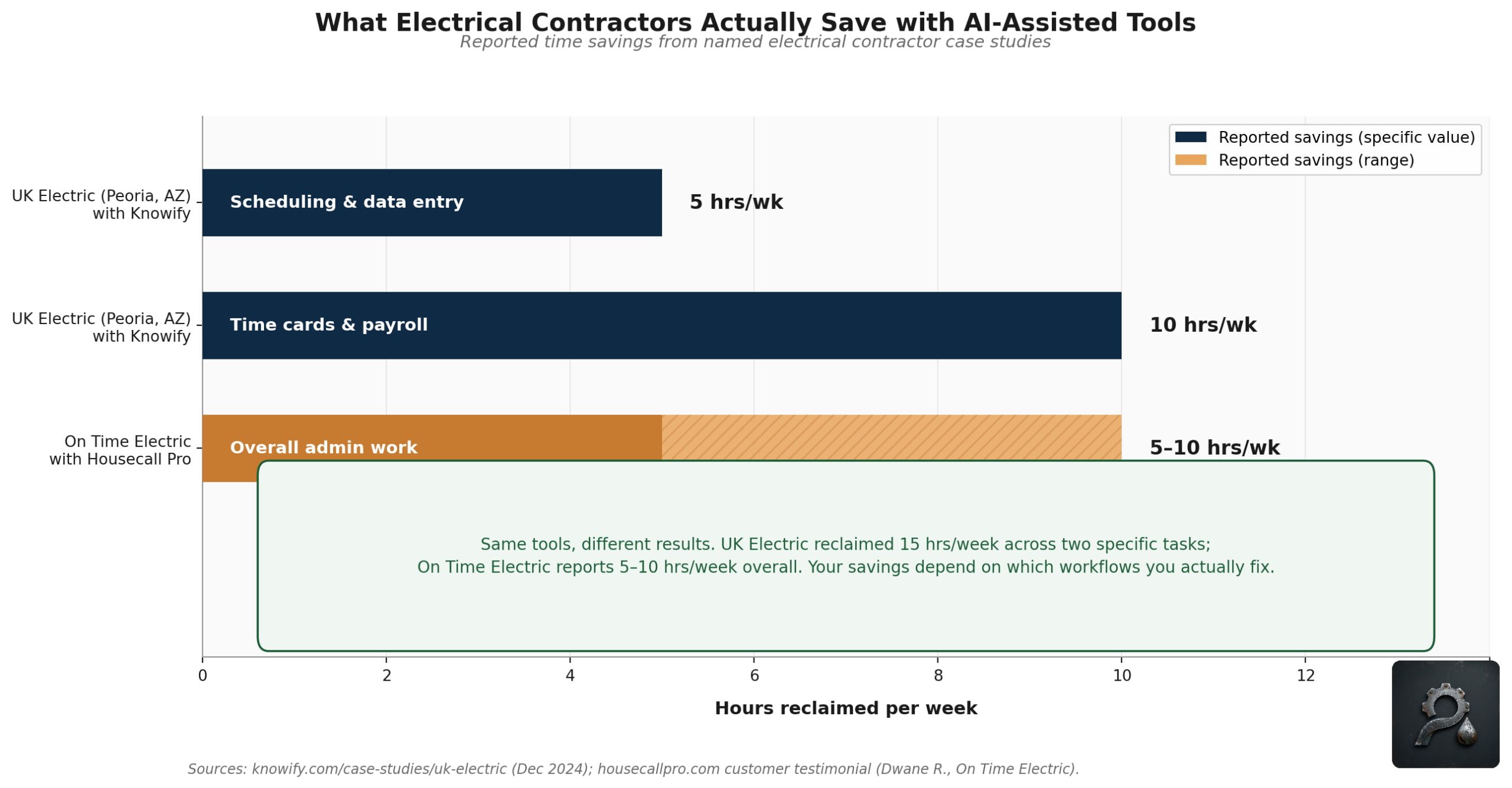
Reported time savings from published electrical contractor case studies. UK Electric (Peoria, AZ) with Knowify and On Time Electric with Housecall Pro. Results vary by business size and implementation — see linked sources for full case studies.
The hours reclaimed weekly (15 in the above case) is time an owner can spend estimating bigger jobs, managing client relationships, or actually being in the field on high-value work. At electrician billing rates that translates directly into revenue, not just saved time.
1. Jobber — Best All-Around FSM for Residential Electrical Contractors
Jobber is the most-used FSM platform in the 1–15 electrician range for good reason — it handles the core workflow (scheduling, quoting, invoicing, customer communication) well, has a clean mobile app, and can be stood up in a few days rather than a few weeks. For residential electrical contractors doing service calls, panel upgrades, EV charger installs, and light remodel work, Jobber covers 80% of operational needs at roughly 20% of the cost of enterprise platforms.
What Jobber Does for Electricians Specifically
• Smart scheduling and dispatch — Drag-and-drop scheduling with route optimization between service calls — critical for electricians running 6–10 jobs a day across a service area
• Mobile estimating — Build estimates from the truck with line items and markup, send for electronic signature on-site — shortens sales cycles from days to hours
• Online booking — Homeowners book EV charger consultations, panel upgrades, and service visits via branded online form — reduces phone-tag overhead
• Client hub — Customers approve quotes, pay invoices, and request follow-up work online — cuts back-office AR workload dramatically
Honest Limitations
• Not built for commercial electrical — no AIA-style billing, no phased job costing, limited support for multi-month installs
• Reporting is surface-level — you see job and revenue data, not electrician-level utilization or job-type profitability
• Permit and code compliance tracking requires workarounds — there’s no built-in module for inspection scheduling or permit tracking
Pricing: Core $49/mo, Connect $139/mo, Grow $199/mo (individual plans). Grow $299/mo including 5 users, Plus $499/mo (5 users), $599/mo (10 users) or $699/mo (15 users) — monthly billing on a 1-year term; annual prepaid runs lower — (team plans for 5–15 users). Free trial, month-to-month available. Best for: residential electrical contractors 1–15 techs focused on service work, panel upgrades, EV charger installs, and small remodels.
2. ServiceTitan — The Enterprise Choice for Large Residential and Commercial Electrical Operations
ServiceTitan is the enterprise platform. For electrical contractors running 20+ technicians with dedicated office staff, high call volume, and sophisticated marketing attribution needs, nothing else touches it on depth of functionality. The company has spent years building electrical-specific workflows — good-better-best pricing templates, detailed technician performance analytics, AI-driven dispatch recommendations, and mobile tools built for in-home sales.
The flip side is price and complexity. ServiceTitan does not publish pricing. Its pricing page lists three packages — Starter, Essentials and The Works — priced per technician and quoted on a demo, with the total depending on the modules you enable. We no longer repeat the third-party per-tech ranges that circulate online, because none of them can be traced to the vendor.
What ServiceTitan Does for Electricians Specifically
• Good-better-best pricing templates — Create customizable good-better-best pricing options in the home, increasing average ticket and customer satisfaction simultaneously
• Mobile app — ServiceTitan Mobile 2.0 delivers real-time job info, customer history, and quote-building tools to field electricians on any device
• AI-enhanced workflow automation — Call booking, lead scoring, dispatch optimization, and post-job follow-up all integrated — the platform actively recommends next actions
• Deep reporting and analytics — Detailed marketing attribution, technician scorecards, project-level P&L, and forecasting built in
Honest Limitations
• Annual contract required — limits flexibility and can lock in contractors who outgrow features or want to switch
• Implementation curve is real — most shops need 60–90 days before they’re extracting full value, and fewer than half of features get used in year one
• Pricing is aggressive — the enterprise pitch assumes you’ll grow into the platform, but many mid-size shops pay for capacity they never use
Pricing: Custom, per technician, across Starter/Essentials/The Works packages — ServiceTitan publishes no rates, and implementation is quoted separately as a one-time fee. Get the platform base, per-tech fees, add-on modules and implementation itemized on the quote before comparing it to anything else on this page. ServiceTitan itself states the platform is “not optimized for a company with 3 or fewer technicians.”
3. Housecall Pro — Best for Residential Electricians Focused on Marketing and Customer Retention
Housecall Pro competes with Jobber in the residential electrical FSM space but pushes significantly harder on marketing automation, customer retention workflows, and the “tech arrival” customer experience. For residential electricians where 40–60% of gross revenue comes from repeat customers — annual panel inspections, upgrade follow-ups, service agreements — the targeted email and SMS campaigns meaningfully outperform Jobber’s simpler tools.
The tech arrival notifications (photo, name, ETA sent to the homeowner before arrival) are especially valuable for electricians, because homeowners are more nervous about an unknown electrician entering their home than most other trades. That small trust-building touch correlates with higher review volume and higher closed-rate on in-home estimates.
What Housecall Pro Does for Electricians Specifically
• Targeted marketing campaigns — Segment by customer type (service vs install vs maintenance) with tailored email/SMS campaigns — drives meaningful repeat business
• On-My-Way texts with photo — Photo and name sent to customer before arrival — dramatically improves trust and review volume for residential electrical work
• Review generation — Automated follow-up links timed to the customer journey — consistently outperforms manual review requests
• In-app upsell tools — Electricians can upsell panel inspections, surge protection, or EV charger prep from the job site using mobile estimate tools
Honest Limitations
• Price scales aggressively with users — meaningful automation features require the Max tier at $649/mo (8 users) on the Electrical pricing path, with $75/user/mo for additional team members
• Map-based tracking updates every few minutes rather than real-time, which frustrates dispatchers managing same-day reschedules
• Phone support limited to top tiers — most support happens through chat with longer response times
$1 Basic $79/mo (Electrical pricing path, read October 7, 2026). Essentials is $299/mo (5 users included) and Max is $649/mo (8 users included) — Housecall Pro requires you to complete an industry and company-size selector before showing them. Annual billing saves roughly 15–25% on each tier.
4. Knowify — The Best Choice for Commercial Electrical Contractors
Here’s where the electrical trade diverges from plumbing and HVAC. A significant portion of electrical work is project-based rather than service-based — commercial tenant fit-outs, multi-phase installs, industrial retrofits, new construction rough-in to trim. For those jobs, a standard FSM platform like Jobber or Housecall Pro fundamentally can’t do the financial work required. You need phased job costing, AIA-style billing, retainage tracking, and progress billing against contract value. Knowify is built specifically for that.
Knowify is a Premier Intuit Partner with one of the most mature QuickBooks integrations in the construction software space, offering bidirectional sync for complex job costing and AIA billing. For commercial electrical subcontractors who already run on QuickBooks Online, the data flow is seamless. For commercial electrical contractors transitioning from paper-based or spreadsheet workflows, Knowify can save substantial admin hours weekly — particularly on AIA billing prep, retainage tracking, and progress billing reconciliation that’s painfully manual in spreadsheets
What Knowify Does for Electricians Specifically
• Construction-grade estimating — Multi-phase estimates and budgets with cost codes, phase-specific cost tracking, and job templates for common project types (tenant fit-outs, service upgrades, industrial panels)
• Commercial billing — AIA-style g702/g703 applications for payments, progress billing, retainage tracking, and milestone billing — critical for commercial subcontractor work
• Real-time job costing — Dashboard continuously updates project financials as costs accrue, giving real-time visibility into job margin before the problem becomes a loss
• QuickBooks integration — Bidirectional sync is genuinely the tightest in the category — eliminates double data entry, eliminates accountant reconciliation time
Honest Limitations
• Interface feels dated compared to newer FSM platforms — functional but not modern
• Scheduling and dispatch tools are basic — for service-heavy operations you’ll want Knowify plus a separate scheduling tool
• Implementation requires a learning curve — the financial depth that makes Knowify valuable also makes it more complex to onboard than simpler FSM options
Pricing: Core: $99/mo billed yearly ($149/mo monthly). Advanced: $249/mo billed yearly ($311/mo monthly). Enterprise: custom. All base plans include 1 user; additional users available on Advanced+. Optional add-ons (Service Pro, Prevailing Wage, Live Equipment Tracking) priced separately.
Best for: Commercial electrical subcontractors, contractors running both project and service work, or anyone requiring AIA and progress billing.
5. LeadTruffle — Capture the After-Hours Calls Other Electricians Miss
Electricians have a specific lead-capture problem that most FSM articles miss: emergency work doesn’t call during business hours. Power outages, tripped panels, storm damage, burning smells from outlets — these calls come at 7 PM, at 10 PM, on weekends, during holidays. The electrician who answers gets the job. The one who sends the homeowner to voicemail loses a $800–$3,000 service call to whoever’s next on Google.
LeadTruffle is AI-powered answering and lead qualification that handles inbound calls 24/7. For electricians specifically, the economics are especially compelling because the average electrical service ticket is higher than plumbing or HVAC — emergency panel work, whole-home rewires, and commercial service calls run $500–$5,000+ per visit. Recovering even a handful of those per month pays for the tool many times over.
What missed calls cost — run it on your own numbers
One figure below is measured. The rest are your inputs, not ours.
| Inbound calls per month | A |
| × share you don’t answer | B |
| × share you would have closed | C |
| × your average ticket | D |
| Estimated monthly loss | A × B × C × D |
Worked example, using assumptions you should replace: 200 calls a month, 27% unanswered (54 calls), a 30% close rate on calls you do answer, and a $600 average service ticket gives roughly $9,700 a month. Change any one of those four inputs and the answer moves a lot — which is the point. Your close rate and average ticket are the two you actually know.
We previously showed a chart here citing a 27–62% miss rate, an “85% never call back” figure and a “62% switch to a competitor” figure. On re-checking in July 2026 we could not trace the last two to any original study — they circulate only between vendors selling call-answering software, and the “62% switch” number appears to be a garbled restatement of a separate 62% miss-rate claim from 2016. We removed them rather than repeat them.
What LeadTruffle Does for Electricians Specifically
• 24/7 AI voice agent — Handles inbound calls with natural conversation, captures service details, and routes true emergencies appropriately
• Qualification logic — Asks the right qualifying questions — panel age, symptom description, property type — so you’re only dispatched to real jobs
• Calendar integration — Books qualified appointments directly into Jobber, Housecall Pro, or Google Calendar
• Web form follow-up — Responds instantly to web form submissions via text or email — speed-to-lead is the single biggest conversion factor
Honest Limitations
• Setup requires about a week to train the AI on your specific service types, pricing, and qualification criteria
• Some customers still prefer speaking to a human — the AI handles this by offering callback scheduling, but expect a small share of callers to request human follow-up
• Works best as a supplement to business-hours staff, not a full replacement
Pricing (verified May 2026): Quote only. LeadTruffle moved to demo-gated pricing in 2026 and no longer publishes the Essential, Growth and Scale rates it previously listed. The vendor page shows month-to-month billing and no long-term contracts; confirm current terms directly. (Checked October 15, 2026.)
Best for: Electrical contractors handling emergency service work, after-hours calls, or anyone losing more than 3–5 leads per week to voicemail.
6. CompanyCam — Documentation That Protects Electricians and Closes Bids
Electrical work has two specific documentation problems that CompanyCam solves better than anything else in the category. First, defensive documentation — when an insurance company disputes an electrical fire claim or a homeowner alleges improper work was done, time-stamped GPS-tagged photos of the panel before and after your work are the difference between getting paid and fighting a lawsuit. Second, sales documentation — before-and-after photos of panel upgrades, whole-home rewires, and commercial fit-outs sell the next bid better than any brochure.
The AI-assisted photo organization added in 2025–2026 makes CompanyCam genuinely better than it was as a simple documentation tool. Every photo is automatically filed under the right project, tagged with location and timestamp, and can be surfaced into before-and-after timelines in seconds.
What CompanyCam Does for Electricians Specifically
• Organized photo documentation — Every panel photo, junction box, conduit run, and finished install documented with GPS and timestamp — defensible record for any future dispute
• AI before/after generation — AI suggests before/after pairs and generates presentation-ready timelines for commercial bids and residential upsells
• Client sharing — Customers see progress photos in real-time on multi-day jobs — dramatically reduces customer anxiety during rewires and remodels
• Dispute protection — Time-stamped evidence of work completed has saved contractors tens of thousands in disputed invoices
Honest Limitations
• Requires team discipline to use consistently — the tool only works if electricians actually photograph work at critical moments
• Project management layer is lighter than a dedicated FSM — it’s designed to supplement, not replace, your operational platform
• Crew and Scale both include 3 users, which is more than a solo electrician needs — Core at $63/mo is the right entry point for one person, though it drops the collaboration features some shops want. Older reviews complaining about a three-user minimum predate the 2026 restructure and no longer apply. Solo electricians who don’t need the collaboration features
Pricing: Core $63/mo on annual billing or $79/mo monthly, including 1 user. Crew $119/$149 and Scale $249/$299, each including 3 users. Additional users $29 annual, $34 monthly. CompanyCam retired its Pro/Premium/Elite tiers in 2026 and there is no longer a user minimum. (Verified July 28, 2026.)
7. NiceJob — Best for Residential Electricians Where Google Reviews Drive Lead Volume
Residential electrical is more review-driven than most electricians realize. Homeowners hiring an electrician for a panel upgrade, EV charger install, or whole-home rewire are spending thousands of dollars to let a stranger work inside their electrical system. That decision gets gut-checked against Google reviews before the phone call gets made. A 4.9-star contractor with 200 reviews beats a 4.7-star contractor with 12 reviews every time, even at higher prices.
NiceJob automates the review request after every closed job. It pulls the customer record from your FSM, sends a personalized review request via text or email, routes happy customers to Google or Facebook review forms, and intercepts unhappy customers into a private feedback channel before they post publicly. For residential electricians where word-of-mouth and Google rank determine inbound lead flow, this is the layer that compounds quietly in the background.
The Pro tier adds AI-generated review replies and reputation marketing tools — the AI drafts professional responses to every review you receive (positive and negative) that you can approve in seconds, plus tools to surface your best reviews on your website and social channels.
What NiceJob Does for Electricians Specifically
- Automated review requests via text/email after every closed job — no manual follow-up
- Native integration with Jobber, Housecall Pro, ServiceTitan, Service Fusion, FieldCamp, and QuickBooks — the request fires from job-complete data already in your FSM
- AI-generated review replies (Pro tier) — drafts responses to every review so you can approve in seconds, important for electricians given the higher liability profile of negative reviews about electrical work
- Reputation marketing tools (Pro tier) — automatically surfaces your strongest reviews on your website and social channels
Honest Limitations
- Reviews-only — NiceJob does one thing well; it doesn’t replace any part of your FSM
- The Reviews-to-Pro step is a 67% jump in cost — only worth it once your review volume outpaces your time to write replies manually, typically around 30+ closed residential jobs per month
- Lower fit for commercial-leaning operations — commercial electrical bids don’t run on Google review velocity the way residential service work does. If you’re 70%+ commercial, the ROI is meaningfully weaker
- Effectiveness depends on integration setup — works best when triggered automatically from FSM job-complete data, which requires a short configuration
Pricing (verified May 2026): Starter $75/month, Pro $125/month. The $50/month step to Pro — a 67% jump — pays for AI-generated review replies and reputation marketing tools. Skip Pro until your review volume outpaces your time to respond manually; Reviews handles the core automation either way.
Best for: Residential electrical contractors where Google reviews drive lead volume (panel upgrades, EV charger installs, service work), and shops closing 30+ residential jobs per month who have stopped manually asking for reviews because they don’t have time. Skip for primarily commercial operations.
8. Workyard — GPS Time Tracking Built for Electrical Field Crews
If you’ve ever argued with an electrician about whether they were actually on site for 8 hours or 6, you understand the problem Workyard solves. It’s GPS-based time tracking designed specifically for construction and electrical field crews — automatic clock-in when the electrician arrives at the job site, automatic clock-out when they leave, with GPS verification built into every time entry.
For electrical contractors billing time-and-materials work or tracking labor against fixed-price bids, accurate job-level labor capture is the difference between knowing your job margins and guessing at them. Workyard also handles the paperwork around prevailing wage jobs, certified payroll reporting, and union reporting — all of which are common in commercial electrical work and painful to manage manually.
What Workyard Does for Electricians Specifically
• GPS-verified time tracking — Electricians auto-clock in when they arrive at a job site and auto-clock out when they leave — no manual time entries, no disputes
• Job-level cost tracking — Every hour logged is tied to a specific job, letting you see labor cost per job in real time against your estimate
• Certified payroll reporting — Automated reports for prevailing wage jobs, certified payroll, and union compliance — saves 5+ hours per payroll cycle on typical commercial work
• Payroll integration — Sync directly with QuickBooks, ADP, Gusto, and major payroll platforms — eliminates double entry of timecards
Honest Limitations
• Some electricians initially resist GPS tracking — frame it as “proof of work” rather than “surveillance” when rolling it out to crews
• Battery drain on older phones can be an issue with continuous GPS — modern phones handle it fine
• Not a full FSM platform — designed to plug into Jobber, ServiceTitan, Knowify, or your existing system
Pricing: $6–$8/user/mo + $50/mo base, Workforce Mgmt $13–$16/user/mo + $50/mo base.
Best for: electrical contractors with 3+ field employees, anyone doing prevailing wage or commercial work, any business where accurate job costing depends on accurate labor capture.
9. Service Fusion — FSM for Multi-Trade Electrical Operations
Service Fusion is worth knowing about because it may suit larger teams: its plans are quoted on a demo, and the vendor page shows no prices as of October 15, 2026. For electrical operations growing past 8 techs, ask in the demo how seats are counted and compare that quote with per-user platforms. Multi-trade operations (electrical plus low-voltage plus audiovisual, for example) and shops with high tech turnover should ask specifically how seats are counted, since per-user pricing creates budget volatility.
The platform itself covers the FSM basics — scheduling, dispatch, CRM, invoicing, estimates — without deep specialization in any trade. For an electrical contractor who just needs to run basic operations cleanly and doesn’t need the depth of ServiceTitan or the commercial-specific features of Knowify, Service Fusion fills the gap at a predictable price. The QuickBooks integration is the strongest in the category, which matters disproportionately for electrical contractors handling both service work and project work that needs job-level accounting.
What Service Fusion Does for Electricians Specifically
• Flat-fee pricing — One flat monthly fee regardless of team size — predictable cost structure as you grow
• FSM essentials — GPS fleet tracking, job scheduling, dispatch management, customer communication — all the operational basics in one platform
• Lead and customer management — Integrated CRM tracks customer communication, service history, and lead sources — useful for sales-driven electrical operations
• Invoicing and payments — Handles invoicing and payment processing in-platform — eliminates the need for separate payment tools
Honest Limitations
• No electrical-specific features — generic trade platform rather than purpose-built for electrical workflows
• Mobile app is functional but less polished than Jobber or Housecall Pro
• Limited reporting depth compared to ServiceTitan or Knowify — covers basics, not advanced analytics
Pricing: Not published. Starter, Plus and Pro are quoted on a demo (checked October 15, 2026).
10. FieldCamp — AI-First Dispatch for Electricians Who Hate Clicking Through Screens
FieldCamp is the most aggressively AI-first FSM on this list, and it earns a place specifically for electrical contractors who’d rather talk to their software than click through dispatch boards. The platform’s “Command Centre” lets you create jobs, schedule visits, generate estimates, and dispatch electricians through natural-language commands — “schedule a panel upgrade for the Hendersons next Tuesday morning, dispatch Marcus, send the customer a confirmation with our service-call rate disclosed” — instead of navigating screens.
For electricians running 5+ trucks, the dispatch logic alone is meaningful. AI Dispatcher matches jobs to electricians by skill set (residential vs commercial vs low-voltage certifications), location, and current availability automatically. AI Call Transcription captures the diagnostic details from inbound calls and pre-populates the work order — particularly useful for emergency electrical calls where the homeowner’s description of the symptoms (“breaker keeps tripping, lights flickering, burning smell”) needs to translate into a clear scope for the responding electrician.
What FieldCamp Does for Electricians Specifically
- Natural-language Command Centre — Create work orders, schedule visits, and generate estimates by typing or speaking commands rather than navigating UI
- AI Dispatcher — Auto-matches jobs to electricians based on certification, location, and availability — strong fit for shops with mixed residential + commercial work
- AI Call Transcription — Captures inbound call details and pre-populates the work order with diagnostic notes — saves the dispatcher’s interpretation step
- Workflow AI Builder — Build custom automation sequences without coding (estimate-sent follow-up, maintenance reminders, post-job review requests)
- Job cost and profit-per-job tracking — Captures labor, mileage, and expenses per job and rolls them up into job cost, profit, and profit-per-hour, so margin is visible before the job closes — useful for electricians weighing T&M against fixed-bid work
- AI Agents marketplace — Prebuilt AI agents you can install and configure for tasks like dispatch, follow-up, and invoicing, running on schedules or triggers
Honest Limitations
- Price ladder is steeper than Jobber or Housecall Pro at the same tech count — you’re paying for the AI-first architecture
- AI features run on a credit-based model — high-volume use requires additional credit packs
- Less mature in residential service-call dispatch than Jobber or Housecall Pro — the platform shines on project work and mixed residential/commercial more than pure residential service
Pricing (verified May 2026, monthly billing): Pro $249/mo (3 users included; additional users $83/user/mo). Growth $699/mo (10 users; $70/user/mo). Scale $1,499/mo (20 users; $75/user/mo). Enterprise $2,000+/mo (25+ users, custom). Annual billing saves 20% across all tiers. Source: docs.fieldcamp.ai.
Best for: Electrical contractors with 3-20 techs who prefer conversational interfaces over dispatch boards, project-leaning shops, or mixed residential/commercial operations.
Which AI Tools Do You Actually Need?
No electrical contractor needs all eight of these tools. The right stack depends on what kind of work you do and at what scale. Here’s the framework:
| Tool | What the vendor publishes | Billing basis | Source |
|---|---|---|---|
| Jobber | $199/mo (Grow, 1 user) to $399/mo (Grow, 10 users). Core from $49/mo; Plus to $699/mo. Cheaper on annual or a 1-year term. | Month-to-month | getjobber.com |
| Housecall Pro | Basic $79/mo (1 user). Essentials is $299/mo (5 users included) and Max is $649/mo (8 users included) — Housecall Pro requires a plan selector to surface them, and MAX signup is demo-gated. | Month-to-month | housecallpro.com |
| Service Fusion | Not published; Starter, Plus and Pro are quoted on a demo. | Month-to-month | servicefusion.com |
| FieldCamp | Not published — quote only (four tiers: Pro, Growth, Scale, Enterprise). Checked Sept 29, 2026. | Month-to-month | fieldcamp.ai |
| NiceJob | Starter $75/mo, Pro $125/mo. 14-day trial, no contract. | Monthly only | get.nicejob.com |
| Workyard | $50/mo base + $8 per user (Starter) or $16 per user (Pro). A 6-user crew is $98/mo Starter, $146/mo Pro. | Annual rates shown | workyard.com |
| CompanyCam | Core $63/mo (1 user), Crew $129/mo (3 users), Scale $249/mo billed annually (3 users), +$29 per extra user. | Annual rates shown | companycam.com |
| LeadTruffle | Quote only — no public pricing. Three tiers by monthly lead volume. | Quote | leadtruffle.co |
Vendor prices change without notice. For the current verified figures on every vendor we track — read from each vendor’s own pricing page and dated — see the contractor software pricing tracker.
All figures re-verified against each vendor’s public pricing page on July 27, 2026. Billing basis is listed per row because it differs by vendor — comparing a monthly rate against an annual one is the most common way these stacks get mis-costed. Where a vendor does not publish pricing, this table says so rather than estimating.
Verified monthly subscription pricing for the eight AI tools we recommend for residential and commercial electrical contractors, sourced directly from each vendor’s pricing page. CompanyCam, Jobber, Housecall Pro and LeadTruffle were re-checked July 28, 2026; the rest carry their May 2026 check. CompanyCam pricing shows Core (1 user) at annual billing; Workyard pricing assumes a 6-user crew on Time Tracking. ServiceTitan and Projul use different pricing models (per-tech and flat-rate tiers respectively) and are not directly comparable on a monthly bar chart — see resource cards below for full pricing detail. We earn affiliate commissions on Jobber, Housecall Pro, FieldCamp, Service Fusion and LeadTruffle. We earn nothing from CompanyCam. Actual costs vary by team size, billing cycle, and add-ons.
AFFILIATE DISCLOSURE Augmented Trades earns commissions when readers sign up for these tools through our links. We do NOT make ROI or savings claims. Pricing shown is the vendor’s published rate; your actual cost varies by team size, billing cycle, and add-ons. Always verify current pricing on the vendor’s site before purchasing.
Sources: Jobber: getjobber.com/pricing | Housecall Pro: housecallpro.com/pricing | FieldCamp: docs.fieldcamp.ai | Service Fusion: servicefusion.com/pricing | LeadTruffle: leadtruffle.co/pricing | CompanyCam: companycam.com/pricing | NiceJob: get.nicejob.com/pricing | Workyard: workyard.com/pricing
Solo and Small Residential Electricians (1–3 techs)
Start with Jobber Core ($49/mo) and CompanyCam Core ($63/mo on annual billing, $79/mo monthly, 1 user included).
Total stack: ~$148/mo monthly billing, ~$108/mo annual.
Add LeadTruffle (Essential, quoted on a demo) once you’re booked more than 2 weeks out and losing weekend calls to voicemail.
Growing Residential Electricians (4–10 techs)
Core stack: Jobber Grow ($299/mo, 5 users included) or Plus ($599/mo, 10 users), Housecall Pro Basic ($79/mo — Essentials $299/mo for 5 users, Max $649/mo for 8 users on the Electrical pricing path), or FieldCamp (quote-only pricing as of Sept 29, 2026) for AI-first dispatch.
Add LeadTruffle Essential, CompanyCam Crew ($149/mo for 3 users on monthly billing, plus $34 per additional user), and Workyard Time Tracking ($8/user + $50/mo base on monthly billing, or $6/user + $50 base on annual).
Reviews:
NiceJob Starter ($75/mo) — for residential service work where Google review velocity drives lead flow
Total monthly investment for a 5-person crew on monthly billing: roughly $760. For a 10-person crew: roughly $1,170. Annual billing reduces the total by 25-35%.
Commercial Electrical Subcontractors
Knowify (Core: $99/mo yearly or $149/mo monthly; Advanced: $249/mo yearly or $311/mo monthly; Enterprise custom — all base plans include 1 user, with optional add-ons for Service Pro, Prevailing Wage, and Live Equipment Tracking priced separately) as the financial and project backbone, plus CompanyCam Core ($63/mo annual, $79/mo monthly, 1 user) or Crew ($119/$149, 3 users) and Workyard Time Tracking ($6/user + $50/mo base on annual billing, $8/user + $50 base monthly) for documentation and labor tracking.
Skip the residential FSM tools — they don’t handle your workflow. For service work on top of project work, add Jobber or Housecall Pro as a service-side layer.
For commercial electrical contractors with strict AIA billing requirements and retainage compliance needs, Knowify remains the depth-of-function leader. For commercial electricians who want unified project management with progress billing (not full AIA depth), Projul (Core+ at $7,188/year for up to 20 users, the tier that adds progress billing; no per-user fees) is a strong alternative.
Large Electrical Operations ($3M+ Annual Revenue)
ServiceTitan plus CompanyCam plus Workyard, with Knowify layered in if you do significant commercial project work. At this scale the math works — the platform cost is a fraction of the revenue lift from better dispatch, higher average tickets, and reclaimed time across a larger team.
What About Tool Tracking Software for Electricians?
None of the software above tracks physical tools — and that gap costs electricians more than most trades. Meters, testers, torque screwdrivers, and specialty bits are small, expensive, and spread across vans and jobsites all day. A dedicated tool tracking solution closes that gap for less than the cost of replacing one lost meter. Two options cover most electrical shops:
We compare the dedicated options in tool tracking software for plumbers and electricians, with current pricing.
Milwaukee ONE-KEY (free)
ONE-KEY is the free inventory and tool tracking app from Milwaukee Tool — iOS, Android, iPad, and web, with no subscription fees. You can catalog tools from any manufacturer in one inventory, ONE-KEY enabled Milwaukee tools come with Bluetooth tracking built in, and the app is backed by a community Bluetooth tracking network that Milwaukee says is the largest in the industry — it crowdsources the locating of lost items. For everything else in the van, ONE-KEY Bluetooth tracking tags let you track any item from any brand in the same app. If you run Milwaukee cordless already, start here: the price is zero.
ShareMyToolbox ($50/month base)
ShareMyToolbox is dedicated tool tracking software for contractors: a central company tool catalog with barcode scanning and field transfers, so tools get signed between employees instead of vanishing between jobs. Pricing (verified July 2026): $50/month base with one admin user, plus additional user connections at $10 per user per month, sold in blocks of five. Prepaying a year takes 5% off. Every plan includes unlimited tools, and field employees download the app free.
Full transparency: neither company pays us a commission. This section exists because readers keep asking about tool tracking, and the FSM vendors do not solve it. If you are a one-truck operation, skip both — a disciplined shelf system costs nothing.
What to Avoid: An Honest Note
• Enterprise FSM platforms sold to small shops — if a ServiceTitan or FieldEdge sales rep is aggressively pitching you a platform designed for 20+ technicians and you have 4, walk away. The implementation time and annual contract lock-in will hurt you
• AI tools that promise to “replace your judgment” on estimating or safety — the best tools augment decisions; they don’t make them. Electrical work has too much liability exposure to let a black box price your bids without oversight
• Any platform that doesn’t integrate with QuickBooks — the electrical trade runs on QuickBooks, and any tool that can’t sync clean financial data creates more problems than it solves
• Tools without a free trial or 30-day money-back guarantee — if a vendor won’t let you test before committing, that tells you something about their confidence in the product
Electrician AI tools: quick answers
What are the best AI tools for decreasing sales costs in a plumbing or electrical business?
The fastest way to lower your cost per booked job is to stop paying for leads you never capture. An AI lead-capture tool like LeadTruffle answers and qualifies after-hours calls 24/7, so the marketing dollars you already spent to make the phone ring do not leak to voicemail. After that, faster quoting wins more of the bids you already chased — the estimating tools in Jobber, Housecall Pro, and FieldCamp shorten the quote cycle. And review automation like NiceJob lowers cost per lead over time by driving organic Google reviews instead of paid clicks. The theme is the same: spend less acquiring each job by converting more of the demand you already pay for.
Is there an AI assistant or AI agent for electricians?
Yes, in a few forms. AI voice agents like LeadTruffle act as a 24/7 receptionist that answers, qualifies, and books calls. FieldCamp goes further on the operations side — its natural-language Command Centre and AI Dispatcher let you create jobs and match them to the right electrician by certification, location, and availability. ServiceTitan layers AI dispatch and follow-up recommendations into an enterprise platform. Pick by where your bottleneck is: missed calls point to LeadTruffle, dispatch and scheduling load points to FieldCamp.
What AI tools help electricians with invoicing?
For residential service work, the FSM platforms handle invoicing and payments directly — Jobber, Housecall Pro, and Service Fusion build the invoice from the job and sync to QuickBooks. For commercial and project work that needs AIA-style progress billing and retainage, Knowify is purpose-built for it, with one of the tightest QuickBooks integrations in the category. Match the tool to the billing type: simple service invoicing versus commercial progress billing.
What automation tools work for electrical companies?
Group them by the task they remove. Scheduling, dispatch, and customer follow-up: Jobber, Housecall Pro, or FieldCamp (the most AI-first of the three). After-hours lead capture: LeadTruffle. Review requests after every closed job: NiceJob. GPS time tracking and certified-payroll reporting for crews and prevailing-wage work: Workyard. Most electricians do not need all of these — start with the FSM that fits your work, then add the one automation that removes your biggest weekly time sink.
Do AI tools for electricians integrate with QuickBooks and existing software?
They should, and it is worth checking before you buy. The electrical trade runs on QuickBooks, and the strongest tools sync to it cleanly — Service Fusion and Knowify have especially deep QuickBooks integrations. For the lead and review layer, LeadTruffle books qualified appointments into Jobber, Housecall Pro, and ServiceTitan, and NiceJob fires review requests from job-complete data in Jobber, Housecall Pro, ServiceTitan, Service Fusion, and FieldCamp. Verify the specific integration depth for your stack, since “integrates with” can mean anything from full data sync to a basic notification.
The Bottom Line
Electricians entering the next five years have something unusual in trades history — a genuine seller’s market with demand growing faster than the workforce can expand. The AI data center boom, infrastructure buildouts, the push to electrify transportation and heating, and the ongoing housing gap all converge on the electrical trade in a way no other specialty contractor benefits from equally.
The contractors who capture this market won’t be the ones with the most trucks or the biggest crews. They’ll be the ones who built operational systems good enough to charge premium rates, pick their jobs, capture every lead, and close bids faster than their competitors. Software is how that gets done in 2026.
Start with the stack that fits your size. Add tools as you grow. Skip anything that doesn’t have obvious ROI within 90 days. The market will still be here — it’s not going anywhere through at least 2030. What matters is making sure your business is positioned to capture it.
Quick Links: Every Tool Reviewed
Jobber
Best all-around FSM for residential electricians
Best for: Residential electrical contractors 1–15 techs focused on service work, panel upgrades, EV charger installs, and small remodels.
Team: $199–$699/mo · Annual saves up to 35%
Housecall Pro
Marketing-forward FSM for repeat-revenue operations
Best for: Residential electricians focused on hardscape, EV chargers, panel inspections, or any service with strong repeat-revenue potential.
(monthly, Electrical pricing path, read October 7, 2026; prices vary by trade, and the landing page shows lower prices from $59/mo before you pick one)
FieldCamp
AI-first dispatch with natural-language Command Centre
Best for: Electrical contractors 3–20 techs who prefer conversational interfaces over dispatch boards. AI Dispatcher auto-matches jobs by certification. Seat counts are set in the quote.
Tiers: Pro · Growth · Scale · Enterprise, priced per quote
ServiceTitan
The enterprise platform for $1M+ operations
Best for: Established electrical contractors with 20+ technicians, dedicated office staff, and the implementation runway to extract the platform’s depth.
Implementation quoted separately · Annual contracts
Service Fusion
Flat-rate FSM that wins on cost past 8 techs
Best for: Electricians growing past 8 techs where per-user pricing starts to compound. Also strong for multi-trade operations (electrical + low-voltage + AV) and shops prioritizing predictable monthly cost. Strongest QuickBooks integration in the category.
Knowify
Construction-grade job costing & AIA billing
Best for: Commercial electrical subcontractors, contractors running both project and service work, or anyone requiring AIA-style billing, retainage tracking, or progress billing.
Enterprise custom · Premier Intuit Partner · verified Aug 2026
Projul
Flat-rate project-first platform for commercial electrical
Best for: Commercial-leaning electrical contractors doing project work (tenant fit-outs, multi-phase installs, new construction). Project-first data model fits better than dispatch-first FSMs.
Or $249–$1,599/mo month-to-month · up to 3 / 10 / 20 / unlimited users · 5% veterans discount
CompanyCam
Panel documentation that protects against disputes
Best for: Electrical contractors documenting panel work, whole-home rewires, commercial fit-outs — or anyone needing legal-grade photo records for insurance and warranty claims.
No user minimum since the 2026 restructure
Workyard
GPS time tracking built for electrical field crews
Best for: Electrical contractors with 3+ field employees, anyone doing prevailing-wage or commercial work, any business where job-level labor cost is the difference between margin hit and margin protected.
Workforce Mgmt $13–$16/user/mo + $50/mo base
LeadTruffle
24/7 AI voice agent for after-hours electrical emergencies
Best for: Electrical contractors handling emergency service work (panel failures, burning outlets, storm damage), after-hours calls, or anyone losing more than 3–5 leads per week to voicemail.
quoted on a demo · Unlimited users
The Augmented Trades Recommended Stack for a Growing Residential Electrician (4–10 techs)
Related: the FSM platforms in this guide are all adding built-in AI agents — auto-booking, dispatch suggestions, drafted follow-ups. Our breakdown of which FSM AI agents are actually worth turning on covers what helps an electrical shop and what’s noise.
Want the electrician prompts we use?
The Electrician’s AI Toolkit: 12 electrician-specific prompts, 10 ready-to-send client scripts, and 3 tracking templates (bids, permits, profitability) — built from the research behind this article. Instant download, direct from us.
Affiliate disclosure: Augmented Trades participates in affiliate programs and may earn a commission when you sign up through links in this article — at no additional cost to you. Augmented Trades earns commissions when readers sign up for Jobber, ServiceTitan, Housecall Pro, FieldCamp, Service Fusion, LeadTruffle, NiceJob, or Projul through our links. We recommend tools based on fit for the contractor reading the article, not commission weighting. Full affiliate disclosure.
Updated September 6, 2026: Removed the third-party ServiceTitan per-technician price range and implementation-fee range — ServiceTitan publishes no rates, and the figures could not be traced to the vendor. Updated July 7, 2026: Added a tool tracking software section for electricians. Updated May 20, 2026: Added FieldCamp as a 9th FSM option. Updated ServiceTitan pricing range to $245-$500/tech across documented tiers. Refined Service Fusion positioning to emphasize cost advantage at 8+ techs (cross-category consistency). All other content unchanged.
Thanks for reading.
Augmented Trades publishes honest AI tool reviews for trade contractors. If this was useful, get the weekly roundup delivered Monday mornings:
More from Augmented Trades:
- https://unionpayscales.com/trades/ibew-electricians/ ↩︎
Related: Best Lead Generation Companies for Contractors — the honest guide to lead sources for electricians, from Google LSA to reviews and referrals.
Related: AI Receptionist for Electricians — capture the panel-upgrade and emergency calls you miss on the job.
Looking beyond AI? For the full business stack — service dispatch, job costing, and the books — see our buyer’s guide to the best software for electrical contractors, with current pricing for service and project shops.

Michael is the founder of Augmented Trades, an independent site that compares AI and software tools for trade contractors on published pricing, contracts, and real feature limits. Tools are recommended on fit for your shop — affiliate partnerships never decide coverage.