
Updated July 28, 2026: CompanyCam, Jobber, Housecall Pro and LeadTruffle were re-verified against their own pricing pages and all four had changed. CompanyCam replaced Pro/Premium/Elite with Core/Crew/Scale and dropped its three-user minimum; Jobber now sells tiers with users included; Housecall Pro publishes Essentials at $189/mo ($149 annual, 5 users included) and MAX at $329/mo ($299 annual, 8 users included); LeadTruffle no longer publishes pricing at all. Other vendors on this page still carry their earlier verification date.
Originally published April 24, 2026. Updated May 27, 2026: added NiceJob (review automation) and Service Fusion (service-line acknowledgment); updated Buildertrend pricing language to reflect 2026 removal of published rates; updated Houzz Pro pricing to acknowledge annual billing options; softened Buildertrend price-escalation claim to defensible cited language. Pricing for JobTread, CompanyCam, LeadTruffle, Projul, Workyard, and Cedreo verified unchanged from May 2026 baseline.
Not sure which tools fit your shop?
Answer seven quick questions and get a stack matched to your trade, size, and budget — every pick traces to published vendor pricing we’ve verified, and several of our recommendations earn us nothing. Try the free Tool Finder →
Affiliate disclosure: Augmented Trades earns commissions when readers sign up for LeadTruffle, NiceJob, Service Fusion, or Projul through our links. We earn nothing from JobTread. We earn nothing from Buildertrend, Houzz Pro, Cedreo, Workyard — they’re included because they’re best-in-class for the specific use cases described, CompanyCam, or regardless of commission structure. Pricing was verified May 2026 from each vendor’s published pricing page or third-party reports where vendors don’t publish.
Something quietly significant happened in residential remodeling last year. According to the NAHB 2026 Remodelers’ Cost of Doing Business Study, the average net profit margin for residential remodelers hit 6.3% in 2024 — the highest reported level since 1996. Gross margins climbed to 29.9%, up from a record-low 24.9% in 2021. For a category that’s spent a decade squeezed between material volatility, labor shortages, and inflated client expectations, this is the best financial moment in a generation.
The catch is that the industry-wide number hides a massive gap between top performers and everyone else. The NAHB data shows the top 25% of remodelers are clearing net margins 5–7 percentage points above the average — roughly 11–13% net on the same project mix. That’s the difference between a remodeling business that funds growth, pays owners well, and builds reserves, and one that’s treading water.
What separates the two isn’t luck or project selection. It’s operational tightness. The top 25% have better estimating, tighter client selections processes, cleaner change order documentation, faster AR, and smaller admin overhead per project. And increasingly, they’re getting there with software that automates the work that previously ate nights and weekends.
This article covers the 8 software platforms worth a residential remodeler or custom home builder’s attention in 2026. Verified pricing from each vendor’s published pricing page or current third-party reports, honest limitations, and recommendations by business size. Every product named is real, and every pricing claim traces to a sourced URL.
Pricing verified May 2026 from vendor pricing pages and current industry reporting. Individual results vary by business size, region, and implementation.
Want the prompts we use?
We turned our research into a 25-prompt pack for trade contractors — for estimates, client communication, proposals, and business operations. Copy, paste, adapt. Save hours every week.
Why the Remodeling Market Is a Good Place to Compete Right Now
Before the tools, it’s worth understanding what’s driving the margin improvement. Four structural trends are working in remodelers’ favor simultaneously.
Housing affordability is keeping homeowners in place. With mortgage rates still elevated and home prices high, owners who would have traded up five years ago are renovating instead. The remodeling share of residential construction spending has grown from 33% in 2007 to 44% in 2025. Aging-in-place demand is accelerating that shift as older homeowners invest in modifications rather than downsizing. The NAHB Remodeling Market Index has stayed above the 50 breakeven point for 24 consecutive quarters — no other residential construction segment can say that.
There are 128,000 remodeling firms in the U.S. as of 2025, up from 69,000 in 2000 (NAHB analysis, Q1 2025). More competition, more spending, more opportunity. The contractors capturing disproportionate share aren’t the ones with the biggest crews — they’re the ones running tight operations that can handle more concurrent projects without losing margin to chaos.
The Margin Story That Actually Matters
The bare industry averages are already good news. The top-quartile performance is the real headline.
Residential remodeler profit margins 2011–2024. The 2024 net margin of 6.3% is the highest since 1996. Top 25% of firms clear 11–13% net on the same project types. Source: NAHB 2026 Remodelers’ Cost of Doing Business Study.
Top-quartile remodelers aren’t working on better projects than their peers. They’re running the same jobs with fewer surprises. Estimates land closer to actual costs. Change orders get processed in hours, not days. Client selections happen inside a structured workflow rather than over scattered text messages. Subcontractor coordination happens in one tool rather than seven.
Every hour of disorganization is an hour of margin loss. In remodeling, where projects run 3–12 months and involve dozens of decisions, disorganization compounds fast. The right software stack doesn’t make you a better builder — it just prevents the preventable margin leaks that drag average firms below the top quartile.
Where the Hours Actually Go
The admin load on a mid-size remodeling operation (4–8 active projects) is different from what service contractors deal with. Client selections management alone can consume 6–7 hours a week for a mid-size shop without software. Change order paperwork adds another 5–7. Subcontractor coordination, progress updates, and estimate prep round out the load.
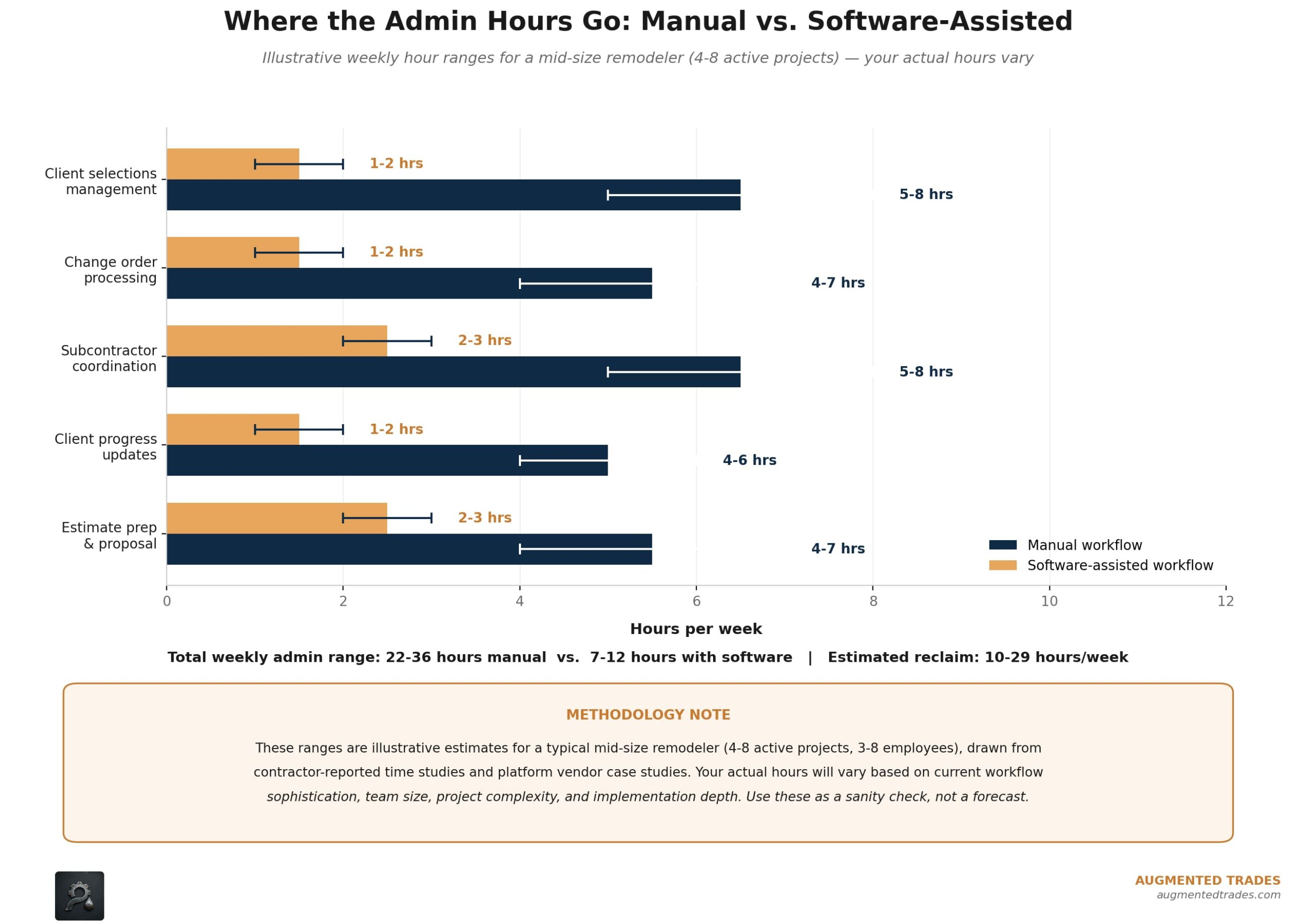
Estimated weekly admin hours for a typical mid-size remodeling operation, illustrating where software-assisted workflows can reclaim time. Individual results vary by business size and current workflow sophistication.
Twenty hours a week reclaimed is more than half of a full-time admin salary. For a remodeler clearing $2.7M in annual revenue (the NAHB industry average), that’s either $35K–$55K in avoided admin hiring, or substantial billable hours redirected into estimating bigger jobs, managing client relationships, or being on-site for quality-critical moments.
1. Buildertrend — The Dominant Platform for Home Builders and Remodelers
Buildertrend is the most widely used construction management platform in the residential remodeler and home builder category. Per Buildertrend’s published company information, the platform is used by roughly 20,000 residential construction firms and powers a significant share of new home builds in the U.S. The reason it’s dominant isn’t that it’s perfect — it’s that it does more things than any competitor in one integrated system.
For a residential remodeler running 4–15 concurrent projects with 3–20 employees, Buildertrend covers the full lifecycle: lead CRM, estimating and proposals, scheduling, job costing, daily logs, client portal, selections, change orders, subcontractor coordination, and accounting integration. Buildertrend acquired CoConstruct in 2021 and has since absorbed its customer base, with active migration of remaining CoConstruct users to the Buildertrend platform throughout 2024–2026.
What Buildertrend Does for Remodelers Specifically
- End-to-end sales management — Lead CRM with email marketing tools and proposal generation — replaces separate CRM tools and shortens the path from first contact to signed contract
- Integrated client portal — Homeowners see real-time project status, approve selections, request changes, view daily logs with photos — dramatically reduces the ‘when is this going to be done’ phone calls that eat every remodeler’s afternoons
- Budget and job costing — Line-item budget tracking with variance alerts, plus one-click purchase orders to preferred suppliers with integration to QuickBooks and Xero
- Selections management — Client-facing selections tool lets homeowners browse finish options, approve within structured deadlines, and lock decisions — the biggest margin protector in remodeling
Honest Limitations
- Steep learning curve — Buildertrend takes 30–60 days to become productive with, and most shops don’t use more than 40% of features in year one
- Aggressive price escalation — Contractor reviews on TrustRadius and Capterra cite renewal price increases that have driven multi-year users off the platform, with one user documenting their cost jumping from ~$199/month at signup to over $900/month (per Bookedsolidcopy April 2026 analysis). The promotional first-month rate doesn’t reflect long-term cost. Annual contracts lock the rate for 12 months only; renewal rates are at Buildertrend’s discretion.
- Mobile app gets mixed reviews — Functional for daily log entry but field users frequently cite slow load times and a clunky interface compared to newer competitors
- Data portability is poor — Bulk export of historical project data is not supported, which locks contractors in once they’ve accumulated years of records
Pricing (verified May 2026, third-party sources): Buildertrend removed all published pricing from its website in 2026, moving to volume-based custom quotes per Projul’s April 2026 pricing analysis. Per third-party sources (CostBench March 2026, Bookedsolidcopy April 2026, contractor-reported pricing on TrustRadius and Capterra): three tiers, all with unlimited users. Those third-party reports put the range from roughly the mid-hundreds to about $1,100 per month depending on tier, plus onboarding fees that are often waived on annual contracts. Treat these as dated ballpark figures, not current prices. Annual contracts standard. Confirm current pricing directly with Buildertrend before signing — published pricing no longer exists.
Best for: residential remodelers and custom home builders with 3–25 employees, 4–15 active projects, who need one platform to run the whole business and can absorb the implementation curve.
2. JobTread — The Rising Alternative for Mid-Size Remodelers
JobTread is the most credible Buildertrend alternative to emerge in the past five years. Built from the ground up as an integrated system covering estimating, scheduling, job costing, client communication, and document management, it’s gained traction with mid-size remodelers who want Buildertrend-level functionality with transparent pricing and faster implementation.
For a remodeler doing $1M–$5M in revenue with 5–15 employees, JobTread hits a sweet spot. Faster to implement than Buildertrend, cleaner modern interface, transparent published pricing (rare in this category), and more responsive product development because they’re earlier in their lifecycle. JobTread also recently added an AI Connector feature that uses MCP-based integration to connect the platform to AI tools like ChatGPT and Claude — a forward-looking move that few competitors have matched.
What JobTread Does for Remodelers Specifically
- End-to-end project management — Complete workflow from pre-construction through closeout on one platform — job templates, bid management, scheduling, daily logs, photos, client communication
- Central job record — Jobs, costs, documents, and files accumulate in one searchable place — particularly valuable for remodelers juggling 6+ concurrent projects with similar but not identical scopes
- Financial visibility — Estimating, contracts, change orders, and invoicing feed actual financial performance dashboards — see job margin in real time without waiting for month-end close
- Transparent pricing — Pricing is published on their website, with no ‘request a quote’ runaround. This alone differentiates them from most competitors in the category
- AI Connector — MCP-based integration that lets you connect AI tools directly to your JobTread data for estimating, document analysis, and client communication
Honest Limitations
- Per-user pricing scales fast — Unlike Buildertrend’s flat-rate model, JobTread charges per internal user. A 15-person team can quickly exceed Buildertrend’s pricing at scale
- Network of integrations smaller than Buildertrend — If you use niche accounting software or specialized design tools, check compatibility before committing
- Fewer training resources and third-party consultants — When you have a complex implementation question, the knowledge base is smaller
- Younger platform means roadmap uncertainty — Stable, but less battle-tested than Buildertrend in edge cases
Pricing (verified May 2026): Annual subscription $159/month for first user plus $18/month per additional user. Monthly subscription $199/month for first user plus $20/month per additional user. Tiered price breaks begin after 10 users. All features included on every plan. Unlimited customers, vendors, and jobs. 30-day money-back guarantee on monthly plans. Verified from JobTread’s published pricing page via G2 and TrustRadius.
Practical examples: JobTread publishes $199/month billed monthly or $159/month billed annually ($1,908/year), plus $20/month per internal user, with tiered price breaks beginning after ten users (verified August 4, 2026).
Best for: remodelers and custom home builders with 3–10 employees starting fresh or frustrated with Buildertrend pricing escalation, especially design-build firms and mid-project-size custom builders. The per-user model favors smaller teams; larger operations should run the math against Buildertrend’s flat rate.
3. Houzz Pro — The Design-Forward Choice for Client-Facing Remodelers
Houzz Pro is what happens when the most-visited home renovation website in the world builds software for the contractors its homeowner audience hires. For kitchen and bath remodelers, interior-focused design-build firms, and custom builders whose clients expect a visually rich proposal experience, Houzz Pro has a positioning advantage no competitor can match: the client probably already has a Houzz account and recognizes the brand.
Unlike pure operational platforms, Houzz Pro integrates CRM, lead capture (including inbound leads from the Houzz marketplace itself), 3D floor planning, mood boards, visual proposals, selections, estimating, invoicing, and online payments. It’s not as deep on job costing and subcontractor management as Buildertrend or JobTread, but it’s meaningfully stronger on the client-facing design and sales experience.
Houzz Pro has two distinct standard tiers structured around different user types. Essential is designed for interior designers and supports teams managing annual projects valued up to $250K. Pro is designed for contractors and supports project volumes up to $500K annually. Houzz Pro no longer publishes a price for either tier. For most remodelers and custom builders, the Pro tier is the appropriate fit — Essential is missing key contractor-focused features.
What Houzz Pro Does for Remodelers Specifically
- 3D design and visualization — Drag-and-drop 3D floor planner plus photorealistic rendering — lets remodelers show clients what a space will look like during the sales conversation, not after they’ve signed
- Selections and mood boards — Curate finish options into visual mood boards tied directly to the estimate — replaces Pinterest boards and Word documents with integrated decisions
- Integrated lead capture — Inbound leads from Houzz’s homeowner marketplace funnel directly into the CRM — for remodelers paying for Houzz marketing anyway, this closes the loop
- Client-facing proposals — Proposals feel more like a design presentation than a construction contract — well-suited for premium custom work where the pitch matters
Honest Limitations
- 12-month contractual commitment — Users on Capterra and G2 report difficulty cancelling before renewal. Treat the Pro plan as a year-long commitment, not a monthly subscription
- Per-user fees on top of base — Additional users are $60/month each beyond the single user included in the base subscription. A 5-person team adds $240/month to the Pro base
- Less robust on field operations and subcontractor management than Buildertrend or JobTread — if you have a large crew of trades, you’ll still need supplemental tools
- Onboarding and customer service get mixed reviews — Multiple users on G2 cite self-taught platform with limited training support after the sale
Pricing (verified August 3, 2026): Houzz Pro no longer publishes plan pricing — the Pro, Custom, and Enterprise tiers are all demo-quoted (verified August 3, 2026). What it does publish: $60/month per additional user, tiers scoped by annual project volume (Pro up to $500K, Custom $500K–$5M, Enterprise $5M+), and advertising packages from $499/month. Verified via Houzz Pro’s published pricing, Capterra, SourceForge, and Slashdot (March 2026).
Best for: kitchen and bath remodelers, interior-focused design-build firms, custom home builders serving premium clients, anyone already spending on Houzz marketing. The Pro tier is the appropriate fit for contractors; skip Essential unless you’re primarily a designer.
4. Cedreo — 3D Design Without a CAD Background
Cedreo solves a specific problem that most remodelers run into: clients make better decisions when they can see the space, but most builders can’t justify hiring a designer or learning CAD. Cedreo is a web-based 3D home design tool that turns 2D floor plans into photorealistic 3D renders, dollhouse views, and 360-degree panoramas. Per Cedreo’s published guidance, a typical full presentation can be built in approximately two hours.
For design-build remodelers doing additions, whole-home renovations, or custom builds, the ability to show a client what their finished space will look like during the sales conversation meaningfully improves close rates. Clients who can visualize commit faster and request fewer mid-project changes.
What Cedreo Does for Remodelers Specifically
- Fast 3D from 2D floor plans — Draw walls, doors, and windows in 2D; Cedreo auto-generates a navigable 3D model complete with furniture, finishes, and daylighting
- Extensive finish library — Library of 8,000+ customizable materials, furniture, finishes, and fixtures means you can show clients real product options, not generic stand-ins
- Client-ready presentations — Photorealistic renders, 360° virtual tours, and ‘dollhouse’ overview views that clients can explore themselves
- Free tier for pilot testing — One project with limited renderings, useful for evaluating before committing to a paid plan
Honest Limitations
- Not a substitute for full CAD or Chief Architect for construction drawings — Cedreo is for presentation, not buildable documents
- Furniture and fixture library is large but not exhaustive — matching specific real-world products exactly sometimes requires workarounds
- Web-based means slow on older computers or poor internet — primarily an office tool, not a field tool
- Rendering credits cap monthly output — Pro plan includes 40 HD renderings per month; high-volume designers will need to manage credit usage
Pricing (verified May 2026): Free tier (1 project, 5 renderings, limited furnishings). Pro $79/month (single user, unlimited projects, 40 HD renderings/month, phone and chat support). Enterprise $129/user/month (team collaboration, project sharing). Verified from Cedreo’s published pricing page.
Best for: design-build remodelers, kitchen and bath specialists, custom home builders who want to win on client presentation without hiring a full-time designer. The Pro single-user plan covers most owner-operators; Enterprise is for design teams with multiple staff producing client presentations.
5. CompanyCam — Documentation That Protects Remodelers on Multi-Month Projects
CompanyCam’s use case for remodelers is different from service trades. Where a plumber uses it to document a panel swap for insurance purposes, a remodeler uses it to document a 4-month project from demo through punch list — hundreds of photos across dozens of job-site days, organized automatically and shareable with the homeowner in real time.
For multi-month remodels, three things go wrong without documentation: clients claim work wasn’t completed that was, subs damage work and deny it, and scope disputes can’t be resolved because there’s no photographic record of ‘what the wall looked like before we opened it up.’ CompanyCam handles all three.
What CompanyCam Does for Remodelers Specifically
- Organized project documentation — Every photo timestamped and GPS-tagged to a specific project — defensible record for the full project lifecycle
- AI photo timelines — AI-assisted before/after pairing generates presentation-ready timelines automatically — reused in the client portal, marketing content, and future sales decks
- Real-time client sharing — Homeowners see progress photos as they happen — dramatically reduces ‘is anyone actually working at my house’ anxiety during rough-in phases when little visible progress happens
- Platform integration — Integrates with Buildertrend, JobTread, Housecall Pro, and Jobber — photos can live in your main platform automatically
Honest Limitations
- No user minimum since the 2026 restructure — Solo operators pay for capacity they don’t fully use. Per-user economics only work starting around 3 active field users
- Requires team discipline to use consistently — the tool only works if your team actually photographs work at critical moments
- Not a project management tool — designed to complement rather than replace Buildertrend or JobTread
Pricing (verified May 2026): Pro Core is $63/month on annual billing or $79/month monthly and includes one user. Crew is $119/$149 and Scale is $199/$249, each including three users. Additional users $29/month (annual) or $34/month (monthly). No user minimum since the 2026 restructure. Verified from companycam.com/pricing.
Best for: remodelers doing multi-month projects, design-build firms wanting marketing-ready before/after content, anyone in insurance-restoration or structural work where documentation has legal weight.
6. LeadTruffle — Captures the Inquiries You’d Otherwise Lose
Remodeler lead economics are different from service trades. A remodeling lead is worth meaningfully more — average project value of $50K–$300K+ for residential remodels versus $200–$2,000 for a plumbing service call — but the sales cycle is longer and first contact matters more. A homeowner who fills out a contact form on a remodeler’s website and gets no response within a few hours probably fills out two more forms before the first remodeler calls back. Speed-to-lead is the single biggest conversion factor in remodeling sales.
LeadTruffle handles inbound calls and web form submissions 24/7 with AI voice agents that qualify leads, capture project details, and route genuine remodeling inquiries into your CRM or calendar. For remodelers spending money on Houzz ads, Google Local Services, or any paid lead generation, the cost of losing a lead to voicemail is directly calculable.
What LeadTruffle Does for Remodelers Specifically
- 24/7 AI voice agent — Handles inbound inquiries about remodeling projects, capturing scope, timeline, budget range, and property details
- Qualification logic — Pre-qualifies by project type (kitchen, bath, whole-home, addition) and budget range — you only see leads that match what you actually do
- CRM and calendar integration — Books qualified consultations directly into Buildertrend, JobTread, Houzz Pro, or Google Calendar
- Instant web form follow-up — Web contact form submissions get an automated text or email within seconds — the single biggest driver of remodeling lead-to-consultation conversion
Honest Limitations
- Significant entry cost — LeadTruffle no longer publishes plan rates — pricing is demo-gated, and a one-time onboarding fee has historically applied. This is not a tool for solo operators with low lead volume; it requires meaningful paid lead spend to justify
- Setup requires about a week to train the AI on your specific project types, pricing ranges, and qualification criteria
- Some homeowners prefer human contact for a major remodel — expect a small share of callers to request human follow-up, which the AI handles gracefully
- Best as a supplement to human sales, not a replacement — closing a remodel still requires a consultation with a real person
Pricing (verified May 2026): Essential, Growth, and Scale. Enterprise custom. All plans include a one-time onboarding fee and unlimited users. Tier names are published on leadtruffle.co; rates and lead volumes are quoted on a demo.
Best for: remodelers spending on paid lead generation, anyone losing inbound inquiries after business hours, design-build firms who want a consistent intake experience regardless of when the homeowner reaches out. Not appropriate for solo operators with low lead volume.
7. Workyard — GPS Time Tracking for Remodeling Crews
Remodelers billing time-and-materials work or tracking labor against fixed-bid projects live and die by accurate labor capture. Manual timecards cost margin in two ways: they over-report (technicians round up, especially on harder days) and they mis-allocate (labor gets assigned to the wrong job when multiple projects are active simultaneously).
Workyard handles both problems with GPS-verified automatic clock-in and clock-out tied to specific job sites. For a remodeler running 6 concurrent projects across a 30-mile service area, accurate labor data lets you see real job costs in real time rather than reconstructing them at month-end.
What Workyard Does for Remodelers Specifically
- GPS-verified time tracking — Employees auto-clock in when they arrive at a job site and out when they leave — no manual time entry, no end-of-day reconstruction
- Job-level labor tracking — Every hour logged is tied to a specific project, letting you see labor cost per job in real time against your estimate
- Certified payroll support — For remodelers doing any prevailing-wage or publicly-funded work, automated reports save hours per payroll cycle
- Payroll integration — Direct sync with QuickBooks, Gusto, ADP, and major payroll platforms — eliminates double entry of timecards
Honest Limitations
- Crew training and buy-in required — frame it as ‘proof of work’ not ‘surveillance’ for best adoption
- Less valuable for solo owner-operators or 2-person shops where you can see everyone working — scales up starting at 3–4 field employees
- Not a standalone FSM — designed to integrate with Buildertrend, JobTread, or your existing system
- Per-user fees plus base — Pricing is per user plus a fixed monthly company base, which adds up faster for larger crews than the per-user-only headline suggests
Pricing (verified May 2026): Time Tracking $6/user/month annual billing ($8/user/month monthly) plus $50/month company base fee. Workforce Management $13/user/month annual ($16/user/month monthly) plus $50/month base. Enterprise custom. Verified from workyard.com/pricing.
Practical examples: 6-user crew on Time Tracking annual = $86/month. 6-user crew on Workforce Management annual = $128/month.
Best for: remodelers with 3+ field employees, anyone doing prevailing-wage work, any business where job-level labor cost is the difference between margin hit and margin protected.
8. NiceJob — Automated Review Capture for Remodelers Where Google Reviews Drive Lead Volume
Remodeling is one of the most review-driven trades. Homeowners hiring a remodeler for a $50K kitchen, $150K addition, or $300K whole-home renovation are committing serious money to let a stranger work inside their home for months. That decision gets gut-checked against Google reviews before the phone call gets made. A 4.9-star remodeler with 200 reviews beats a 4.6-star remodeler with 18 reviews every time, even at higher prices.
NiceJob automates the review request after every closed project. It pulls the customer record from your FSM (Buildertrend, JobTread, Houzz Pro, Projul, QuickBooks), sends a personalized review request via text or email after job completion, routes happy customers directly to Google or Facebook review forms, and intercepts unhappy customers into a private feedback channel before they post publicly. For remodelers where word-of-mouth and Google rank determine inbound lead flow, this is the layer that compounds quietly in the background.
The Pro tier adds AI-generated review replies and reputation marketing tools — the AI drafts professional responses to every review you receive (positive and negative) that you can approve in seconds, plus tools to surface your best reviews on your website and social channels.
What NiceJob Does for Remodelers Specifically
- Automated review requests via text/email after every closed project — no manual follow-up, no awkward in-person ask at the punch list
- Native integration with Buildertrend, JobTread, Houzz Pro, Projul, and QuickBooks — the request fires from job-complete data already in your platform
- AI-generated review replies (Pro tier) — drafts responses to every review so you can approve in seconds; particularly important for remodelers where a single negative review can color years of premium work
- Reputation marketing tools (Pro tier) — automatically surfaces your strongest reviews on your website and social channels, important for design-build firms competing on portfolio strength
Honest Limitations
- Reviews-only — NiceJob does one thing well; it doesn’t replace any part of your operational platform
- The Reviews-to-Pro step is a 67% jump in cost — only worth it once your project volume outpaces your time to write replies manually, typically around 15+ closed projects per month
- Effectiveness depends on integration setup — works best when triggered automatically from project-complete data, which requires a short configuration
- Lower fit for one-off custom builders — if you complete 4 projects per year at $1M each, the per-job math is weaker than a remodeler doing 30+ smaller projects annually
Pricing (verified May 2026): Reviews $75/month, Pro $125/month. The $50/month step to Pro — a 67% jump — pays for AI-generated review replies and reputation marketing tools. Skip Pro until your review volume outpaces your time to respond manually. Verified from get.nicejob.com/pricing and PartnerStack public listings.
Best for: Residential remodelers and design-build firms closing 15+ projects per month where Google reviews drive inbound leads. Less essential for one-off custom builders doing fewer, larger projects.
9. Projul — Flat-Rate Alternative for Remodelers Done with Per-User Pricing
Projul is built around a single value proposition that’s increasingly rare in construction software: flat-rate pricing with no per-user fees. For a remodeler running 8–15 employees, the difference between $4,788/year flat-rate and a per-user platform that scales with team size is often $5,000–$10,000 annually.
The platform covers the standard construction management feature set — estimating, scheduling, job costing, CRM, time tracking, invoicing, and QuickBooks integration — without feature gating behind higher tiers. Projul positions itself explicitly as the alternative to Buildertrend’s price escalation and JobTread’s per-user scaling, and the math supports the positioning for mid-size operations.
What Projul Does for Remodelers Specifically
- Flat-rate pricing — One annual fee covers your entire company regardless of team size or project count
- All features on every plan — Estimating, scheduling, CRM, time tracking, job costing, invoicing, and QuickBooks integration included from the start, no upgrade required
- No onboarding fees — Implementation included in the base subscription, unlike Buildertrend’s $400–$1,500 onboarding charge
- Mobile app built for field crews — Designed for daily field use rather than retrofitted from a desktop product
Honest Limitations
- Smaller user community than Buildertrend or JobTread — Less third-party content, fewer consultants, smaller user forums
- Less depth on enterprise features — If you need complex AIA billing, multi-entity accounting, or commercial-grade subcontractor portals, evaluate carefully against Knowify or Buildertrend Complete
- Annual commitment — The flat-rate value only works on annual billing; not designed for month-to-month evaluation
- Newer platform — Less battle-tested than 15+ year incumbents in edge cases
Pricing (verified May 2026): Core $4,788/year flat-rate (no per-user fees, unlimited users, all features included). Higher tiers and custom enterprise pricing available. Verified from Projul’s published pricing and marketing materials.
Best for: remodelers with 5–20 employees who’ve outgrown per-user pricing or want to avoid Buildertrend’s price escalation, anyone wanting predictable annual costs without surprises, contractors who prioritize total cost over feature depth.
A Note on CoConstruct
If you’ve encountered CoConstruct in your software research, here’s the honest update: it’s effectively sunset. Buildertrend acquired CoConstruct in 2021 and is actively migrating existing customers to the Buildertrend platform. CoConstruct hasn’t received meaningful feature development since 2021, support has been reduced, and Buildertrend’s own migration page outlines the transition timeline for remaining customers.
New evaluators should not consider CoConstruct in 2026. If you’re currently on CoConstruct, plan your migration on your own timeline — either to Buildertrend (the default migration path) or to an alternative like JobTread or Projul if you’d prefer to evaluate options rather than be moved automatically. Any investment you make in CoConstruct setup, training, or configuration will need to be redone when the platform reaches end of life.
A Note on Service Fusion
If you’ve seen Service Fusion mentioned in trade contractor software comparisons, here’s why it’s not in our remodeler stack: Service Fusion is built for dispatched service work (HVAC, plumbing, electrical service calls), not multi-month construction projects. The platform’s strengths — flat-rate unlimited-user pricing, dispatch optimization, QuickBooks integration — don’t translate to remodeling workflows where projects span 3-12 months and selections management drives the customer experience.
The exception: if you run a service line alongside remodeling (handyman repair, maintenance contracts on past clients, warranty service), Service Fusion can handle that side while Buildertrend, JobTread, or Projul handles your construction projects. For pure remodeling and custom builder operations, skip it.
Service Fusion pricing for reference: Starter $245/month (or $208/month annual), Plus $382/month (or $325/month annual), Pro $627/month (or $533/month annual). All plans unlimited users. Verified May 2026 from servicefusion.com and ITQlick.
Before you buy software: one free tool can shrink the most tedious part of quoting. See our breakdown of Home Depot’s free AI material-list builder — what it does for remodelers and custom-home builders, and the estimating gaps you’ll still need real software to fill.
Which Tools Do You Actually Need?
Remodelers at different stages need different stacks. Here’s the framework, with pricing re-verified July 27, 2026:
| Tool | Role in the stack | What the vendor publishes | Source |
|---|---|---|---|
| Buildertrend | Operational platform | Quote only — no public pricing. 10% off if paid annually upfront. | buildertrend.com |
| JobTread | Operational platform | $199/mo + $20 per internal user (users 2–10). 20% off annual. No contract or setup fee. | jobtread.com |
| Projul | Operational platform | Core $399/mo, Core+ $599/mo, Pro $1,199/mo. Annual billing only — no monthly option. No per-user fees. | projul.com |
| CompanyCam | Photo documentation | Core $63/mo (1 user), Crew $129/mo (3 users), Scale $199/mo (3 users), +$29 per extra user. Prices shown are annual billing; monthly costs more. | companycam.com |
| Workyard | GPS time tracking | $50/mo base + $8 per user (Starter) or $16 per user (Pro), annual billing. A 6-user Starter crew is $98/mo. | workyard.com |
| NiceJob | Review automation | Reviews $75/mo, Pro $125/mo. Monthly billing; no annual discount published. 14-day free trial, no contract. | nicejob.com |
| LeadTruffle | AI lead capture (optional) | Quote only — no public pricing. Three tiers by monthly lead volume, plus a one-time onboarding fee. | leadtruffle.co |
How to read this: pick one operational platform — Buildertrend, JobTread, or Projul — not all three. Add CompanyCam, Workyard, and NiceJob as needed. LeadTruffle is optional and depends on paid lead volume.
All figures re-verified against each vendor’s public pricing page on July 27, 2026. Where a vendor does not publish pricing, this table says so rather than estimating. Billing basis is stated per row because it differs by vendor — Projul sells annual only, and CompanyCam and Workyard quote annual rates that rise on monthly billing.
Solo Remodeler or 2-Person Shop
Start small: JobTread annual ($159/month for first user) plus Cedreo Pro ($79/month). Total: roughly $238/month. Houzz Pro is the design-forward alternative to JobTread here, but its plan pricing is demo-quoted, so budget for it separately. CompanyCam Core now includes one user at $63/mo annual, so it is viable solo — older advice to skip it until you had three field users predates the 2026 restructure. Skip Workyard until you have crews to track. Skip LeadTruffle until you’re spending real money on paid lead generation.
Growing Remodeler (3–8 employees, $1M–$3M revenue)
Core stack: Buildertrend Essential (custom-quoted — no published pricing as of August 4, 2026) OR JobTread ($159/month billed annually, plus $20/month per internal user) OR Projul ($399/month flat) as your operational backbone. Add CompanyCam Core ($63/month annual, 1 user; Crew is $119 for 3) for documentation. Add Workyard Time Tracking ($86/month annual for 6 users) for labor tracking. LeadTruffle Essential optional if you’re losing inbound leads to voicemail.
Total monthly investment: Roughly $480–$730/month on annual billing, depending on which operational platform you choose and whether you add LeadTruffle. The choice between Buildertrend, JobTread, and Projul comes down to feature depth (Buildertrend wins), modern UX (JobTread wins), and cost predictability (Projul wins).
Design-Forward Remodeler or Kitchen/Bath Specialist
Stack: Houzz Pro (demo-quoted) as the lead operational platform (its design-forward features align with your sales process), plus Cedreo Pro ($79/month) for 3D presentation. Add CompanyCam Core ($63/month annual, 1 user) for project documentation. Add LeadTruffle (Essential) if Houzz advertising is generating volume you can’t manually keep up with. Total: roughly $407–$636/month on annual billing.
Established Custom Home Builder (10+ employees, $3M+ revenue)
Stack: Buildertrend Advanced or Complete (custom-quoted — no published pricing as of August 4, 2026) as primary — at this scale the depth justifies the cost, and the unlimited-user model becomes cost-effective. Add CompanyCam Crew ($119/month annual for 3 users, $29 per extra seat). Add Workyard Workforce Management ($128/month annual for 6 users, scales up). Add LeadTruffle (priced by monthly lead volume). Optional: Cedreo Enterprise for design teams.
Total monthly investment: $985–$2,000+/month depending on Buildertrend tier and Workyard headcount. At this revenue tier the math is obvious — operational efficiency at scale pays for the stack many times over.
What to Avoid
- Any platform that won’t show you pricing until after a sales call — transparency on cost is table stakes, opacity signals a pricing practice that favors the vendor. Buildertrend is the notable exception in this category (no public pricing, but documented third-party data exists); most other platforms should publish
- Multi-year contracts without a meaningful pilot period — remodeler software is a 3–6 month evaluation commitment, not a signature-then-good-luck decision
- Tools that claim to replace client selections meetings entirely — AI can structure the process but the premium-remodeler sales experience still needs human presence
- Enterprise construction platforms (Procore, Sage Intacct Construction) sold to sub-$5M remodelers — the implementation burden outweighs the functionality benefit until you’re meaningfully larger
- CoConstruct as a new evaluation — see the note above. The platform is sunset for new customers
- Software with annual price escalation clauses you can’t negotiate out — Buildertrend specifically has earned a reputation for 50%+ year-over-year increases. Get pricing terms in writing before signing
The Bottom Line
The remodeling market is as favorable as it’s been in 30 years. Net margins are at their highest since 1996. Demand is structural, not cyclical. Competitors are multiplying but so is the overall market. The top 25% of firms are pulling away from the bottom 75% on operational tightness, and the software stack is a meaningful part of that separation.
You don’t need to rebuild your entire business around software. You need to pick the right 2–3 tools for your current scale, implement them fully, and let the reclaimed hours and protected margins compound. A remodeler running 4 concurrent projects who saves 20 admin hours weekly and protects 2% of labor margin doesn’t just ‘run smoother’ — they meaningfully improve their position in net margin within a year.
Start with the stack that fits your size. Add tools as you grow. Skip anything that doesn’t show obvious ROI within 90 days. The market will reward remodelers who operationalize now, and the gap between top-quartile and average performance is only going to widen from here.
Quick Links: Every Tool Reviewed
Buildertrend
The dominant platform for residential builders
Best for: Residential remodelers and custom builders with 3–25 employees who need depth on every workflow and can absorb the learning curve.
JobTread
Modern UX with transparent published pricing
Best for: Mid-size remodelers (3–10 employees) starting fresh or frustrated with Buildertrend pricing escalation. Includes new AI Connector.
Projul
Flat-rate alternative — no per-user fees
Best for: Remodelers with 5–20 employees who want predictable costs and have outgrown per-user pricing models.
Service Fusion
Flat-rate FSM for remodelers with service lines alongside
Best for: Remodelers running a service line (handyman repair, maintenance contracts, warranty service) alongside project work. Not the right primary platform for construction projects. Pair with Buildertrend, JobTread, or Projul for the project side. Unlimited users on every plan.
Unlimited users · Annual saves 15%
Houzz Pro
Design-forward platform with integrated lead marketplace
Best for: Kitchen/bath remodelers, design-build firms, custom builders serving premium clients who already use Houzz for marketing.
Cedreo
3D home design without the CAD learning curve
Best for: Design-build remodelers who want photorealistic client presentations during the sales conversation, not after.
CompanyCam
Organized project documentation for multi-month builds
Best for: Remodelers doing multi-month projects, insurance restoration work, or anyone wanting marketing-ready before/after content.
Workyard
GPS-verified time tracking and certified payroll
Best for: Remodelers with 3+ field employees, prevailing-wage work, or anyone where job-level labor cost determines margin.
NiceJob
Automated review capture for design-build remodelers
Best for: Remodelers where Google reviews drive lead volume — kitchen/bath, design-build, whole-home renovations. Pro tier adds AI-generated review replies. Skip for one-off custom builders doing fewer, larger projects.
Native Buildertrend / JobTread / Houzz Pro / Projul / QuickBooks integration
LeadTruffle
24/7 AI voice agent for inbound remodeling inquiries
Best for: Remodelers spending on paid lead generation (Houzz, Google LSAs) or losing inbound inquiries after business hours.
The Augmented Trades Recommended Stack for a Growing Remodeler (3–8 employees)
More from Augmented Trades
- Best AI Tools for Plumbers in 2026
- ServiceTitan vs Jobber for HVAC Contractors
- Best AI Tools for Landscapers in 2026
- Best AI Tools for Electricians in 2026
- The AI Tools Plumbers Actually Use
- JobTread AI Connector: What It Means for Custom Home Builders
Get the Augmented Trades Weekly — AI tools for the trades, compared and ranked, every Monday morning.
Affiliate disclosure: Augmented Trades earns commissions when readers sign up for LeadTruffle, NiceJob, Service Fusion, or Projul through our links. We earn nothing from JobTread. We earn nothing from Buildertrend, Houzz Pro, Cedreo, or Workyard — they’re included because they’re best-in-class for the specific use cases described, regardless of commission structure. Pricing was verified May 2026 from each vendor’s published pricing page or third-party reports where vendors don’t publish. We make no ROI or savings claims that aren’t directly tied to a cited source. Always verify current pricing on the vendor’s site before purchasing.
Footnotes
1. NAHB Remodelers’ Cost of Doing Business Study, 2026 edition (covering 2024 data).
2. NAHB Remodeling Market Index, Q1 2026.
3. NAHB analysis, Q1 2025.
4. Vendor pricing verified May 2026 from: buildertrend.com/pricing (with supplementary third-party data from CostBench, TrustRadius, and Capterra given Buildertrend does not publish pricing publicly), jobtread.com (via G2 and TrustRadius), houzz.com/houzz-pro/pricing, cedreo.com/pricing, companycam.com/pricing, leadtruffle.co/pricing, workyard.com/pricing, and projul.com.
Affiliate disclosure: Augmented Trades participates in affiliate programs and may earn a commission when you sign up through links on this page, at no additional cost to you. We never accept payment for placement or rankings. We earn affiliate commissions on some links, and those never change which tool wins a category. See our full affiliate disclosure.
Go deeper on the remodeler stack: our AI estimating guide for remodelers compares DIY prompts against dedicated software for remodel bids, the CompanyCam + NiceJob workflow turns your before-and-after photos into review requests, our client portal comparison covers the feature most platforms now lead with, and the remodelers hub has the full reading order for building out your toolset.
Related: Build-and-remodel shops share most of the GC stack — see the best tools for contractors in 2026 for the full six-category breakdown.
Related: Deciding between the two big remodeler platforms? See JobTread vs Buildertrend: what remodelers actually say in 290+ reviews.

Michael is the founder of Augmented Trades, an independent site that compares AI and software tools for trade contractors on published pricing, contracts, and real feature limits. Tools are recommended on fit for your shop — affiliate partnerships never decide coverage.