The electrical trade has a math problem in 2026, and it’s not the kind you fix with a calculator.
Vendor changes found in the July 2026 re-check: CompanyCam, Jobber, Housecall Pro and LeadTruffle were re-verified against their own pricing pages and all four had changed. CompanyCam replaced Pro/Premium/Elite with Core/Crew/Scale and dropped its three-user minimum; Jobber now sells tiers with users included; Housecall Pro changed its tiers and now prices by trade and team size (read October 7, 2026, Electrical pricing path: Teams Essentials $299/mo with 5 users, Teams Max $649/mo with 8 users); LeadTruffle no longer publishes pricing at all. Other vendors on this page still carry their earlier verification date.
Originally published May 5, 2026.
Bureau of Labor Statistics projects 81,000 new electrician openings every year through 2034 — 9% growth, more than triple the average for all U.S. occupations. Associated Builders and Contractors estimates the construction industry needs 349,000 net new workers in 2026 alone to keep up with demand. And data centers — the AI infrastructure backbone everyone is racing to build — depend on electrical work for 45 to 70 percent of total construction cost, according to IBEW.
The contractors who win in this market aren’t the ones who hire faster. They’re the ones who bid faster, with tighter margins, on more jobs per week — because the work is there for anyone who can show up with a price.
If you’re an electrical contractor still building estimates the way you did three years ago, you’re leaving money on the table. This post covers exactly how to use AI to bid faster — both the free DIY path with ChatGPT or Claude, and the purpose-built electrical estimating software that goes deeper.
Why Electrical Estimating Is Where AI Matters Most
Electrical bids are different from almost every other trade. You’re calculating conduit runs that change with every wall opening. NEC labor units that shift based on conduit type, mounting condition, and crew skill. Material costs that move weekly with copper futures. Panel schedules with hundreds of devices to count. Branch circuits with home runs that have to be measured, traced, and priced individually.
Code changes move electrical scope too. NEC 210.8(F) now covers GFCI protection for outdoor-listed HVAC equipment in jurisdictions that enforce it as written; our guide to the Sept. 1 NEC 210.8(F) change covers what moved and what to confirm with your local inspector.
A single missed conduit run on a $500K commercial bid can cost you $8,000 in margin. A miscounted panel schedule on a 200-amp residential service upgrade can wipe out the entire job’s profit. The cost of slow, error-prone estimating compounds with every bid you submit.
That’s exactly why AI delivers faster ROI in electrical estimating than almost anywhere else. Whether you’re on the DIY path with a $20/month ChatGPT subscription or running purpose-built electrical estimating software, the core gain is the same: more bids submitted per week, with tighter pricing, in less time.
The Time Math
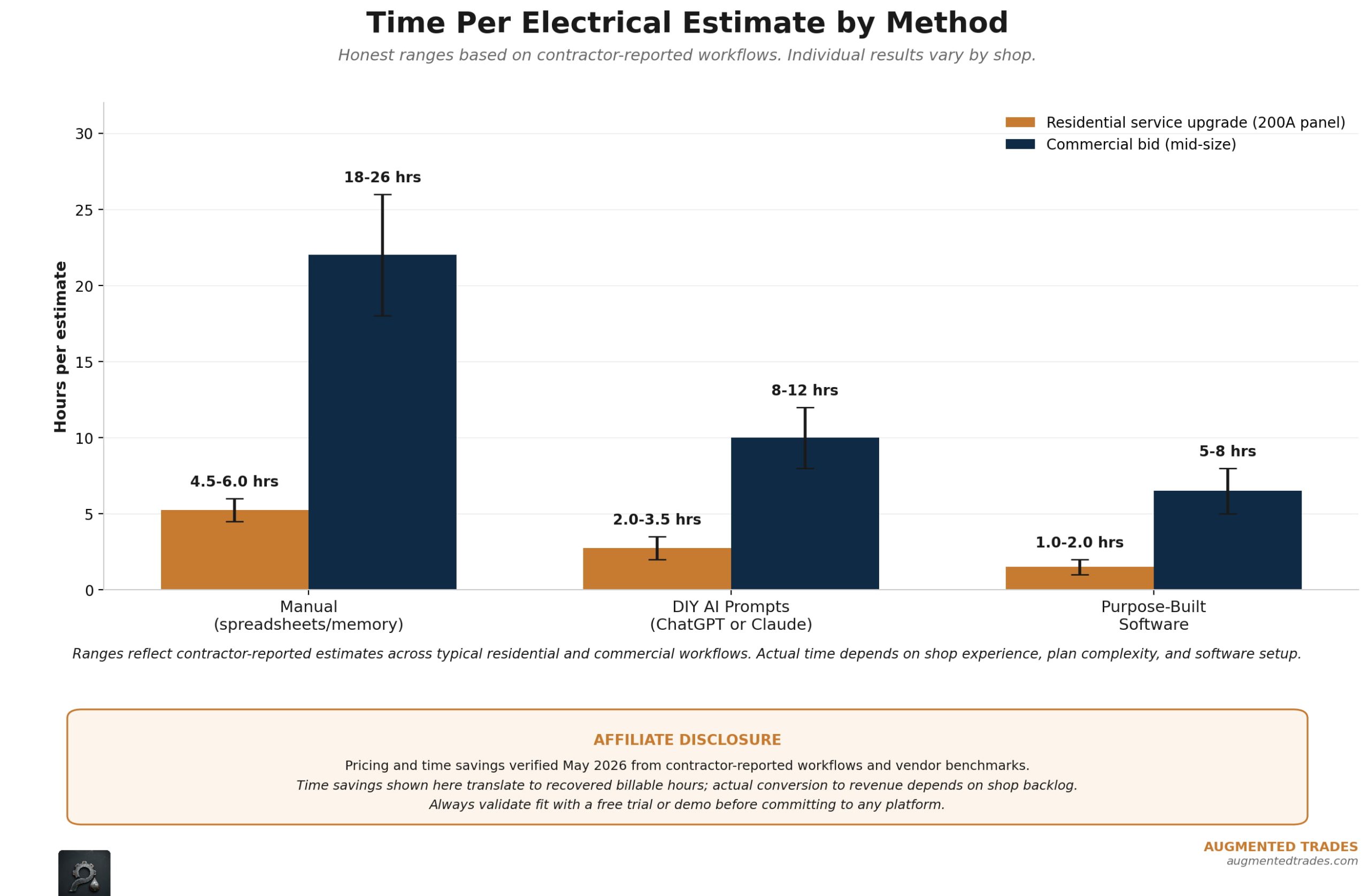
The chart above shows the realistic time-per-estimate range across three approaches. A standard residential service estimate that takes 4.5 to 6 hours manually drops to 2 to 3.5 hours with AI prompt assistance and 1 to 2 hours with purpose-built software. On commercial work the gap is dramatic: an 18 to 26 hour manual takeoff becomes 5 to 8 hours with proper estimating software.
For a contractor running 8 estimates per week, that’s the difference between losing 30+ hours a week to the estimating process or recovering 10-12 hours of billable time. At residential rates of $50-$130 per hour, that recovered time alone can cover the cost of every AI tool on this list — many times over.
Path 1 — DIY With ChatGPT or Claude
If you’ve never used AI for estimating before, this is where you start. ChatGPT Plus and Claude Pro both run $20 per month. They don’t replace your trade knowledge, your job history, or your supplier relationships — but they cut the writing, structuring, and proposal generation time dramatically once you learn how to prompt them well.
The DIY path won’t read your plan sets, won’t pull material costs from your supplier database, and won’t run takeoffs from PDFs. What it does extremely well is take your scope, your labor hours, your material list, and your customer details — and produce a clean, professional, formatted estimate in under two minutes. For solo electricians and small shops doing service work and small remodels, that’s often all you need.
A Prompt Template That Actually Works
Copy this into ChatGPT or Claude and adapt to your job. The structure matters — be specific about scope, materials, labor, and the format you want back.
You are helping me write a professional electrical estimate for a residential
customer. I'll give you the job details. Format the response as a clean,
formatted estimate suitable for sending to the customer.

JOB DETAILS:
- Job type: [200-amp service upgrade with new panel]
- Location: [Customer name and address]
- Scope: [Replace existing 100-amp panel with new 200-amp panel,
  upgrade meter base, replace SE cable to weatherhead, install
  new ground rods, label and test all circuits]
- Labor: [12 hours @ $95/hr]
- Materials:
  - 200A main breaker panel: $385
  - 200A meter base: $145
  - 4/0 SE cable, 25 ft: $180
  - Ground rods (2) and clamps: $65
  - Misc breakers, lugs, wire nuts: $120
  - Permit and inspection fee: $185
- Markup on materials: 25%
- My company name: [Your company]
- My company contact: [Phone, email]
- Estimate validity: 30 days

Please format with:
1. Clear scope of work in plain language
2. Itemized materials with markup applied
3. Labor breakdown
4. Total with line for sales tax (TBD)
5. Professional language suitable for a residential customer
6. Standard terms (30-day validity, 50% deposit on signing, balance due on completion)
The output will be a professional estimate ready to copy into your invoicing software or send directly. For repeat job types, save the prompt template and just swap the variables. Once you have 10-15 templates dialed in for your most common job types — service upgrades, panel changes, EV charger installs, recessed lighting, generator transfer switches — your estimating time drops dramatically.
What the DIY Path Doesn’t Do
ChatGPT and Claude can’t run takeoffs from blueprints. They can’t pull current material pricing from Trade Service or your supplier. They don’t know NEC labor units. They won’t catch a missed conduit run because they’re working only with what you tell them.
For a solo residential electrician or small service shop, that’s fine. For a commercial contractor bidding on plans, it’s not enough. That’s where purpose-built electrical estimating software comes in.
Path 2 — Purpose-Built Electrical Estimating Software
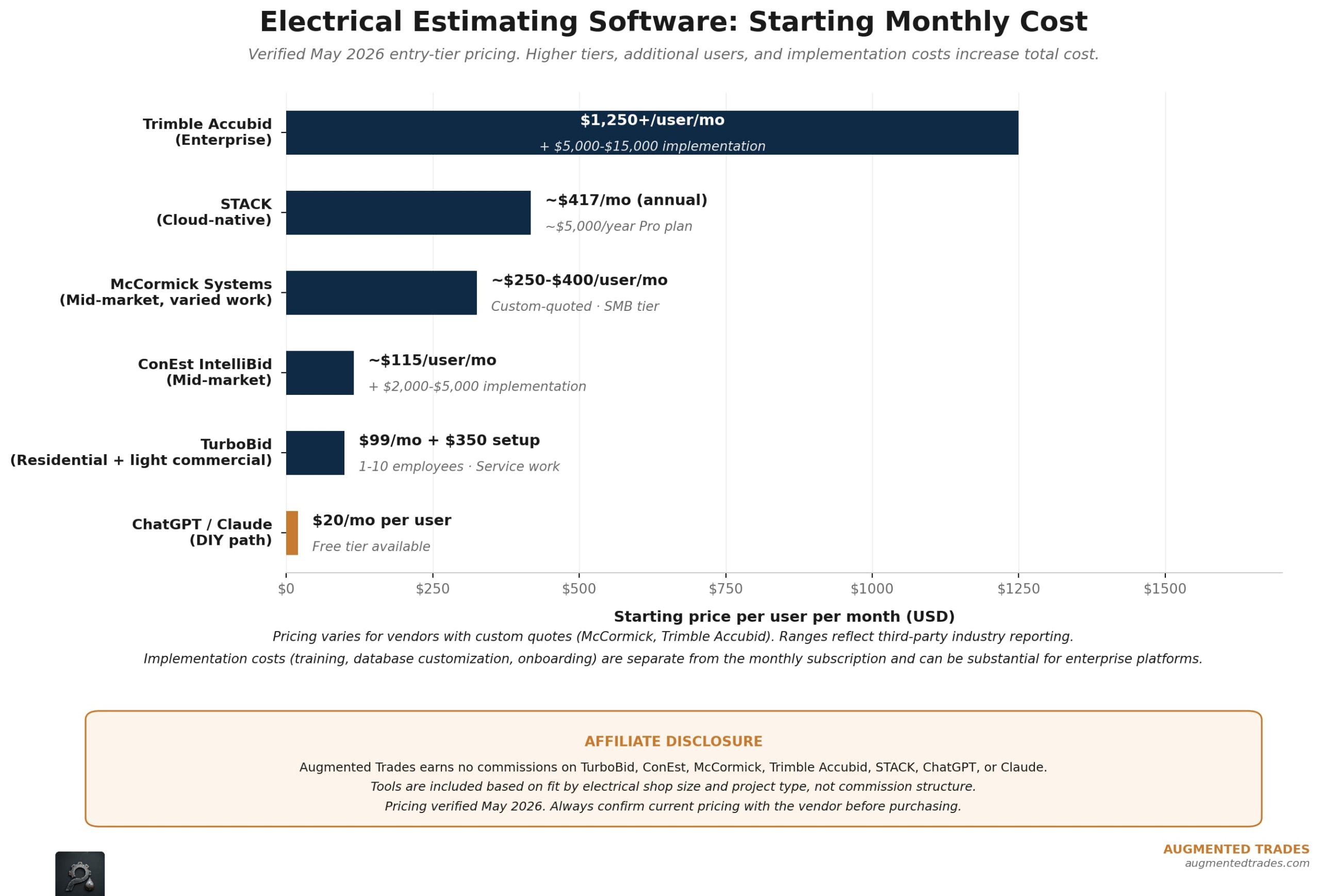
The chart above shows the real pricing landscape for electrical estimating software in May 2026, verified directly from vendor sites and 2026 industry comparisons. The range from $20/month (DIY) to $1,250+/month (Trimble Accubid Enterprise) reflects genuine differences in capability, audience, and total cost of ownership.
Here are the platforms worth knowing, organized by who they serve.
TurboBid — Best Entry Point for Residential and Light Commercial
TurboBid is the most accessible purpose-built electrical estimating tool on the market. At $99 per month plus a $350 one-time setup fee, it’s roughly the price of a single recovered residential service call per month. The platform was built specifically for electrical and plumbing contractors — not retrofitted from general construction software.
What you get: NEC-compliant labor units built in, weekly material price updates from Trade Service and major vendors, flat-rate pricing books for service work, and a customizable database of items and assemblies. The bid packages include photos, item-level pricing, and proposal documents that look genuinely professional. Contractors using TurboBid consistently report cutting their estimate time by 40-60% on residential and light commercial work.
The honest limitation: TurboBid is designed for residential and light commercial. It’s not the right tool for a contractor bidding on $5M commercial buildouts or industrial projects. The interface is functional rather than modern, and the on-premise install (with a Mac requiring Parallels and Windows) feels dated. For its core audience, none of that matters — but if you’re scaling into mid-market commercial, you’ll outgrow TurboBid within a year or two.
Pricing (verified May 2026): $99/month subscription + $350 one-time setup fee. One-time purchase option available. 14-day free trial.
Best for: residential and light commercial electrical contractors, 1-10 employees, doing service work and small projects up to $250K.
ConEst IntelliBid — Best Mid-Market Database Control
ConEst sits in the mid-market sweet spot. IntelliBid is the estimating engine, paired with SureCount for digital takeoff. The two tools work together — quantities identified in SureCount through pattern recognition flow directly into IntelliBid while preserving drawing organization and project phases. That tight integration matters because the most common estimating error is mismatch between what was measured and what was priced.
The IntelliBid database includes 140,000+ items and 500,000+ pre-built assemblies, which is roughly four times the depth of TurboBid’s library. Mid-sized contractors who want granular control over their database, labor units, and reporting find ConEst’s setup options compelling. Cloud and on-premise installation are both supported.
The honest limitation: ConEst requires meaningful upfront investment to configure properly. Plan on 4-8 weeks of structured training and database customization before the platform delivers full value. Implementation costs typically run $2,000-$5,000 on top of the subscription. For shops without the bandwidth to invest in setup, you’ll get less out of ConEst than the price suggests.
Pricing (verified May 2026): Starts around $115 per user per month, plus implementation costs.
Best for: mid-sized electrical contractors, 10-30 employees, with consistent bid volume on commercial and multi-family residential projects.
McCormick Systems — Best Established Mid-Market Platform
McCormick has been doing electrical estimating software since 1979 — over 45 years in the trade. That longevity translates to a deep, mature database (55,000+ items and 25,000+ pre-built assemblies) and a workflow that genuinely understands how electrical contractors think. The patented Auto Home Run feature automatically calculates wire pulls from outlet locations to panels — a feature that exists nowhere else and saves hours on every commercial bid.
McCormick offers cloud-hosted and on-premise options, integrates directly with NetPricer and Trade Service for material updates, and supports complex change order tracking and time-and-materials billing. The platform is widely used by electrical contractors doing commercial, industrial, residential, low voltage, and solar work.
The honest limitation: pricing is custom-quoted, but industry research suggests typical SMB pricing runs $250-$400 per user per month, with implementation requiring weeks of training. The interface, while functional, has been described by contractors as feeling dated compared to newer cloud-native tools. The depth and reliability of the McCormick database is its biggest selling point — and worth the cost for shops doing complex bids.
Pricing (verified May 2026): Custom quotes based on company size and modules. Typically $250-$400 per user per month for SMB tier.
Best for: established electrical contractors doing varied work (commercial, industrial, residential, low-voltage), 15-50 employees, with dedicated estimators.
Trimble Accubid — Best Enterprise Choice for Complex Commercial
Trimble Accubid is the heavyweight option, designed for large commercial and industrial electrical contractors bidding on complex projects with extensive coordination requirements. The database includes 120,000+ pre-built assemblies, NEC-compliant labor units across all conditions, BIM integration for coordination with mechanical and structural systems, and the bid management depth that large operations need to track 50+ active bids simultaneously.
Pricing reflects the enterprise positioning: $15,000+ per user per year, plus implementation costs that typically run $5,000-$15,000. For a shop doing $10M+ in annual revenue with a dedicated estimating team, the math works. For a shop under that revenue threshold, Accubid is structurally too expensive to justify.
Pricing (verified May 2026): $15,000+ per user per year ($1,250+/month per user).
Best for: electrical contractors doing $5M+ commercial and industrial work, with dedicated estimators and BIM coordination requirements.
STACK — Best Cloud-Native Option
STACK takes a different approach: cloud-first, AI-powered takeoff, real-time team collaboration, and pricing structured around annual contracts rather than per-user fees. Starting around $5,000 per year for the Pro tier (roughly $417 per month), STACK fits between TurboBid and the enterprise platforms in both price and capability.
The cloud-native architecture matters for shops with multiple offices or estimators working remotely. AI-powered symbol detection on PDF plans is a genuine time saver — though contractors using STACK report that the AI is helpful as a starting point rather than a replacement for verification. The trade-off versus McCormick or ConEst is that STACK’s electrical-specific database is less mature; you’ll customize more and rely more on your own pricing.
Pricing (verified May 2026): Pro plan ~$5,000/year ($417/month equivalent).
Best for: distributed teams, contractors who prioritize cloud collaboration over deep database depth, and shops bidding mixed-trade projects.
Beyond the Estimating Tool: The Full AI Stack for Electrical Contractors
Estimating software solves one problem — building accurate, fast bids. But a complete electrical contractor AI stack covers more ground:
Field service management for scheduling, dispatch, invoicing, and customer communication: Jobber (verified October 15, 2026, monthly billing, one user: Core $49, Connect $139, Grow $199; team-plan prices depend on user count and were not rechecked) and Housecall Pro (on its Electrical pricing path: Basic $79 for 1 user; Essentials $299 for 5 users; Max $649 for 8 users, monthly) are the two strongest options for residential service electrical work.
Lead capture from missed calls: LeadTruffle (Essential; quoted on a demo) catches the after-hours and missed-call leads that are particularly costly for electricians, where emergency calls drive premium rates.
Job documentation: CompanyCam (Core $63/month on annual billing or $79/month monthly, 1 user included) handles before/during/after photos, panel schedule documentation, and the dispute-protection that matters when a customer questions whether work was completed to code.
AI-native dispatch for growing operations: FieldCamp (quote-only pricing across Pro, Growth, Scale and Enterprise tiers as of September 29, 2026) is positioned as a premium AI-first alternative for shops that have outgrown traditional FSM tools.
The estimating software handles the bid; the FSM platform runs the operation around it. Together they’re how electrical contractors compress the entire cycle from inquiry to invoice.
ROI by Shop Size
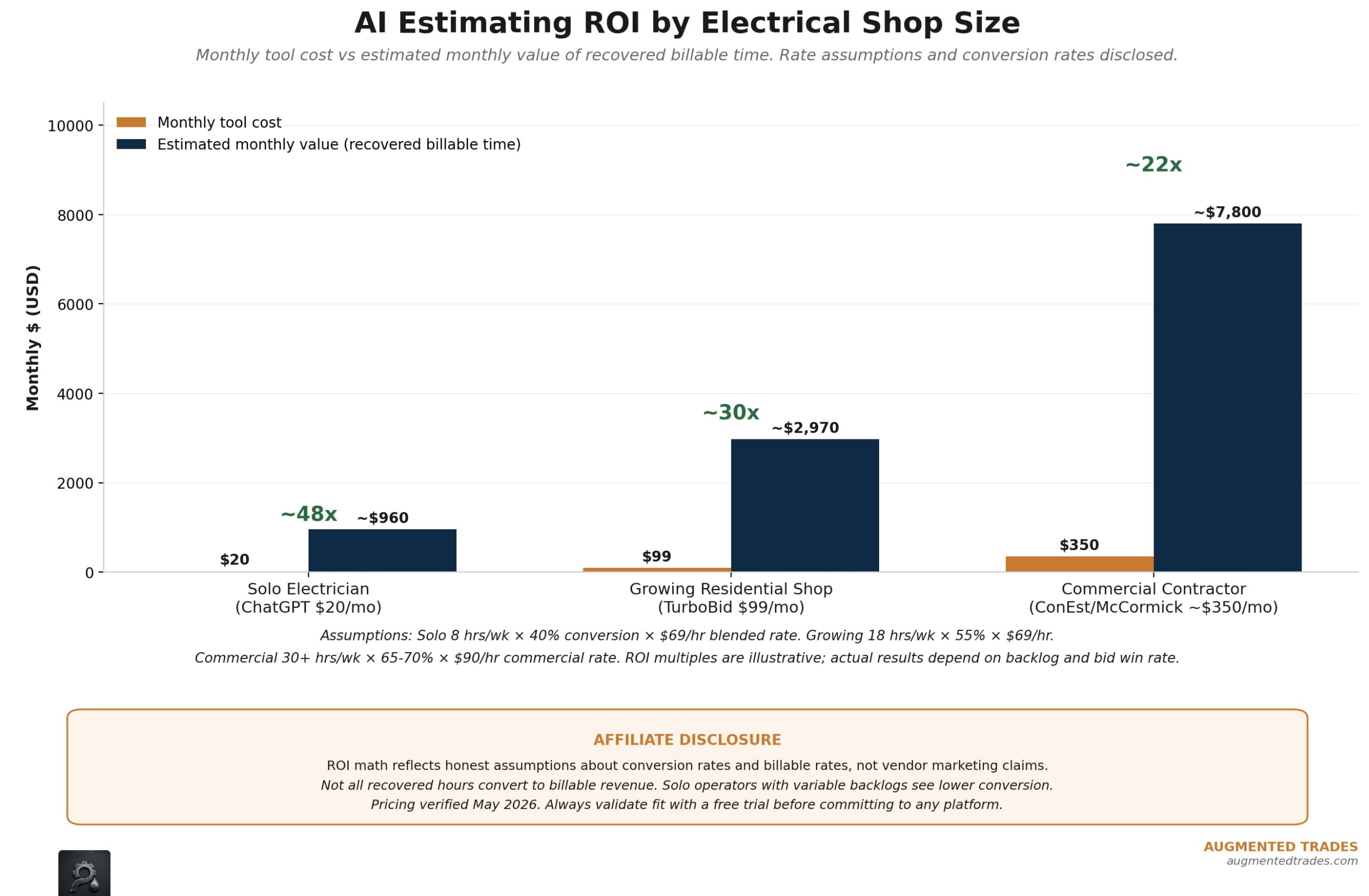
The chart above shows realistic ROI math for AI estimating across three shop profiles. The conversion rates (40% solo, 55% growing, 65-70% commercial) reflect honest expectations: not all freed hours convert to billable revenue, especially for solo operators with variable backlogs.
For a solo electrician doing 3-5 estimates per week, the DIY path with ChatGPT or Claude saves roughly 8 hours per week. Even assuming only 40% of those saved hours convert to additional billable work at a $69/hour blended rate, that’s roughly $960 in monthly value against a $20 subscription cost — a ~48x ROI multiple.
For a growing residential shop running 8-12 estimates per week, TurboBid at $99/month delivers roughly 18 hours of weekly time savings. With a 55% conversion rate to additional bids submitted or billable work at a $69/hour blended rate, that’s roughly $2,970 in monthly value against a $99 subscription — a ~30x ROI.
For a commercial contractor bidding on plan-based commercial and industrial work, ConEst or McCormick at roughly $350/month per user delivers 30+ hours of weekly time savings. At a 65-70% conversion rate to additional billable work and commercial billable rates of ~$90/hour, that translates to roughly $7,500-$8,000 in monthly value against $350 in cost — a 20x-23x ROI.
The pattern: ROI multiples are highest for solo electricians and lowest (still strong) for commercial contractors. That’s because the DIY path has near-zero cost. As shops scale and need more capability, costs grow but still produce strong returns. There is no shop size where AI estimating doesn’t pay for itself, assuming you actually use it.
Decision Framework: Which Path Is Right for Your Shop
Solo Electrician (1 tech)
Start here: ChatGPT Plus or Claude Pro at $20/month. Build 10-15 prompt templates for your most common job types. Save them in a notes app or document for reuse.
Add when ready: Jobber Core at $49/month for scheduling, invoicing, and customer communication. ChatGPT handles the writing; Jobber handles the operation.
Total monthly investment: $59. Time saved: 6-10 hours per week.
Growing Residential Shop (2-10 techs)
Start here: TurboBid at $99/month + $350 setup for purpose-built electrical estimating, paired with Jobber Grow ($299/month, 5 users included) or Housecall Pro Basic ($79/month — Essentials is $299/month for 5 users) for FSM.
Add as you scale: LeadTruffle (quote only — pricing is demo-gated) for missed-call lead capture, CompanyCam Core ($63/month on annual billing, 1 user included) for job documentation.
Total monthly investment: $576-$596/month on annual billing, plus a one-time $350 TurboBid setup fee; LeadTruffle is quoted on a demo and not included. Time saved: 15-25 hours per week across the team.
Commercial Electrical Contractor (10+ techs)
Start here: ConEst IntelliBid (~$115/user/month + implementation) or McCormick Systems (~$250-$400/user/month) for purpose-built estimating with deep database control. Pair with Jobber Plus ($599/month, 10 users included) or evaluate FieldCamp Growth (quote-only pricing) for AI-native dispatch.
Layer in: LeadTruffle, CompanyCam, and consider Trimble Accubid if you’re routinely bidding on $5M+ projects with BIM coordination.
Total monthly investment: $1,500-$5,000+/month depending on team size, project complexity, and which estimating platform you choose. ROI is measurable in recovered estimator hours, increased bid volume, and tighter margin protection on complex commercial work.
What to Avoid
A few things that show up in electrician estimating software searches that aren’t worth your time or money:
Generic construction estimating software adapted for electrical. Tools like PlanSwift and ProEst can technically handle electrical takeoffs, but they lack pre-built electrical databases, NEC labor units, conduit fill calculators, and home run calculations. You’ll spend more time configuring them than you’d save using them. Stick with electrical-specific platforms.
Free AI tools claiming to do “instant electrical estimates” from photos. The technology isn’t there yet for production use. Industry testing has consistently shown AI estimating tools running on uncalibrated databases produce errors of 15-40% on commercial bids — enough to destroy the project’s profit. Use AI as a decision-support tool, not a replacement for trade expertise.
Long-term contracts before you’ve validated fit. Several enterprise platforms require 12-month commitments with $5,000+ implementation fees before you’ve proven the platform works for your shop. Always negotiate a 60-90 day pilot period or month-to-month option for the first quarter.
The Bottom Line
Our recommendation for most electrical contractors: Start with ChatGPT or Claude at $20/month and learn to prompt them well. Build templates for your 10 most common job types. After 60 days, you’ll know whether the time savings justify investing in TurboBid ($99/month) for residential or ConEst/McCormick for commercial.
The labor shortage, the data center boom, and the 81,000 annual electrician openings projected through 2034 mean the work is there for any shop that can submit more bids per week with tighter pricing. The contractors who adopt AI estimating in 2026 will be the ones operating at higher margins in 2028 and beyond — while their competitors are still building bids by hand on Sunday nights.
The window won’t stay open. It never does.
Quick Links: Every Tool Reviewed
ChatGPT
Cheapest entry point to AI-assisted electrical estimating
Best for: Solo electricians doing service work and small remodels. Use the estimating prompt template in this article to produce clean, professional estimates in under 2 minutes. Once you have 10–15 prompt templates dialed in for your common job types, estimating time drops dramatically.
(Free tier works for basic use; Plus unlocks better reasoning)
Claude
Alternative AI assistant for the same DIY workflow
Best for: Electricians who want a second AI option for estimate writing. Strong for structured outputs and longer technical documents. Many contractors run both ChatGPT and Claude and pick whichever produces better output for a given estimate type.
(Free tier also available)
TurboBid
Best entry point for residential and light commercial
Best for: Residential and light commercial electrical contractors, 1-10 employees, doing service work and small projects up to $250K. NEC-compliant labor units built in, weekly material price updates, flat-rate pricing books. Cuts estimate time 40-60% on residential work.
One-time purchase option available · 14-day free trial
ConEst IntelliBid
Mid-market sweet spot with deep database control
Best for: Mid-sized electrical contractors (10-30 employees) with consistent bid volume on commercial and multi-family residential. 140,000+ items, 500,000+ pre-built assemblies. Pairs with SureCount for digital takeoff. Plan 4-8 weeks of structured training and setup before full value.
Cloud and on-premise installation supported
McCormick Systems
45+ years of electrical estimating expertise
Best for: Established electrical contractors doing varied work (commercial, industrial, residential, low-voltage, solar), 15-50 employees, with dedicated estimators. The patented Auto Home Run feature automatically calculates wire pulls from outlets to panels — saves hours on every commercial bid.
Cloud-hosted and on-premise options
Trimble Accubid
Enterprise platform for complex commercial and industrial
Best for: Electrical contractors doing $5M+ commercial and industrial work, with dedicated estimators and BIM coordination requirements. 120,000+ pre-built assemblies, full BIM integration, bid management for 50+ active bids simultaneously. Structurally too expensive below this revenue threshold.
Implementation $5,000-$15,000
STACK
Cloud-native option with AI-powered takeoff
Best for: Distributed teams, contractors who prioritize cloud collaboration over deep database depth, shops bidding mixed-trade projects. AI-powered symbol detection on PDF plans is a genuine time saver. Electrical-specific database is less mature than McCormick or ConEst — you’ll customize more.
Annual contracts, not per-user pricing
Jobber
Most accessible FSM for residential electrical service
Best for: Residential electrical service contractors 1-15 techs. Scheduling, quoting, invoicing, customer hub. Pairs with TurboBid for the full estimating-to-invoice workflow. Most accessible entry tier in the FSM space.
Teams: Grow $299 (5u) · Plus $499 (5u) / $599 (10u) / $699 (15u)
Annual saves up to 35%
Housecall Pro
Marketing-first FSM with online booking and review automation
Best for: Residential electrical service shops where word-of-mouth and Google reviews drive growth. Stronger marketing automation than Jobber. Online booking widget captures after-hours service inquiries automatically.
(monthly, Electrical pricing path, read October 7, 2026; prices vary by trade, and the landing page shows lower prices from $59/mo before you pick one)
FieldCamp
AI-native dispatch for growing electrical operations
Best for: Electrical contractors who’ve outgrown traditional FSM tools and want AI-native dispatch and weather-aware scheduling. Seat counts are set in the quote.
Tiers: Pro · Growth · Scale · Enterprise, priced per quote
LeadTruffle
24/7 AI voice agent for electrical emergency calls
Best for: Electrical contractors handling emergency service work, after-hours calls (no power, no AC in summer, generator failures), or anyone losing more than 3-5 leads per week to voicemail. Emergency calls drive premium rates — missing them is expensive.
Scale · quoted on a demo
CompanyCam
Photo documentation for panel schedules and code-compliance proof
Best for: Electrical contractors who want time-stamped job documentation for warranty claims, callbacks, or code-inspection disputes. Panel schedule photos with timestamps prevent “did you actually do that work” disputes months after the job closes.
Crew $119 · Scale $249 annual — 3 users
No user minimum since the 2026 restructure
The Augmented Trades Recommended Path by Electrical Shop Size
Affiliate disclosure: Augmented Trades earns commissions when readers sign up for Jobber, Housecall Pro, FieldCamp, or LeadTruffle through our links. We earn nothing from TurboBid, ConEst, McCormick Systems, Trimble Accubid, STACK, ChatGPT, Claude — they’re included because they’re the right tools for specific electrical contractor segments, CompanyCam, or regardless of commission structure. Pricing was verified May 2026 from each vendor’s published pricing page or third-party industry comparisons where vendors don’t publish. We make no ROI or savings claims that aren’t directly tied to a cited source or clearly framed as estimates with rate assumptions disclosed. Always verify current pricing on the vendor’s site before purchasing.
More from Augmented Trades
- Best AI Tools for Electricians in 2026 — our pillar guide on the full AI tool stack for electrical contractors
- AI Estimating for Plumbers — the DIY-vs-DFY framework applied to plumbing
- AI Estimating for Remodelers and Custom Home Builders — how the trades coordinating with you are estimating their work
Want the electrician prompts we use?
The Electrician’s AI Toolkit: 12 electrician-specific prompts, 10 ready-to-send client scripts, and 3 tracking templates (bids, permits, profitability) — built from the research behind this article. Instant download, direct from us.
More estimating guides for the trades: AI estimating for HVAC contractors · AI estimating for landscapers · HVAC estimating software compared · plumbing estimating software compared
Affiliate disclosure: Augmented Trades participates in affiliate programs and may earn a commission when you sign up through links on this page, at no additional cost to you. We never accept payment for placement or rankings. We earn affiliate commissions on some links, and those never change which tool wins a category. See our full affiliate disclosure.
Related: how electricians use AI to win more bids.
AI electrical estimating FAQs
How do AI estimation tools handle electrical takeoffs? You upload plans — a PDF or digital plan set — and the AI-powered software runs quantity takeoffs, auto-detecting devices, fixtures, and runs, then prices them in real time. For electrical contractors bidding complex projects, that turns hours of manual counting into minutes.
Is electrical estimating software accurate enough to trust? Auto-detection gets you a strong first pass, but you still review the count — the AI handles the tedious part of the electrical work while you apply judgment on the project-specific details before the bid goes out.
Cloud-based or desktop? Most modern electrical estimating software is cloud-based, so your team can upload plans and estimate from the office or the field without installing anything.
Answer a few quick questions and our free Tool Finder builds you a custom software shortlist — with the reasoning and pricing behind each pick.
Find your tools (free) →
Michael is the founder of Augmented Trades, an independent site that compares AI and software tools for trade contractors on published pricing, contracts, and real feature limits. Tools are recommended on fit for your shop — affiliate partnerships never decide coverage.