Disclosure: Augmented Trades participates in affiliate programs. If you click a link and make a purchase we may earn a commission at no additional cost to you. Read our full disclosure.
The flat-rate pricing trap, the Good/Better/Best advantage, and which tools actually move the needle
Updated July 28, 2026: CompanyCam, Jobber, Housecall Pro and LeadTruffle were re-verified against their own pricing pages and all four had changed. CompanyCam replaced Pro/Premium/Elite with Core/Crew/Scale and dropped its three-user minimum; Jobber now sells tiers with users included; Housecall Pro changed its tiers and now prices by trade and team size (read October 7, 2026, HVAC pricing path: Teams Essentials $299/mo with 5 users, Teams Max $649/mo with 8 users); LeadTruffle no longer publishes pricing at all. Other vendors on this page still carry their earlier verification date.
Originally May 7, 2026 — Revised May 11, 2026 by Michael
What makes HVAC estimating different
Plumbers, electricians, and landscapers can win on cost accuracy alone. HVAC contractors win on something else: pricing presentation — the systematic structure of how you show options to customers. The math behind that structure is the entire game. If you’re deciding between software lanes first, start with our HVAC estimating software comparison.
ServiceTitan illustrates the impact with a typical scenario: a failed inducer motor on a 15-year-old furnace presented as three tiered options — Good ($450, basic motor swap), Better ($650, swap plus maintenance check and one-year service agreement), and Best ($8,500, full furnace replacement given the unit’s age). Most customers pick the middle option. Without that structured presentation, the same job often closes at $450 — a $200 difference per ticket on identical labor.
Third-party analysis suggests companies using Good/Better/Best presentation tools see 15-25% increases in average ticket size, with in-field financing for high-ticket replacements increasing close rates by 20-35%. These percentages aren’t ServiceTitan’s official numbers — they’re aggregated from third-party reporting on user outcomes — but the directional impact is consistent across the industry.
This article breaks down what HVAC estimating actually requires in 2026, where AI can help, and which tools fit your business size — whether or not we earn a commission on them.
New: This article covers HVAC estimating in depth. For the wider view of how estimating fits with FSM, missed-call rescue, photo documentation, reviews, and accounting in a complete 2026 operation, see our HVAC AI stack by shop size.
What HVAC estimating actually is
Three distinct pieces make up a real HVAC pricing system. Most contractors only do one or two of them well, which is exactly why margins drift downward over time without anyone noticing.
Flat-rate price book — a standardized list of jobs and what each one costs. “Capacitor swap: $185. Compressor replacement: $1,650.” This eliminates tech-by-tech price variance and protects margin on routine work.
Good/Better/Best presentation — for any job over the basic repair, present three tiers. The customer almost always picks the middle option, which is priced higher than your default would have been.
Job costing — the back-office calculation of what each job actually cost you, including labor burden, truck cost, parts, and overhead. This is what tells you whether your flat-rate book is accurate.
The pricing math: as a common industry rule of thumb, HVAC service labor is often priced at roughly a 3-5x markup over base technician labor cost. That isn’t a customer-gouging exercise — it’s the math required to cover labor burden (typically 25-35% on top of base wage), vehicle costs, parts inventory, dispatch overhead, and profit. If your pricing structure doesn’t reflect that math, you’re subsidizing your customers from your own pocket.
AI’s role in HVAC estimating is narrow but real. It doesn’t replace your knowledge of local labor markets or current equipment costs. It catches the costs you’d otherwise forget, generates the proposal language, and dynamically updates flat-rate books as parts pricing shifts.
Path 1: DIY — AI + Spreadsheets
For solo HVAC operators and 2-3 tech shops without budget for industry-specific software, the DIY stack works if you have the discipline. The tradeoffs are real, though, and worth understanding before you commit.
The stack:
ChatGPT or Claude ($0–$20/month) for prompts that walk through pricing logic, generate Good/Better/Best proposal language, and convert a parts list into a tiered estimate
A flat-rate price book template (spreadsheet-based) with built-in labor burden and overhead recovery formulas
Manufacturer pricing references (Carrier, Trane, Goodman, Lennox dealer portals) for current equipment costs
What AI can do here:
Walk you through labor burden math the first few times until you internalize it (typically 25-35% on top of base wage)
Generate Good/Better/Best language from a basic repair description
Catch obvious omissions in a quote (“you didn’t include the disposal fee for the old unit”)
Convert manufacturer part numbers into customer-friendly descriptions for proposals
What AI can’t do here:
Know your local labor burden (you have to provide this)
Know current refrigerant pricing in your market (R-410A and R-454B move weekly)
Know your overhead structure (rent, insurance, truck payments, dispatch software)
Replace a real flat-rate price book that updates with industry data quarterly
The biggest DIY trap in HVAC: techs in the field with calculators and notebooks. The moment your second tech starts quoting jobs differently than your first, you’ve lost pricing consistency — and pricing consistency is what protects margin in this trade.
When DIY works:
Solo operator, you’re the only one quoting
Under 100 service calls per year
You already know your real cost structure
You’re primarily doing diagnostic and repair work, not replacement sales
When DIY breaks down:
Multiple techs in the field, each pricing differently
You’re selling replacements (where Good/Better/Best presentation moves the needle most)
Your average ticket is dropping but you can’t pinpoint why
Your techs are calling the office mid-job to confirm pricing
If you recognize yourself in that second list, the DIY path isn’t where you should be. Move to the next section.
Path 2: Done-For-You — HVAC Software Stack
The HVAC software market is more fragmented than other trades. Six tools dominate, and they don’t compete with each other so much as serve different business sizes and pricing philosophies.
Platform
What the vendor publishes
Billing basis
Source
Housecall Pro
Basic $79/mo (1 user) · Essentials $229/mo (1 user) or $299/mo (5 users) · Max $349/mo (1 user) or $649/mo (8 users) — HVAC pricing path, read October 7, 2026
Core $99/mo and Advanced $329/mo on yearly billing; $149/mo and $399/mo billed monthly. Knowify does not publish a per-additional-user rate. Enterprise quote only
Vendor prices change without notice. For the current verified figures on every vendor we track — read from each vendor’s own pricing page and dated — see the contractor software pricing tracker.
Figures re-verified against each vendor’s published pricing page on July 27, 2026. Three of the six publish no pricing at all — FieldEdge, FieldEdge Flat Rate and ServiceTitan quote every deal, so this table says so rather than estimating a per-technician or per-ticket number.
Verified pricing comparison for HVAC estimating and pricing software, May 2026. Sources linked in chart footer.
The cleverest pricing model in the HVAC software space. Zero monthly subscription. You pay per work order created in the app — historically around $1.65-$2 per work order depending on plan and region. FieldEdge no longer publishes a fixed per-ticket price publicly; current pricing is quote-based via their site. You can either absorb the per-ticket cost into your overhead or pass it to the customer as a small line item. Comes with a pre-built flat-rate database for HVAC, plumbing, and electrical that’s updated quarterly. Works as an overlay alongside any FSM (it integrates with FieldEdge natively, syncs to QuickBooks, and exports to most other systems).
Best for: Solo operators and small shops who need flat-rate pricing without the overhead of a full FSM. The per-ticket model means you only pay when you’re actually working — no fixed monthly cost during slow seasons.
A generalist FSM with strong residential focus. On Housecall Pro’s HVAC pricing path (read October 7, 2026), Basic is $79/month, Essentials is $229/month for one user or $299/month for a 5-user team, and Max is $349/month for one user or $649/month for an 8-user team. Includes flat-rate pricing tools, online booking, automated review requests, and Wisetack financing integration for high-ticket replacements. The customer-facing experience is polished — homeowners can book online, approve estimates digitally, and pay through the system.
Best for: Solo to small residential HVAC shops where customer experience and marketing automation matter more than deep estimating depth.
Construction-focused FSM that lands well with HVAC subcontractors handling commercial and residential work. Two main plans: Core at $99/month annual ($149 monthly) and Advanced at $329/month annual ($399 monthly), plus a custom Enterprise tier. Strongest QuickBooks integration in the category — sync nearly everything bidirectionally. Built-in AIA billing for commercial work, change order management, and labor burden tracking. The construction lens means it handles project-based work better than dispatch-based service.
*Knowify does not publish a per-additional-user rate; teams of 10+ should price the Advanced plan with seat additions before committing.
Best for: HVAC contractors doing mixed service and project work, especially commercial subcontractors who need AIA billing and tight QuickBooks integration.
HVAC-specialized FSM with deep flat-rate pricing tools. Quote-based pricing only — they don’t publish on the website. Per third-party reports, expect roughly $100/month per office user and $125/month per technician, plus a $500-$2,000 setup fee. A 5-tech shop with 2 office staff lands around $825/month before add-ons. Strong QuickBooks sync, mature flat-rate pricebook, and tight integration with their own FieldEdge Flat Rate app for techs in the field.
*Pricing not published on vendor site. Figures via third-party software comparison platforms; confirm with vendor before relying on these numbers.
Best for: Established 5-15 tech HVAC shops already running on QuickBooks, with office staff handling dispatch.
The most popular generalist FSM in the home-services world. Grow plan is $199/month for 5 users; Grow is $399/month for 10 users. Strong scheduling, route optimization, and customer communication.
Honest limitation: Jobber’s job costing tools are basic compared to FieldEdge or Knowify. It’s a quoting and scheduling tool, not a deep estimating tool. Many HVAC contractors use Jobber alongside FieldEdge Flat Rate for the pricebook layer.
Best for: HVAC shops focused on residential maintenance routes (seasonal tune-ups, recurring service agreements) where scheduling and customer communication matter more than deep flat-rate logic.
The enterprise platform that defines what HVAC operations look like at scale. Pricing is custom and not published. Per third-party reports, expect approximately $200-$500 per technician per month, plus $5,000-$50,000 in implementation fees, plus a 12-month minimum contract. A 10-tech HVAC operation typically pays $30,000-$60,000 per year all-in depending on configuration.
*ServiceTitan does not publish pricing publicly. Figures via third-party analysis. ServiceTitan itself states the platform is “not optimized for a company with 3 or fewer technicians” and often declines small-shop onboarding.
What you’re paying for: the most sophisticated Good/Better/Best presentation tools in the category, in-field financing through Wisetack, marketing attribution that ties revenue back to specific ad campaigns, and membership program automation.
Best for: HVAC operations with 15+ technicians and $3M+ in annual revenue. Below that scale, the implementation cost and complexity rarely pencil out.
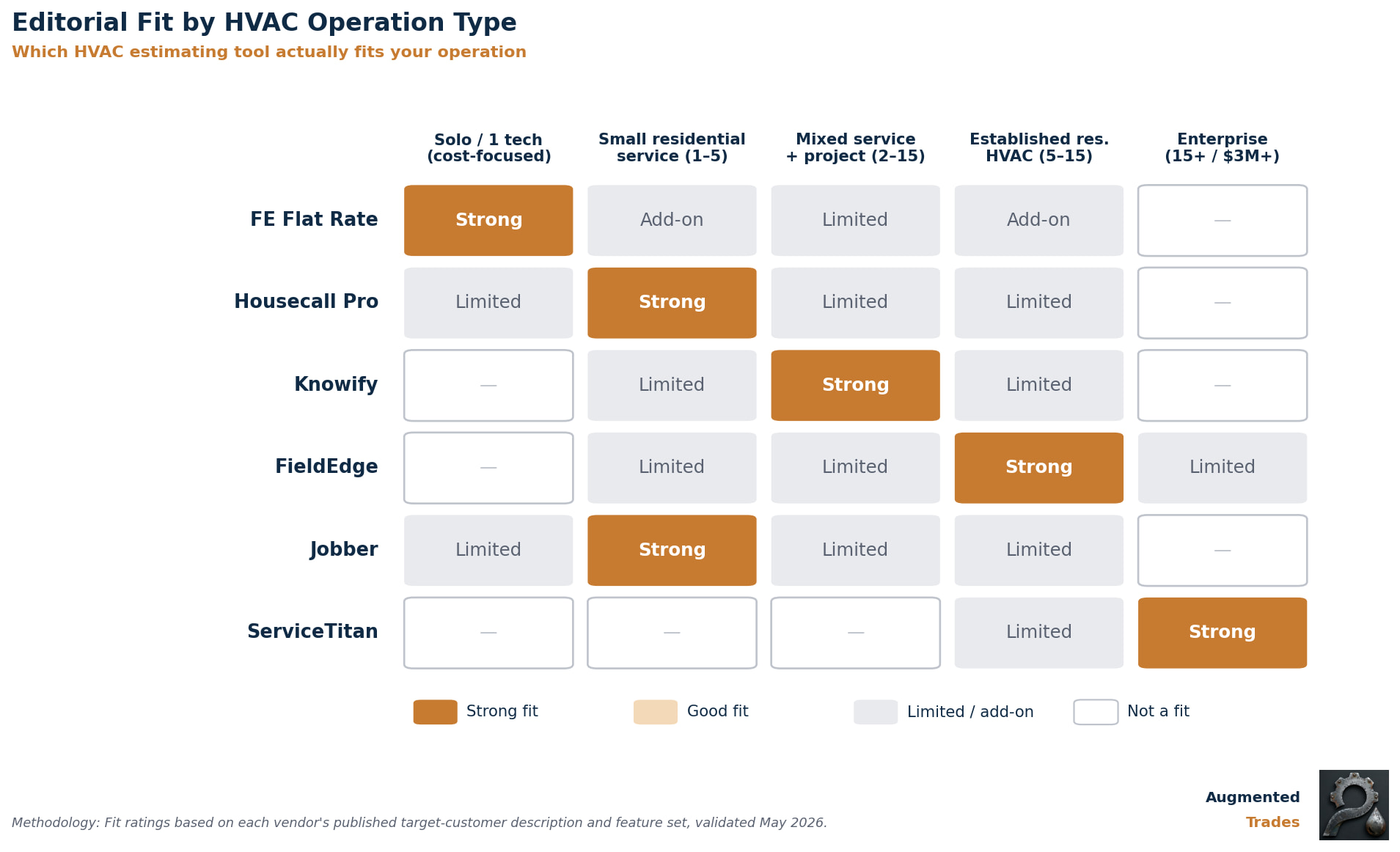
Which one fits your business?
Fit ratings based on each vendor’s published target-customer description and feature set. Validated May 2026.
The honest verdict, ignoring affiliate dynamics — and bear in mind that the FSM you pick interacts with the rest of your stack, so the complete HVAC software stack guide is worth reading alongside this:
Solo / 1 tech focused on cost: FieldEdge Flat Rate. Zero monthly cost, pay-per-ticket model means software cost scales exactly with your work volume.
Solo / small residential service: Housecall Pro or Jobber. You need fast scheduling, recurring billing, and clean customer communication. Add FieldEdge Flat Rate separately for the pricebook layer.
2–15 techs / mixed service and project work: Knowify. Especially if you’re doing commercial subcontracting or need strong QuickBooks integration.
5–15 techs / established residential HVAC: FieldEdge. The mature flat-rate pricebook and tight QuickBooks sync are real advantages. Budget for the setup fee and quote-based pricing model.
15+ techs / $3M+ revenue: ServiceTitan. The implementation curve is real (6-12 months), but the Good/Better/Best presentation tools and marketing attribution justify the cost at this scale.
What AI actually adds to HVAC estimating
Stripping the marketing language: AI’s real role in HVAC estimating today is narrower than the vendor pitches suggest. Four places where it earns its keep:
Dynamic flat-rate book updates. AI-powered systems can pull current parts pricing from supplier feeds and automatically adjust your flat-rate book to maintain target margins. When R-454B refrigerant pricing jumps in a quarter, your book updates without manual intervention.
Good/Better/Best generation. Given a basic diagnosis (“failed inducer motor on a 15-year-old furnace”), AI can generate three coherent option tiers with appropriate add-ons and replacement reasoning. Saves 5-10 minutes per quote and produces consistent presentations across techs.
In-field financing decisions. For high-ticket replacements ($8,000-$25,000), AI-integrated platforms like ServiceTitan and Housecall Pro can pre-qualify customers for financing while the tech is still in the home. Third-party analysis suggests this can increase close rates on replacement jobs by 20-35%.
Historical job-cost analysis. FieldEdge, Knowify, and ServiceTitan all pull patterns from past jobs to flag underbid risk on new estimates. This is where AI becomes irreplaceable — not generating estimates from scratch, but catching when this estimate looks worse than 80% of similar jobs you’ve completed.
What AI does NOT do, despite some marketing claims:
Replace your knowledge of local labor markets and union vs non-union dynamics
Know your truck inventory or refrigerant tank levels in real time
Generate accurate residential load calculations from photos alone (Manual J still requires a real assessment)
Predict refrigerant pricing shifts (the market moves on regulatory changes, not pattern recognition)
FAQ
Can ChatGPT write HVAC estimates? ChatGPT can structure an estimate from inputs you provide (parts list, your labor rate, your local refrigerant pricing), generate Good/Better/Best proposal language, and walk you through labor burden math. It cannot tell you current parts costs in your market, your overhead structure, or what jobs typically take in your geography. Treat it as a calculator and writing assistant, not a pricing oracle.
What’s the cheapest HVAC estimating software? FieldEdge Flat Rate (formerly Coolfront) has the lowest entry cost — zero monthly subscription, you only pay when you’re actually working. For a fixed-monthly model, Housecall Pro Basic at $79/month and Jobber Core at $49/month are the cheapest entry points, but neither has the depth of HVAC-specific flat-rate pricing tools that FieldEdge Flat Rate brings.
Is ServiceTitan worth it for a 5-tech HVAC shop? For most 5-tech shops, no. ServiceTitan itself states their platform is “not optimized for a company with 3 or fewer technicians” and the implementation cost ($5,000-$50,000) plus 6-12 month deployment timeline rarely pencils out under 15 technicians. At 5 techs, FieldEdge or Knowify will likely deliver 80% of the value at 20% of the cost. Revisit ServiceTitan when you cross 15 techs and $3M+ in revenue.
FieldEdge vs Housecall Pro: which is better for HVAC? Different tools for different operations. FieldEdge is HVAC-specialized with mature flat-rate pricing and tight QuickBooks integration — best for established 5-15 tech shops with office staff handling dispatch. Housecall Pro is residential-generalist with stronger customer-facing tools and marketing automation — best for solo to small shops where customer experience matters more than deep estimating depth. If you’re running a tech-heavy operation that lives on flat rates, FieldEdge. If you’re running a customer-experience-focused residential shop, Housecall Pro.
Quick Links: Every Tool Reviewed
Affiliate disclosure: Cards marked with the orange “AFFILIATE” badge earn us a commission when readers sign up — at no additional cost to you. Cards marked with the navy “DIRECT” badge are vendor links with no commission relationship. FieldEdge Flat Rate, FieldEdge, and Knowify are direct links — recommendations are based on fit by operation type, not commission rate. All pricing verified May 2026.
Best for: Solo operators and small shops who need flat-rate pricing without the overhead of a full FSM. The per-ticket model means you only pay when you’re actually working — no fixed monthly cost during slow seasons. Works as overlay alongside any FSM.
~$1.65–$2 per work order* 30,000+ repair database, updated quarterly QuickBooks integration included *Pricing not published; figures via third-party platforms
Customer-experience-focused FSM with marketing automation
Best for: Solo to small residential HVAC shops where customer experience and marketing automation matter more than deep estimating depth. Includes flat-rate pricing tools, online booking, automated review requests, Wisetack financing integration for high-ticket replacements.
Teams: Essentials $299/mo (5 users) · Max $649/mo (8 users) · Individual (1 user): Basic $79, Essentials $229, Max $349 (monthly, HVAC pricing path, read October 7, 2026; prices vary by trade, and the landing page shows lower prices from $59/mo before you pick one)
Construction-focused FSM for mixed service + project work
Best for: HVAC contractors doing mixed service and project work, especially commercial subcontractors who need AIA billing and tight QuickBooks integration. Strongest QuickBooks integration in the category. Built-in change order management and labor burden tracking.
Core $99/$149 · Advanced $329/$399 (annual/monthly billing) Enterprise: custom · No published per-user rate
Best for: Established 5–15 tech HVAC shops already running on QuickBooks, with office staff handling dispatch. Mature flat-rate pricebook, tight QuickBooks sync, and integration with FieldEdge Flat Rate Mobile for techs in the field.
~$100/office user + ~$125/tech* $500–$2,000 setup fee 5-tech shop ~$825/mo before add-ons *Quote-based; figures via third-party reports
Most popular FSM for residential maintenance routes
Best for: HVAC shops focused on residential maintenance routes (seasonal tune-ups, recurring service agreements) where scheduling and customer communication matter more than deep flat-rate logic. Pairs naturally with FieldEdge Flat Rate for the pricebook layer.
Core $49 · Connect $139 · Grow $199 (Individual) Teams: Grow $299 (5u) · Plus $499 (5u) / $599 (10u) / $699 (15u) Annual saves up to 35%
Best for: HVAC operations with 15+ technicians and $3M+ annual revenue. The most sophisticated Good/Better/Best presentation tools in the category, in-field Wisetack financing, marketing attribution that ties revenue to ad campaigns, and membership program automation. ServiceTitan itself states it’s “not optimized” for shops with 3 or fewer technicians.
~$200–$500 per technician per month* $5,000–$50,000 implementation fee 12-month minimum contract *Custom-quoted; figures via third-party reports
Cheapest entry to AI-assisted Good/Better/Best language
Best for: Solo operators doing under 100 service calls/year who already know their cost structure. Walks you through labor burden math, generates Good/Better/Best proposal tiers from a diagnosis, converts manufacturer part numbers into customer-friendly descriptions. Treat as a calculator and writing assistant, not a pricing oracle.
Best for: HVAC contractors who want a second AI option. Strong at structured outputs, long-context documents, technical correspondence, and customer-facing proposal writing. Many contractors run both and pick whichever produces better output for a given task.
Jobber
Grow ($299/mo, 5 users included) or
Housecall Pro Essentials ($299/mo, 5 users) +
FieldEdge Flat Rate
for pricebook layer.
Total: $299/mo for either FSM (5 users) + FieldEdge Flat Rate, priced separately
Mixed service + project (2–15 techs)
Knowify
Advanced ($329/mo annual) for AIA billing, change orders, and QuickBooks integration. Especially valuable for commercial subcontracting.
Total: $329–$399/mo
ServiceTitan
(~$200–$500/tech/mo, custom-quoted, $5K–$50K implementation). The Good/Better/Best tools and marketing attribution justify the cost at this scale.
Total: ~$3,000–$7,500/mo for 15-tech shop
The honest start for most HVAC shops: FieldEdge Flat Rate + ChatGPT Plus for under $50/mo testing cost. Run your next 30 service tickets through both systems and measure the change in average ticket size — most shops see the math within 30 days.
This article was written by the founder of Augmented Trades. Affiliate disclosure: Augmented Trades earns commissions when readers sign up for Jobber, Housecall Pro, and ServiceTitan through our links. We earn nothing from FieldEdge Flat Rate, FieldEdge, or Knowify — they’re included because they’re best-in-class for HVAC estimating, regardless of commission structure. Pricing was verified May 2026 from each vendor’s published pricing page where available; figures for FieldEdge, FieldEdge Flat Rate, and ServiceTitan come from third-party software comparison platforms where vendors don’t publish public rates.
Michael is the founder of Augmented Trades, an independent site that compares AI and software tools for trade contractors on published pricing, contracts, and real feature limits. Tools are recommended on fit for your shop — affiliate partnerships never decide coverage.