The first construction platform to ship a real MCP integration — what it does, who it’s for, and why most competitors can’t match it.
Originally May 9, 2026 — Revised May 11, 2026 by Michael
Augmented Trades is an independent resource for trade contractors. We verify details against vendors’ own documentation and source them inline, and our picks are by fit, not payout.
Last month, JobTread released what they call the AI Connector — a feature that lets contractors connect Claude or ChatGPT directly to their JobTread account. Type a request like “build a budget for a 10×20 kitchen remodel” into Claude. The AI then pulls live job data from JobTread, builds the estimate, and writes it back into the platform.
On the surface, that sounds like every other AI announcement in the construction software space over the past year. It isn’t. The architecture is genuinely different from how most construction platforms have approached AI, and the implications matter for any contractor evaluating tools right now.
What the AI Connector actually does
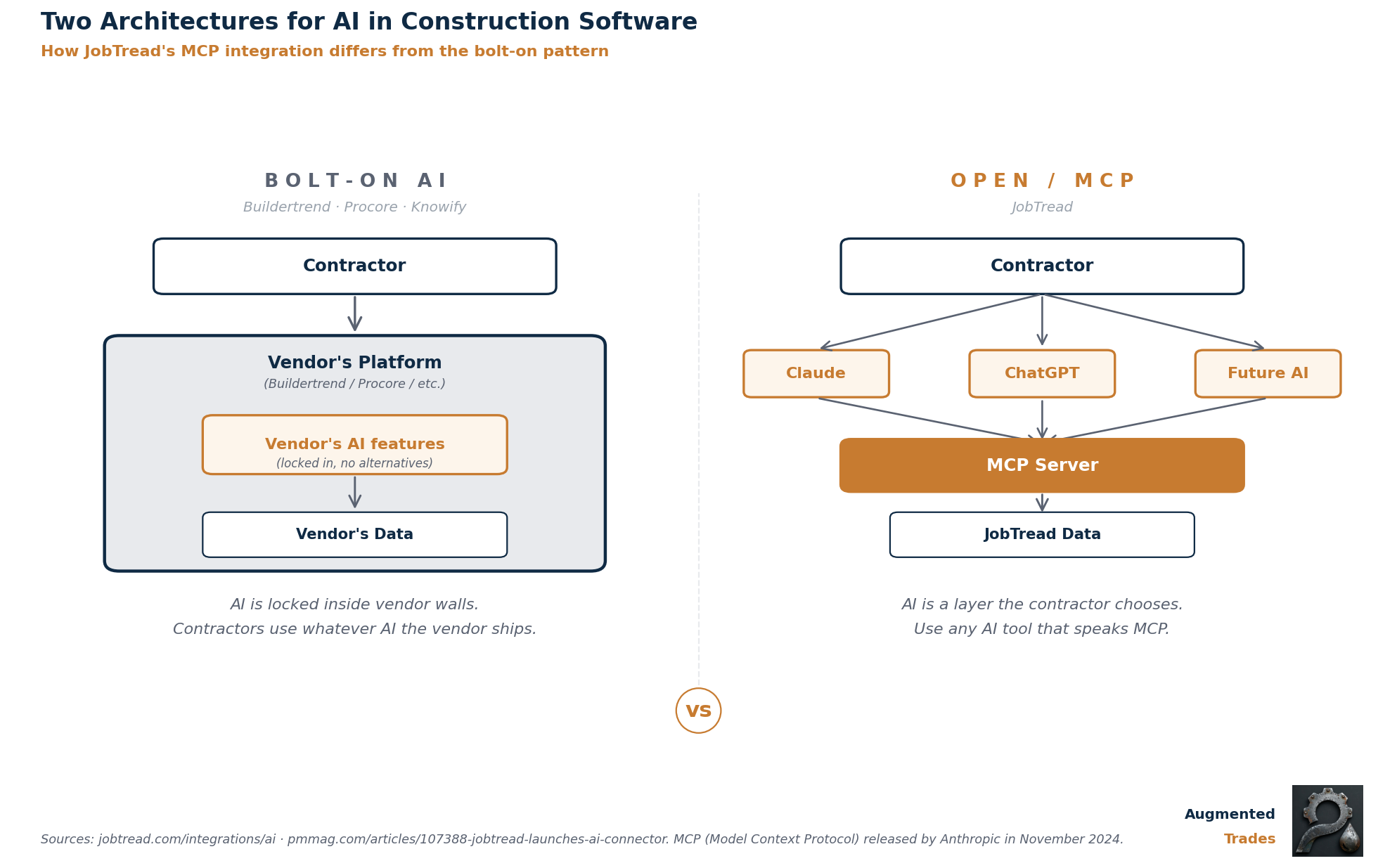
JobTread’s AI Connector takes the open-architecture path: contractors use their preferred AI tool — Claude or ChatGPT — connected to live job data through an MCP server. Sources: jobtread.com/integrations/ai, pmmag.com.
JobTread built the AI Connector on the Model Context Protocol (MCP). MCP is an open standard that lets AI tools like Claude and ChatGPT talk to external software through a structured interface. Per JobTread’s announcement, contractors can connect their preferred AI tool to their JobTread account and use natural language to:
- Build estimates, budgets, and schedules using real job data from the contractor’s JobTread account
- Analyze performance across active and historical jobs to surface patterns
- Identify field issues before they impact the project — for example, surfacing labor over-runs as they happen
- Generate proposals and customer communications using project data the AI can read directly from the system
Understand one detail before you turn this on. The AI Connector operates using your account permissions. JobTread states that the AI takes every action as you. There isn’t a separate “AI permission” layer that sandboxes what the assistant can touch; it inherits whatever the connected user account can already do. JobTread’s own guidance is to use trusted AI platforms, review outputs before confirming any action, and avoid giving the connection unnecessary access to sensitive data. In practice, you manage risk through who connects their AI and what that person’s JobTread role already allows — not through a special AI lockdown setting.
On its own site, JobTread now groups the AI Connector into named capabilities: AI Estimating (draft budgets, estimate costs, add client-ready descriptions), AI Scheduling (generate timelines, flag missing tasks), AI Selections (pull materials and pricing from suppliers), AI Takeoff (extract quantities from plans), and AI Insights (analyze performance without digging through reports). It also lists AI Change Orders, AI Client Communication, and AI Workflows.
Why this is different from how most platforms have done AI
Over the past 18 months, most construction software vendors have added AI features. Buildertrend has AI-assisted tools. Procore has AI features inside their interface. Knowify has added some AI workflows. The pattern is consistent: the vendor builds AI into their own product, the AI runs inside the vendor’s walls, and contractors use whatever the vendor decided to ship.
JobTread’s approach is fundamentally different. They’re not adding AI features. They’re exposing their data through an MCP server. As a result, contractors can use any AI tool that speaks MCP — Claude, ChatGPT, or future models — on their live JobTread data.
JobTread positions this as an architectural difference, not just a feature difference. As their comparison documentation argues, competitors layer AI on top of their existing interfaces, while JobTread’s open API exposes data to any AI tool the contractor chooses.
That’s marketing language, but the underlying architecture genuinely supports the claim. JobTread’s open API was already a differentiator before the AI Connector launched. The MCP integration is what turns that open API into something contractors can actually use without writing code.
Who this is actually for
JobTread reached 10,000 customer companies in February 2026, primarily in the small-to-mid construction segment — residential general contractors, remodelers, custom home builders, pool builders, and similar trades. Their pricing is single-tier: $199/month billed monthly, or $159/month billed annually ($1,908/year). Add $20/user, with per-user price breaks beginning after ten users. Buildertrend, by contrast, no longer publishes plan pricing at all. Its pricing page routes every prospect to a custom quote (verified August 4, 2026). That positions JobTread squarely in the under-$1M-revenue contractor market that has historically been priced out of enterprise construction software. For a deeper head-to-head, see our JobTread reviews from 290+ remodelers.
For that audience, the AI Connector matters in a specific way. Most contractors in this segment can’t afford to hire a dedicated estimator or operations analyst. The AI Connector approximates that role. For example, a contractor can ask Claude to “compare gross margin across the last 12 months of kitchen remodels and flag any where labor exceeded estimate by more than 15%.” The answer comes from real data.
That’s not a job a generalist FSM tool like Jobber or Housecall Pro can do. It’s also not something a contractor at this scale would build themselves with a developer. The AI Connector makes a kind of analysis available that previously required either expensive software or in-house analytical headcount.
Honest limitations worth knowing
A few things the announcement doesn’t address that contractors should think about:
You still need an AI account. JobTread provides the connection, but the AI tool itself (Claude, ChatGPT) is a separate subscription. Real cost includes both.
AI hallucinations are still possible. MCP gives the AI access to real data, which reduces hallucination risk significantly compared to AI working from training data alone. But it doesn’t eliminate it. Every AI-generated estimate still needs a human review before it goes to a customer.
The audit log matters more than it sounds. JobTread emphasized that every AI action is logged. That’s good — but it also means contractors need to actually review those logs periodically. An unsupervised AI making estimates is still a fabrication risk waiting to happen.
The bigger picture
MCP is a relatively new standard (Anthropic released it in November 2024), and JobTread is one of the first construction software platforms to ship a working integration. That timing matters. Over the next 12-24 months, expect other construction platforms to build MCP servers of their own. Otherwise, they risk getting left behind as contractors gravitate toward tools that work with their preferred AI.
Vendors with closed systems and proprietary AI features face a strategic choice. They can open up their data through MCP and risk commoditizing their AI advantage. Or they can stay closed and watch Claude or ChatGPT, running on competitor platforms’ data, outpace their AI features.
JobTread made the choice to open up. For contractors evaluating construction management software in 2026, this changes the calculus on what to look for. AI isn’t a feature anymore — it’s an operating layer. The platforms that treat it that way will pull ahead. The ones that treat AI as a chatbot bolt-on will fall behind.
See JobTread’s AI Connector page →
JobTread’s Open API vs. the AI Connector: which one do you need?
Searching for the JobTread API lands a lot of people on the AI Connector, but they solve different problems. The AI Connector is the no-code path: you connect Claude or ChatGPT, and the AI works inside your account with your permissions — no developer required.
The JobTread Open API is the developer path. Per JobTread, it lets software developers integrate JobTread with other applications and systems — keeping data in sync between systems to eliminate double entry, feeding JobTread data into business-intelligence tools for reporting, and setting up triggers so an action in one system fires an action in another. JobTread publishes API documentation and even offers an official API Developer Certification.
The rule of thumb: if you want to ask questions and draft work in plain English, use the AI Connector. Do you want two systems talking to each other on their own, like a custom dashboard or a sync with unsupported software? That’s the Open API, and you’ll want a developer (or the certification course) to build it.
Where to find the JobTread API documentation
JobTread publishes its API documentation at app.jobtread.com/docs. The Open API is built on Pave, JobTread’s own query language — which JobTread describes as similar to GraphQL, meaning you request exactly the data fields you need and nothing more. Authentication uses Grant Keys, and webhooks let an event in JobTread (a new job, a signed contract, a budget change) trigger a real-time action in another system. JobTread expects integrations to stay within its published API rate limits.
If you’d rather not hand a developer a cold start, JobTread also offers an official API Developer Certification covering authentication, Pave querying, pagination and aggregation, webhooks, and rate limits. For most contractors the takeaway is simpler. The documentation and certification are public, and any competent developer can build against them. Still, you (or someone you hire) have to write code. If you don’t want to write code, the AI Connector is the no-code path.
JobTread AI Connector: quick answers
Is the JobTread API the same as the AI Connector?
No. The JobTread API (the Open API) is the developer path — raw programmatic access for building custom integrations. The AI Connector is the no-code path that lets Claude or ChatGPT work inside your account with your permissions. If you are not writing code, the AI Connector is the one you want; the JobTread API is there when a developer needs to sync data with other systems.
What is the JobTread AI Connector?
It connects an AI assistant — Claude or ChatGPT — directly to your JobTread account through an MCP (Model Context Protocol) server, so the AI can read your live job data and help build estimates, schedules, selections, takeoffs, and reports inside the platform.
Is the JobTread AI Connector free?
The connector is part of the JobTread platform, which starts at $199/month billed monthly (or $159/month billed annually), plus $20/month per internal user. You also need your own AI subscription — Claude or ChatGPT — which is a separate cost.
Which AI tools work with JobTread?
JobTread names Claude and ChatGPT as the AI tools that connect through its MCP server.
Is the JobTread AI Connector safe to use?
JobTread’s position is yes, with careful use. The connector acts with your account’s existing permissions, so the company advises reviewing AI outputs before confirming any action and limiting access to sensitive data. The AI assists — it does not replace your review.
Does JobTread have an API?
Yes. JobTread offers an Open API — built on its Pave query language, authenticated with Grant Keys, and documented at app.jobtread.com/docs — that lets developers integrate JobTread with other software systems. It also offers an official API Developer Certification. The AI Connector is the no-code alternative, and it uses the same API-first architecture.
Is the JobTread AI Connector an MCP server?
Yes. JobTread confirms the AI Connector is an MCP (Model Context Protocol) server it built in-house — its own explainer describes it as “a secure bridge between software and AI tools.” Because MCP is an open standard, the JobTread MCP server works with Claude (JobTread’s recommended platform), ChatGPT, or any other AI tool that speaks MCP — you are not locked into one assistant. JobTread’s documentation includes two cautions. First, the connection runs under your JobTread credentials, so the AI acts as you with your full permissions. Second, there is no built-in undo, so review anything the AI plans to change before you confirm it. If you’re searching for a “JobTread MCP server,” this is it — the AI Connector is that MCP server.
Related Reading
- Best AI Tools for Remodelers / Custom Home Builders — the broader category context for residential GCs evaluating construction software
- AI Estimating for HVAC Contractors: DIY vs Done-For-You — different trade, same DIY-vs-Done-For-You framework
- AI Estimating for Landscapers: DIY vs Done-For-You — for design-build contractors who do landscape work alongside construction
- Best AI Tools for Roofers in 2026 — companion pillar for trade-specific tooling
This article was written by the founder of Augmented Trades. Affiliate disclosure: Augmented Trades does not currently earn an affiliate commission on JobTread. We do earn commissions on some other tools mentioned in passing in this article (Jobber, Housecall Pro) when readers sign up through links elsewhere on our site. JobTread is covered here because the AI Connector is a meaningful technical development worth understanding, regardless of commission structure. JobTread pricing re-verified August 4, 2026 against the vendor’s public pricing page; other information from JobTread’s published materials at jobtread.com and third-party trade publication coverage at pmmag.com.
Affiliate disclosure: Augmented Trades participates in affiliate programs and may earn a commission when you sign up through links on this page, at no additional cost to you. We never accept payment for placement or rankings. We earn affiliate commissions on some links, and those never change which tool wins a category. See our full affiliate disclosure.
Answer a few quick questions and our free Tool Finder builds you a custom software shortlist — with the reasoning and pricing behind each pick.
Find your tools (free) →
Michael is the founder of Augmented Trades, an independent site that compares AI and software tools for trade contractors on published pricing, contracts, and real feature limits. Tools are recommended on fit for your shop — affiliate partnerships never decide coverage.