
Originally published May 11, 2026. Updated May 26, 2026: corrected JobNimbus and AccuLynx pricing per third-party sources verified directly against vendor pricing pages; replaced unverifiable source citations; recalculated stack costs for all four operation types; verified EagleView pricing structure across all four tiers (Bronze/Silver/Gold/Platinum) directly from eagleview.com/pricing Updated July 28, 2026: re-verified every vendor price directly against its own pricing page. Roofr, Hover, CompanyCam, Jobber and NiceJob had all changed since May; AccuLynx, JobNimbus and LeadTruffle have stopped publishing pricing entirely and are now shown as quote-only. The cost-by-operation-type chart was rebuilt as a component build-up that separates published monthly subscriptions from per-report costs and quote-only vendors, so every subtotal adds up from figures you can check.
Deciding between a roofing-specific tool and a general platform? Start here: Do roofers need roofing-specific software, or will Jobber/ServiceTitan do?
Not sure which tools fit your shop?
Answer seven quick questions and get a stack matched to your trade, size, and budget — every pick traces to published vendor pricing we’ve verified, and several of our recommendations earn us nothing. Try the free Tool Finder →
The roofing trade in 2026 has a speed problem that the right roofing software, increasingly AI-powered, is uniquely positioned to fix.
Augmented Trades verifies every vendor price on this page against the vendor’s own published pricing, with figures sourced inline so you can check them. Some links earn us a commission (we flag which), but every pick is by fit, not payout.
Research consistently shows that 78% of homeowners hire the first contractor who responds1 to their inquiry. After a hailstorm hits, that means the roofer who picks up the phone at 11 PM — or whose AI does — books the inspection. The competition shows up Monday morning to find the job already sold.
The same speed dynamic plays out on every estimate. The 22-year-old aerial measurement workflow — climb the ladder, take a tape measure, sketch it on a notepad, drive back to the office, build the proposal in Word, email it Tuesday — is structurally too slow against a competitor pulling a $13 Roofr report from his truck and emailing a signed proposal before he leaves the driveway.
This isn’t speculation about where roofing is going. It’s already here. The roofing market is projected to grow steadily through 2030 alongside persistent labor shortages — meaning the contractors who win in 2026 won’t be the ones who hired faster. They’ll be the ones who bid faster, responded faster, and closed faster — because they automated the parts of the job that don’t require a roofer on a ladder.
This pillar covers the AI tools roofing contractors are actually using in 2026, organized by roofing operation type. The break-even analysis at the end shows exactly when each tool pays for itself, by company size.
Why Roofing Estimating Is Different
Most trade-focused AI tool guides treat roofing like generic field service work. It isn’t. Five things make roofing fundamentally different from plumbing or electrical:
1. Aerial measurement is the entire bottleneck. A residential re-roof estimate isn’t waiting on labor calculations — it’s waiting on accurate roof measurements. Per the National Roofing Contractors Association, EagleView reports remain the insurance-grade benchmark, and the entire AI estimating category was built around eliminating the ladder-and-tape-measure workflow.
2. Storm seasons create demand spikes that overwhelm manual operations. When a hailstorm hits, 500+ homeowners in a county can start searching “roofer near me” in 48 hours. The shop that can answer those calls 24/7 and pull measurement reports the same morning captures the market. The shop that can’t doesn’t.
3. Insurance restoration has its own software ecosystem. Storm-restoration roofers writing daily supplements need carrier-accepted measurement reports (EagleView is the standard), Xactimate compatibility, and supplement management tools that general FSM platforms don’t provide. AccuLynx and JobNimbus exist specifically for this market.
4. Photo documentation is the difference between getting paid and getting sued. Hail damage cases, scope disputes with adjusters, and “what was actually agreed to” arguments six months after a job closes — every single one is solved by time-stamped, geotagged photos taken before, during, and after the work. Roofers without photo discipline lose money every year to disputes they can’t prove their way out of.
5. The customer is often an insurance company, not a homeowner. That changes everything about communication, documentation, and timeline. Tools built for residential plumbing service don’t speak the same language as adjusters.
These differences explain why the right AI stack for a roofer is almost completely different from a plumber’s or electrician’s — and why generic “best AI tools for contractors” lists fail roofers consistently.
The Five Categories That Matter
Every roofing operation needs tools in five categories. The right specific tool depends on your operation type and size, but the categories are universal:
- Aerial measurement — Roofr, EagleView, Hover
- Roofing-specific CRM (for restoration/retail roofers) — AccuLynx, JobNimbus
- General FSM (for residential service roofers) — Jobber, Housecall Pro
- Photo documentation — CompanyCam
- Lead capture and review automation — LeadTruffle, NiceJob
A solo residential roofer might run a stack of just three tools (Roofr + Jobber + ChatGPT) for under $70/month plus report costs. A 15-person storm restoration operation might run six tools (EagleView + AccuLynx + CompanyCam + LeadTruffle + NiceJob + ChatGPT), and cannot get a total without quotes from AccuLynx and LeadTruffle. Both are correct for their operations.
Let’s go through each category.
Category 1: Aerial Measurement Tools
This is where roofing AI started, and where most roofers will see the fastest return. Three tools dominate, each with a different fit.
Roofr — Best Entry Point for Residential Contractors
Roofr restructured pricing in March 2026, retiring legacy plan names. The current model is a free Starter tier plus paid subscriptions, with measurement reports always pay-as-you-go.
Pricing (verified July 28, 2026 from Roofr’s pricing page):
- Starter: Free forever, no subscription. $19 per measurement report, typically back within 24 hours. Includes 10 trial proposals, invoices and work orders.
- Measure+: $109/mo for 6-hour guaranteed report delivery, or $169/mo for 2-hour. Reports drop to $13. This is one plan with a speed toggle, not two separate tiers.
- Essentials: $249/mo. $13 reports at 2-hour guaranteed delivery, unlimited proposals, invoices and work orders, card and ACH payments, unlimited e-signatures.
- Scale: $349/mo. Adds 7 customizable job boards, crew management, job costing and profit margins, performance dashboard, QuickBooks integration, role-based permissions.
- Add-ons: Instant Estimator $149/mo, Roofr Sites $99/mo (currently in beta), SMS texting $49/mo on Essentials and Scale only.
- Every tier includes unlimited users. ESX file bundles run $31 on Starter and $23 on paid plans.
What’s actually different about Roofr: It’s the only major roofing measurement platform with a genuine free entry point. A residential roofer running 5-10 reports a month can validate the workflow at near-zero cost before committing to a subscription. The platform also integrates with CompanyCam, QuickBooks, Gmail, and Google Calendar.
Honest limitations: Browser-only — no native mobile app, which is the consistent #1 complaint in Capterra reviews. Roofs aren’t available in every market (Capterra users report ~50% availability in some areas). Insurance restoration workflows are basic compared to purpose-built tools like AccuLynx. Roofr publishes every tier price and per-report cost openly, which is increasingly rare in this category.
Best for: Residential roofing contractors running 1-10 employees, doing retail re-roofs and small commercial. Especially strong for price-sensitive shops just starting to adopt software.
EagleView — The Insurance Restoration Standard
EagleView invented the aerial measurement category and remains the gold standard for storm-restoration roofers writing Xactimate supplements. The data is what matters: high-resolution aerial imagery, measurements precise enough to be accepted as-default by virtually every major U.S. insurance carrier.
Pay-as-you-go pricing (verified July 28, 2026 from eagleview.com/pricing): Premium reports (the standard roofing measurement) run $32.75 Bronze → $24.25 Gold for small roofs (≤20 sq), $60 Bronze → $49 Gold for medium (21-40 sq), and $87 Bronze → $75.50 Gold for large (40+ sq). Commercial Premium runs $89.50 Bronze → $79 Gold. Specialty reports priced separately: Gutter $13.75 residential, Bid Perfect $18, Walls $40, Walls Windows & Doors $67.50-$78, Full House $91-$105. Bronze is the default pay-as-you-go rate; Silver/Gold are prepay plans with progressive volume discounts; Platinum is custom-quoted. EagleView One subscriptions launched February 2026 are also custom-quoted.
What’s actually different: Accepted by every major insurance carrier as default. If you’re writing supplements daily, EagleView reports aren’t optional — they’re the lingua franca between contractor and adjuster.
Honest limitations: EagleView is a measurement tool, not a CRM. There is no scheduling, invoicing, customer messaging, employee management, or FSM workflow. Most roofers use EagleView in combination with a CRM like AccuLynx or JobNimbus. Per-report cost adds up fast at high volume — a shop pulling 40+ Premium Medium reports/month spends $2,000-$2,400/month on Bronze pay-as-you-go, dropping to $1,960-$2,200/month on Gold prepay.
Best for: Storm-restoration roofers, insurance-heavy operations, and any shop writing regular Xactimate supplements where carrier acceptance is non-negotiable.
Hover — 3D Visualization + Estimating
Hover relaunched as a connected platform on January 13, 2026 — what Roofing Contractor Magazine covered as the company’s biggest product moment in years. It’s no longer just an expensive measurement tool. It’s now an end-to-end visual workflow combining 3D smartphone scans, automated estimating from those 3D models, ready-to-sign proposals with e-signature, and 1,000+ workflow integrations.
Pricing (verified July 28, 2026 from Hover’s pricing page, Construction tab):
- Starter: $0. Your first 3 projects are free with no credit card. After that you pay per project at standard rates, with no monthly commitment.
- Pro: $999/year, billed annually — Hover does not sell a monthly plan. Includes $20 off every project and $1,000 in Hover credits for every $10,000 spent.
- Enterprise: custom-quoted for multi-location operations.
- Roof-only reports, per project: $29 simple / $49 average / $69 complex on Starter; $9 / $29 / $49 on Pro.
- Full exterior, per project: $59 / $99 / $139 on Starter; $39 / $79 / $119 on Pro.
- Expedited delivery: $39 per project on Starter, $19 on Pro.
What’s actually different: The 3D model is the differentiator. Homeowners see their actual home rendered with the proposed roof shingles, siding colors, and trim selections you’re quoting. That visual selling pattern closes deals at higher rates than text-only proposals — particularly on retrofits and aesthetic-driven jobs.
Honest limitations: Pro is annual-only at $999/year, so there is no low-commitment way to trial the subscription tier — you either pay per project on Starter or commit to a full year. Some properties (heavily treed, dense neighborhoods) can’t be scanned due to line-of-sight issues. The visual workflow is overkill for pure storm-restoration work where you just need carrier-accepted measurements.
Best for: Retail roofers selling aesthetic upgrades (color choices, shingle styles), siding contractors, exterior remodelers, and shops where visual presentation drives close rates.
Category 2: Roofing-Specific CRMs
If you’re doing storm-restoration work, insurance supplements, or running multi-crew operations, the general FSM platforms (Jobber, Housecall Pro) won’t have the depth you need. Two roofing-specific platforms dominate.
AccuLynx — Built for Insurance Restoration
AccuLynx is the established roofing-specific CRM, built specifically around insurance restoration workflows. Deep supplement management, Xactimate compatibility, and integrations with EagleView and ABC Supply make it the dominant choice for storm-restoration shops with 5+ trucks.
Pricing (checked August 23, 2026): AccuLynx publishes no rates. Its plan-options page now lists two plans, Pro and Elite, as a feature comparison with no dollar figures, and directs buyers to a custom price quote. This is a change from earlier in 2026: through July, AccuLynx published an Essential plan at $250/month on that page. Essential is no longer in the lineup, and acculynx.com/pricing redirects to a request form. Third-party comparisons have put higher-tier pricing in the range of $60–$120 per user per month, but that is those publishers’ reporting rather than a published AccuLynx rate, and it predates the current lineup. Implementation is widely reported at $5,000 and up, and AccuLynx typically requires an annual contract — confirm both directly before committing.
Honest limitations: No free trial. Closed API limits integrations with tools outside their preferred ecosystem. Pricing opacity makes evaluation harder than competitors. Implementation typically takes 4-6 weeks before the platform delivers full value.
Best for: Storm-restoration roofers, insurance-heavy operations with 5-50 employees, multi-location roofing portfolios, and any shop where supplement management is a core workflow.
JobNimbus — Flexible Retail/Mixed-Revenue Roofers
JobNimbus is the flexible alternative to AccuLynx, with an open API, drag-and-drop pipeline management, and the SumoQuote estimating and proposal builder integrated into the platform. The 14-day free trial removes the evaluation barrier that AccuLynx imposes.
Pricing (checked July 28, 2026): JobNimbus does not publish pricing. Its plans are sold by team size, and every tier shows “Request pricing”:
- Essentials — up to 3 users, 3 project boards, 10 automations
- Pro — up to 10 users, 5 project boards, 30 automations
- Premium — up to 19 users, unlimited project boards, 100 automations
- Enterprise — 20+ users, unlimited locations, automations and integrations
- The base-fee-plus-per-user structure reported by third parties earlier in 2026 no longer matches the tiers on JobNimbus’s own site, which now include a fixed number of users per plan. Treat any per-user figure you find elsewhere as out of date.
A 5-user shop on Growing realistically pays $375-$500/month before texting. A 10-user shop pays $1,000-$1,200/month. JobNimbus does not publicly publish pricing — these figures are sourced from third-party analyses published March-April 2026. Implementation runs $500-$2,000 for small shops and $5,000+ for enterprise installations.
JobNimbus offers a 14-day free trial without requiring a credit card — useful for validating fit before committing.
Honest limitations: Less specialized for insurance restoration than AccuLynx. Storm-restoration shops doing high volumes of supplements consistently report AccuLynx wins on workflow depth. JobNimbus tries to serve roofers, general contractors, and other trades — that broader scope means less roofing-specific feature depth.
Best for: Retail roofers, mixed-revenue operations doing both retail and restoration, growth-stage shops (5-15 employees), and any operation that needs API flexibility to connect with other tools.
Category 3: General FSM for Residential Service Roofers
If you’re running residential service work — repairs, maintenance, small re-roofs, leak repairs — and you’re not heavily into insurance restoration, the general FSM platforms cover your needs at lower cost than the roofing-specific CRMs.
Jobber — Most Accessible Entry Point
Jobber is the most popular FSM among small roofing service shops. Scheduling, quoting, invoicing, customer hub, payment collection in one platform. Strong mobile app for crews working from job sites.
Pricing (verified July 28, 2026 from Jobber’s pricing page, monthly billing):
- Individual, 1 user: Core $49/mo, Connect $139/mo, Grow $199/mo.
- Teams: plans now include a set number of users. Grow with 5 users is $299/mo. Plus is $499/mo at 5 users, $599/mo at 10, and $699/mo at 15.
- Jobber’s older “Connect Team” and “Grow Team” labels no longer appear on its pricing page — if you see them quoted elsewhere, the source is out of date.
- Annual billing carries a discount, and a first-year promotion was running when we checked. Promotional rates expire; confirm the current number before you budget.
Best for: Residential roofing service shops doing repair work, leak diagnostics, and small re-roofs. Solo to 15 employees. Especially strong when paired with Roofr for measurement reports.
Housecall Pro — Marketing-First Alternative
Housecall Pro competes with Jobber but leans heavier on the marketing and customer communication side. Automated review requests, postcard campaigns, online booking widgets, and customer communication automation are baked into the platform — useful for roofers doing residential service where word-of-mouth and Google reviews drive growth.
Pricing (checked July 28, 2026):
- Basic: $59/mo billed annually, $79/mo billed monthly. One user.
- Essentials $189/$149 (5 users); MAX $329/$299 (8 users). Housecall Pro’s pricing page requires you to complete an industry, company-size and goals selector before the higher plan cards render. We list only the tier they publish outright — ask them directly for the other two rather than trusting a third-party figure.
Best for: Residential roofing service shops focused on retail repeat business and review-driven growth. Especially valuable for shops where seasonal maintenance (tune-ups, gutter cleaning, winter prep) generates recurring revenue.
Category 4: Photo Documentation — CompanyCam
CompanyCam is the most universally applicable tool on this list for roofers, regardless of operation type. Hail damage documentation, insurance claim photos, before/during/after job timelines, scope dispute protection — every roofer needs this category, and CompanyCam is the dominant platform. That said, if you already run Housecall Pro or Jobber, both added built-in photo tools in May 2026 — see how the built-in options stack up against CompanyCam before paying for a second app.
Pricing (verified July 28, 2026 from CompanyCam’s pricing page):
- Core: $63/mo billed annually, $79/mo monthly. 1 user included.
- Crew: $119/mo billed annually, $149/mo monthly. 3 users included.
- Scale: $199/mo billed annually, $249/mo monthly. 3 users included.
- Additional users: $29 each on annual billing, $34 on monthly.
- Read this before comparing: CompanyCam replaced its older Pro / Premium / Elite tiers in 2026, and there is no longer a three-user minimum on every plan — Core includes one user. Several of the same dollar figures ($79, $149, $199, $249) now attach to different plans and different seat counts than they used to, so older comparisons are easy to misread.
Why this matters for roofers specifically: Insurance claims live or die on photo evidence. A storm-restoration roofer who can’t produce time-stamped, geotagged photos of hail damage at the time of inspection has no leverage with adjusters. The platform also auto-tags photos by job, address, and date — meaning you’re not hunting through camera rolls for “that one roof photo from last summer.”
Best for: Every roofing operation. Solo to enterprise. Especially valuable for storm restoration where photo evidence drives insurance reimbursement.
Category 5: Lead Capture and Review Automation
LeadTruffle — 24/7 AI Voice Agent for Storm Calls
LeadTruffle is the AI voice agent that answers your phone after-hours, qualifies leads, captures contact and property details, and routes urgent storm-damage calls to your dispatch system. For roofers specifically, this is the highest-ROI tool on this entire list during storm season — when 500+ homeowners might call your office in 48 hours and your team physically can’t answer them all.
Pricing (checked July 28, 2026): LeadTruffle no longer publishes plan pricing. Its site now routes to a demo request, and the tier rates it previously listed are gone. Treat LeadTruffle as quote-only — get a rate from them before you budget around it.
- Quote only. We are not going to print a monthly figure for a vendor that has stopped publishing one. Any specific LeadTruffle price you find in a comparison article today predates this change.
Why this matters for roofers specifically: Speed-to-lead research consistently shows responding within 5 minutes makes a business up to 21x more likely to qualify a lead than waiting 30 minutes.2 For a roofer where the average ticket is $8,000-$15,000 and a single storm event generates dozens of inquiries, missing one weekend call costs more than a year of LeadTruffle subscriptions.
Best for: Any roofing operation doing residential work with after-hours call volume. Critical during storm season. The math typically works after capturing a single missed-call lead.
NiceJob — Review Automation for Service-Based Roofers
NiceJob handles automated review request workflows specifically designed for service businesses. SMS and email review requests triggered by job completion, sentiment capture before reviews go public (giving you a chance to fix issues before they become 1-star Google reviews), and integrations with most major FSM platforms.
Pricing (verified July 28, 2026 from NiceJob’s pricing page):
- Reviews: $75/mo.
- Pro: $125/mo — adds referral campaigns, repeat-business automation, AI review replies and competitor insights.
- NiceJob Sites (optional website add-on): $99/mo plus a $199 setup fee.
- Enterprise, franchise and multi-location pricing is custom-quoted. Plans are month-to-month with no contract, and there is a 14-day free trial.
Why this matters for roofers specifically: Google reviews are the #1 lead source for residential roofers in most markets. A shop with 47 reviews at 4.8 rating books jobs that a shop with 12 reviews at 4.2 doesn’t — even when the latter does better work. Systematic review collection is non-negotiable for retail roofers.
Best for: Residential and retail roofers doing 15+ jobs per month. Less critical for storm-restoration shops where the customer is the insurance company, not a future Google searcher.
DIY Path — ChatGPT and Claude
For solo roofers and small shops not yet ready for paid platforms, a $20/month ChatGPT or Claude subscription handles a surprising amount of estimating and proposal work. The model won’t read your plan sets, won’t pull material prices from your supplier, and won’t run takeoffs from satellite imagery — but it will take your measurements, labor hours, and material list and produce a professional, formatted proposal in under two minutes.
Pricing: ChatGPT Plus $20/month, Claude Pro $20/month. Free tiers work for basic use.
Best for: Solo residential roofers doing 2-3 estimates per week. Use the proposal-writing prompt to generate clean, professional bids from your measurements and material lists. Pair with Roofr’s free Starter plan ($19/report pay-as-you-go) and you have a functional under-$50/month estimating workflow.
The Stack by Roofing Operation Type
Here’s where the article gets specific. The right tool stack depends entirely on what kind of roofing operation you run.
Solo Residential Roofer (1 owner-operator)
The stack:
- Roofr Starter — free, $19 per measurement report
- ChatGPT Plus or Claude Pro — $20/mo
- Optional: Jobber Core — $49/mo, if you want scheduling and invoicing
Monthly cost at typical solo volume: $20/mo in subscriptions, plus $19 per Roofr report — about $153/mo at 7 reports. Report volume is the variable: 4 reports/month puts you near $96, 10 reports/month near $210. Past roughly 12 reports a month a paid Roofr plan pays for itself, because report cost drops from $19 to $13.
What you’re solving: Speed of estimate generation. The Roofr-plus-ChatGPT combination cuts a 4-hour manual estimate to 30-40 minutes total.
Growing Residential Service Shop (2-10 employees)
The stack:
- Roofr Essentials — $249/mo, $13 per report
- Jobber Grow — $299/mo, includes 5 users
- CompanyCam Crew — $149/mo monthly, 3 users included
- NiceJob Starter — $75/mo
- ChatGPT or Claude — $20/mo
- LeadTruffle — quote only. Belongs in this stack, but no longer publishes pricing, so it is not in the subtotal.
Monthly cost at typical 5-tech configuration: $792/mo in published subscriptions — Roofr Essentials ($249) + Jobber Grow with 5 users ($299) + CompanyCam Crew ($149) + NiceJob Starter ($75) + ChatGPT ($20) — plus $13 per Roofr report, about $65 at 5 reports. LeadTruffle belongs in this stack but no longer publishes pricing, so it sits outside the subtotal and needs a quote.
What you’re solving: Operational scale. At this size you’re losing money to slow lead response, scope disputes, and disorganized photo documentation. This stack systematically fixes each leak.
Storm Restoration Operation (5-20 employees, insurance-heavy)
The stack:
- EagleView pay-as-you-go reports — $24.25–$87 per Premium report
- AccuLynx — quote only. No published rate as of July 2026.
- CompanyCam Scale — $249/mo monthly, 3 users included
- LeadTruffle — quote only.
- ChatGPT or Claude — $20/mo
Monthly cost at typical 8-user shop: there is no honest single figure. The publicly priced portion is $269/mo — CompanyCam Scale ($249) + ChatGPT ($20) — plus EagleView reports at $24.25–$87 each depending on roof size and prepay tier. The two largest line items, AccuLynx and LeadTruffle, both stopped publishing prices in 2026 and require quotes. Any single monthly number for this stack is an estimate, not a sourced price.
What you’re solving: Insurance restoration workflow at scale. This stack is built around carrier-accepted documentation, supplement management, and storm-response capacity. Jobber and Roofr don’t have the depth this operation needs.
Multi-Crew Retail Roofer (10-30 employees, mixed retail/restoration)
The stack:
- Roofr Scale — $349/mo, or EagleView reports, depending on your insurance mix
- JobNimbus — quote only. Every tier is “Request pricing.”
- Hover Pro — $999/year, annual only, for retail visual selling
- CompanyCam Scale — $249/mo monthly, 3 users included
- LeadTruffle — quote only.
- NiceJob Pro — $125/mo
- ChatGPT or Claude — $20/mo
Monthly cost at typical 12-user mixed-revenue configuration: $743/mo in published monthly subscriptions — Roofr Scale ($349) + CompanyCam Scale ($249) + NiceJob Pro ($125) + ChatGPT ($20) — plus Hover Pro at $999/year (annual only, no monthly plan) and per-report costs. JobNimbus and LeadTruffle both require quotes and sit outside the subtotal.
What you’re solving: Mixed-revenue complexity. JobNimbus’s open API and flexibility handle the mix of retail and restoration work that AccuLynx is less suited to. Hover handles the retail visual-selling motion that EagleView doesn’t.
Break-Even Analysis: When Each Tool Pays for Itself
This is the section that matters most for roofers actually making buying decisions. For each tool, here’s the math on when it covers its own cost.
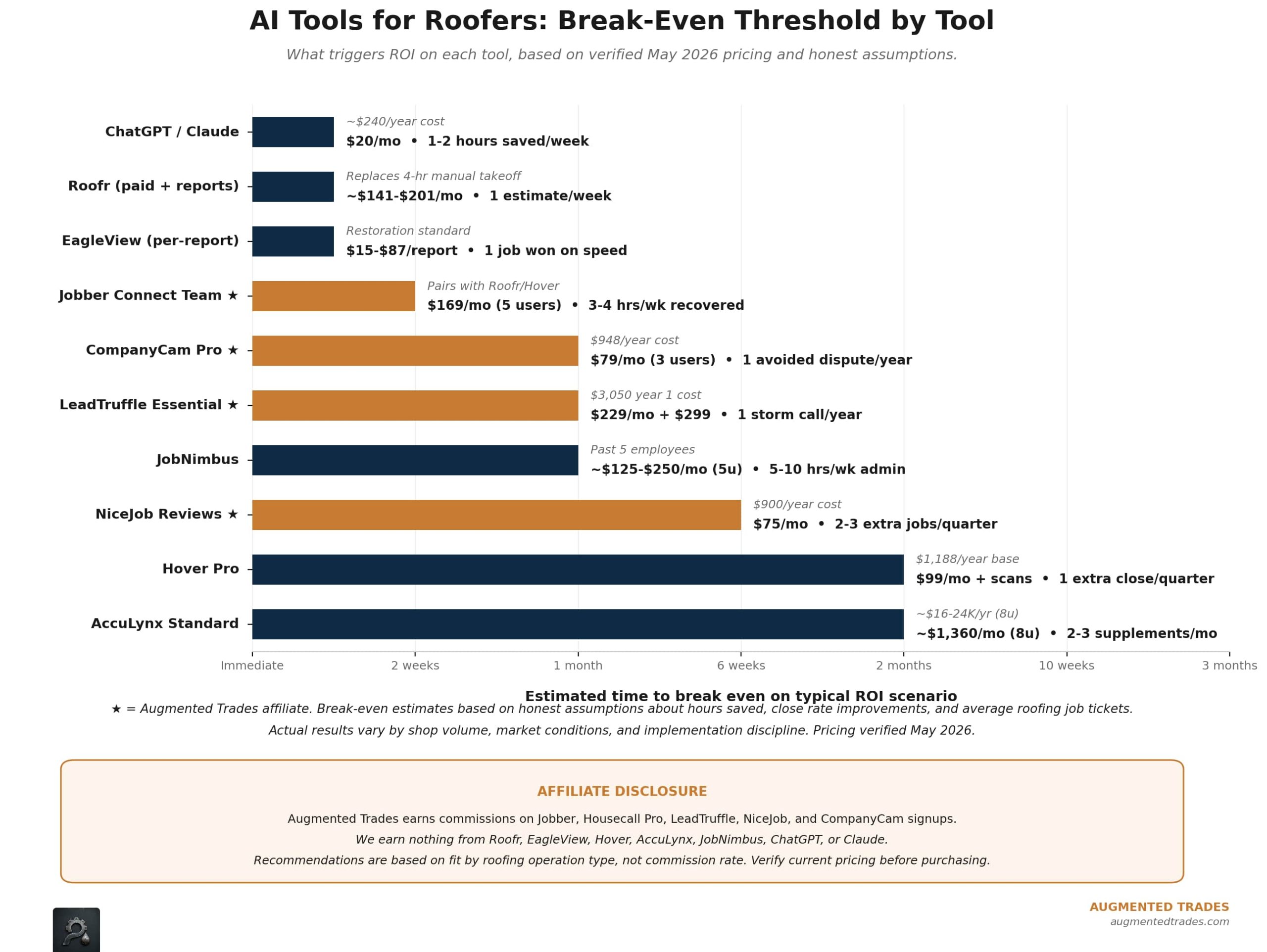
Roofr Paid Subscription (Essentials $249/mo or Scale $349/mo, + $13/report)
Break-even: 1 measurement report per week, replacing a 4-hour manual takeoff.
- At a $50-$75/hour blended estimator rate, one recovered estimate = $200-$300 in time value
- Roofr Essentials at $249/mo + 4 reports/month at $13 each = $301/mo
- Math: Even at the most conservative assumption (one recovered 4-hour estimate at $50/hr = $200), Roofr breaks even after week one of a typical month.
EagleView (Pay-As-You-Go)
Break-even: One job won on speed.
- Average insurance restoration ticket: $10,000-$25,000
- EagleView Premium report: $24.25-$87 depending on roof size and prepay tier
- Math: A single won job covers 100+ reports. Break-even is essentially immediate for any contractor in the insurance-restoration market. The tool only fails to pay for itself if you’re pulling reports for jobs you don’t actually bid.
Hover Pro ($999/year, billed annually, + per-project scans)
Break-even: 1-2 retail close rate improvement per quarter.
- Average retail re-roof ticket: $12,000-$30,000
- Hover Pro annual cost: $999, billed annually, + per-project scan fees
- Math: A single additional retail close per quarter from the 3D visual selling motion covers the platform for the year. Multi-scan months are also recouped within the year on volume discounts.
AccuLynx (Pro and Elite — quote only)
Break-even: Supplement recovery on 2-3 insurance jobs per month.
- Average successful supplement: $3,000-$8,000 in recovered scope
- AccuLynx annual cost: not publishable. Both remaining plans, Pro and Elite, are quote-only as of August 23, 2026, so no annual subscription figure can be sourced
- Math: Two recovered supplements a month will cover most roofing CRM subscriptions at this scale, but AccuLynx no longer publishes a rate, so run this against the quote you are given rather than against a number we can source.
JobNimbus (quote only)
Break-even: 5-10 hours/week of admin time saved across the team.
- 10-person shop on JobNimbus Pro (quote-only; the tier covers up to 10 users): saves an estimated 5-10 hrs/week across the team
- Math: At $50/hr blended administrative cost, 5 hrs/week saved = $1,000/mo in recovered time. Pays for itself within month one for any operation past 5 employees.
CompanyCam Crew ($119/mo annual, 3 users)
Break-even: One avoided scope dispute per year.
- Average roofing scope dispute cost: $2,000-$8,000 (in unpaid scope, change order recovery, or legal/admin time)
- CompanyCam Crew annual cost: $1,428
- Math: A single dispute avoided in a year covers 2-8 years of subscription. This is the easiest break-even on this list — the question isn’t whether CompanyCam pays for itself but how many disputes it prevents.
LeadTruffle (quote only)
Break-even: 1 captured emergency call per quarter.
- Average storm-damage emergency call value: $5,000-$15,000
- LeadTruffle first-year cost: not publishable — LeadTruffle no longer lists plan rates
- Math: A single captured weekend storm-damage lead in the first year covers the entire annual subscription with margin to spare. For roofers in storm-prone markets, this tool is structurally underpriced relative to the upside.
NiceJob ($75-$125/mo)
Break-even: 2-3 additional jobs per quarter from improved review velocity.
- Average residential roofing job: $8,000-$15,000
- NiceJob Starter annual cost: $900 ($75/mo × 12)
- Math: Two additional jobs per quarter from systematic review collection (which tends to lift close rates for shops moving from manual to automated review requests) covers the platform many times over.
ChatGPT or Claude ($20/mo)
Break-even: 1-2 hours of proposal writing time saved per week.
- Average roofer’s time value: $50-$75/hour
- ChatGPT/Claude annual cost: $240
- Math: Recovers its cost in less than two hours of saved proposal writing time per month. The cheapest productivity gain on this list by a significant margin.
Solo Residential Roofer
1 owner-operator · all figures monthly billing
| Published monthly subscriptions | Monthly |
|---|---|
| Roofr Starter | $0 |
| ChatGPT Plus or Claude Pro | $20 |
| Monthly subtotal | $20 |
| Per-report costs (variable) | Unit |
| Roofr measurement report — 7 × $19 | $133 |
$20/mo + $19 per report — about $153/mo at 7 reports
Optional: Jobber Core adds scheduling and invoicing at $49/mo. Roofr reports drop from $19 to $13 on any paid Roofr plan, which starts to pay off past roughly 12 reports a month.
Growing Residential Service Shop
2–10 employees · all figures monthly billing
| Published monthly subscriptions | Monthly |
|---|---|
| Roofr Essentials | $249 |
| Jobber Grow — includes 5 users | $299 |
| CompanyCam Crew — 3 users | $149 |
| NiceJob Starter | $75 |
| ChatGPT or Claude | $20 |
| Monthly subtotal | $792 |
| Per-report costs (variable) | Unit |
| Roofr report on a paid plan — 5 × $13 | $65 |
| Quote required — not included above | — |
| LeadTruffle | quote only |
Vendor prices change without notice. For the current verified figures on every vendor we track — read from each vendor’s own pricing page and dated — see the contractor software pricing tracker.
$792/mo + $13 per report, plus a quote for LeadTruffle
LeadTruffle moved to demo-gated pricing in 2026 and no longer publishes plan rates, so it cannot be included in the subtotal.
Storm Restoration Operation
5–20 employees, insurance-heavy · this stack cannot be priced without two quotes
| Published monthly subscriptions | Monthly |
|---|---|
| CompanyCam Scale — 3 users | $249 |
| ChatGPT or Claude | $20 |
| Publicly priced portion | $269 |
| Per-report costs (variable) | Unit |
| EagleView Premium, by roof size and prepay tier | $24.25–$87 |
| Quote required — not included above | — |
| AccuLynx Pro / Elite | quote only |
| LeadTruffle | quote only |
No complete total exists. Only $269/mo of this stack is publicly priced — CompanyCam Scale ($249) + ChatGPT ($20). AccuLynx is quote-only on both of its plans, as is LeadTruffle.
AccuLynx removed its published Essential tier in August 2026; both remaining plans, Pro and Elite, are quoted. LeadTruffle publishes nothing. So the software core of this stack cannot be priced from published sources at all — treat any monthly figure you see for it as an estimate.
Multi-Crew Retail Roofer
10–30 employees, mixed retail/restoration · monthly unless noted
| Published monthly subscriptions | Monthly |
|---|---|
| Roofr Scale | $349 |
| CompanyCam Scale — 3 users | $249 |
| NiceJob Pro | $125 |
| ChatGPT or Claude | $20 |
| Monthly subtotal | $743 |
| Billed annually — not a monthly plan | Annual |
| Hover Pro (no monthly option exists) | $999/yr |
| Per-report / per-project (variable) | Unit |
| Roofr report on a paid plan | $13 |
| Hover roof-only scan on Pro, by structure | $9–$49 |
| Quote required — not included above | — |
| JobNimbus | quote only |
| LeadTruffle | quote only |
$743/mo + $999/yr for Hover + per-report costs, plus quotes for JobNimbus and LeadTruffle
Hover Pro is annual-only at $999/year. We do not divide it into a monthly figure, because you cannot buy it monthly.
All figures verified against each vendor’s own published pricing page on July 28, 2026. JobNimbus, LeadTruffle and AccuLynx no longer publish pricing. AccuLynx dropped its Essential tier and now offers two quote-only plans, Pro and Elite (verified 2026-08-23).
What to Avoid
Three things that show up in “best AI tools for roofers” searches that aren’t worth your time:
1. “All-in-one” platforms that try to replace your entire stack. Several roofing CRMs market themselves as “everything you need in one platform.” In practice, the best roofers in 2026 combine best-in-class tools: EagleView for measurement, AccuLynx for CRM, CompanyCam for documentation. The all-in-one platforms typically do each individual task worse than the specialized tool. Beware especially of platforms that claim to include EagleView-quality measurement, AccuLynx-quality supplement management, AND CompanyCam-quality photo documentation — none of them actually do.
2. Free AI tools claiming to do “instant roof estimates from photos.” The technology isn’t there yet for production use. AI estimating tools running on uncalibrated databases can produce large bidding errors — easily enough to destroy job profitability. Use AI as a decision-support tool, not a replacement for trade expertise and accurate measurements.
3. Long-term contracts before validating fit. Several enterprise roofing platforms require 12-month commitments with $5,000+ implementation fees before you’ve proven the platform works for your shop. Always negotiate a 60-90 day pilot period, month-to-month option for the first quarter, or use the free trial periods (Roofr Starter and JobNimbus 14-day trial) to validate before committing.
The Bottom Line
Our recommendation for most roofing contractors: Start with Roofr’s free Starter tier and ChatGPT Plus at $20/month. Pull a few measurement reports at $19 each, write your first few proposals through the AI, and validate the workflow on real jobs. Total cost to test: under $200.
After 60 days, you’ll know whether you need:
- Roofr’s paid subscription for the lower per-report cost and full CRM workflow
- EagleView if you’re moving deeper into insurance restoration
- AccuLynx or JobNimbus if your operation has outgrown spreadsheets
- CompanyCam, LeadTruffle, and NiceJob as you scale
The labor shortage isn’t going away. The $42 billion roofing market opportunity isn’t slowing down. The contractors who adopt AI tools in 2026 will be the ones operating at higher margins in 2028 and beyond — while their competitors are still climbing ladders with tape measures.
The window won’t stay open forever. The roofers who move first own the next decade in their local markets.
The Free, Independent Tech Resource for the Trades
Get the weekly Augmented Trades newsletter
Honest AI tool reviews, verified pricing, and tactical breakdowns for trade contractors. Delivered every Monday morning. No spam, no recycled hype.
Free forever. Unsubscribe anytime.
Quick Links: Every Tool Reviewed
Roofr
Best entry point for residential roofers
Best for: Residential roofing contractors 1-10 employees, doing retail re-roofs and small commercial. Free Starter tier removes evaluation risk. Browser-only (no native mobile app), but the price point is unmatched.
Measure+ $109–$169/mo · Essentials $249/mo · Scale $349/mo
$13/report on any paid plan · unlimited users
EagleView
The insurance restoration measurement standard
Best for: Storm-restoration roofers and insurance-heavy operations writing daily Xactimate supplements. Accepted as-default by virtually every major U.S. insurance carrier. Pair with AccuLynx or JobNimbus for full restoration workflow.
Specialty reports: $13.75–$105 (Gutter/Walls/Full House)
EagleView One subscription: custom-quoted
Hover
3D smartphone scans + AI estimating + visual selling
Best for: Retail roofers selling aesthetic upgrades (shingle styles, color choices), siding contractors, exterior remodelers. The 3D photo-realistic visualization closes higher than text-only proposals on retail jobs.
Pro: $999/year — annual only, no monthly plan
Roof-only scans $9–$69 · expedited $19–$39/project
AccuLynx
Built specifically for insurance restoration
Best for: Storm-restoration roofers, insurance-heavy operations 5-50 employees, multi-location portfolios. Deep supplement management, Xactimate compatibility, EagleView and ABC Supply integrations. The dominant choice for shops writing supplements daily.
Pricing page is now a request form (checked Jul 2026)
Annual contract · 4–6 week implementation
JobNimbus
Flexible CRM for retail and mixed-revenue roofers
Best for: Retail roofers, mixed retail/restoration operations, growth-stage shops (5-15 employees). Open API for integration flexibility. SumoQuote estimating and proposal builder included. 14-day free trial.
Essentials 3u · Pro 10u · Premium 19u · Enterprise 20u+
Users included per tier, not billed per seat
Jobber
Most accessible FSM for residential roofing service
Best for: Residential roofing service shops doing repairs, leak diagnostics, small re-roofs. 1-15 employees. Strong mobile app. Pairs naturally with Roofr for measurement reports. Cheapest entry to systematic FSM.
Teams include users: Grow $299 (5u)
Plus $499 (5u) · $599 (10u) · $699 (15u)
Housecall Pro
Marketing-first FSM with review automation and online booking
Best for: Residential roofing service shops focused on retail repeat business. Seasonal work (gutter cleaning, winter prep, maintenance contracts). Stronger marketing automation than Jobber. Online booking captures after-hours leads automatically.
Essentials $189/mo ($149 annual, 5 users) · MAX $329/mo ($299 annual, 8 users)
Higher tiers require their plan selector — ask direct
CompanyCam
Hail damage documentation and insurance claim photos
Best for: Every roofing operation. Solo to enterprise. Especially critical for storm restoration where photo evidence drives insurance reimbursement. Auto-tags photos by job and address. Insurance claims live or die on time-stamped, geotagged evidence.
Crew $119 / $149 · Scale $199 / $249 — 3 users
Additional users $29 annual / $34 monthly
LeadTruffle
24/7 AI voice agent for storm-damage calls
Best for: Any roofing operation handling residential work with after-hours call volume. Highest-ROI tool during storm season — when 500+ homeowners might call your office in 48 hours. Single captured emergency call typically covers a full year of subscription.
Previously published tiers are no longer listed
NiceJob
Trade-aware review automation for retail roofers
Best for: Residential and retail roofers doing 15+ jobs per month. Google reviews are the #1 lead source for retail roofing. NiceJob captures private feedback first when customers signal unhappiness — gives you a chance to fix issues before they become 1-star public reviews.
Sites add-on $99/mo + $199 setup
No contract · 14-day free trial
ChatGPT
Cheapest entry to AI-assisted proposal writing
Best for: Solo roofers doing 2-3 estimates per week. Pair with Roofr Starter’s pay-as-you-go measurement reports and you have a functional under-$50/mo estimating workflow. Cuts proposal writing time from hours to minutes.
(Free tier works for basic use)
Claude
Alternative AI assistant from Anthropic
Best for: Roofers who want a second AI option. Strong at structured outputs, long-context documents, insurance correspondence, and customer communications. Many contractors run both and pick whichever produces better output for a given task.
(Free tier also available)
The Augmented Trades Recommended Stack by Roofing Operation Type
Affiliate disclosure: Augmented Trades earns commissions when readers sign up for Jobber, Housecall Pro, LeadTruffle, or NiceJob through our links. We earn nothing from Roofr, EagleView, Hover, AccuLynx, JobNimbus, CompanyCam, ChatGPT, or Claude — they’re included because they’re the right tools for specific roofing operations, regardless of commission structure. Pricing was verified July 28, 2026 against each vendor’s own published pricing page. AccuLynx, JobNimbus and LeadTruffle no longer publish pricing at all and are shown as quote-only rather than estimated; Housecall Pro publishes only its Basic tier. We make no ROI or savings claims that aren’t directly tied to a cited source or clearly framed as estimates with rate assumptions disclosed. Always verify current pricing on the vendor’s site before purchasing.
More from Augmented Trades
- Best AI Tools for Plumbers in 2026 — the AI tool stack for plumbing service operations
- Best AI Tools for Remodelers and Custom Home Builders 2026 — the construction-side toolkit
- How HVAC Contractors Use AI to Win More Bids in 2026 — the HVAC bidding playbook
- https://brightcall.ai/blog/improving-lead-response-times#:~:text=78%25%20of%20customers,lead%20management%20tools. ↩︎
- https://www.leadresponsemanagement.org/lrm_study/ ↩︎
Want the prompts we use?
We turned our research into a 25-prompt pack for trade contractors — for estimates, client communication, proposals, and business operations. Copy, paste, adapt. Save hours every week.
Affiliate disclosure: Augmented Trades participates in affiliate programs and may earn a commission when you sign up through links on this page, at no additional cost to you. We never accept payment for placement or rankings. We earn affiliate commissions on some links, and those never change which tool wins a category. See our full affiliate disclosure.
Related: Best Lead Generation for Roofing Contractors — storm and restoration vs. retail replacement, and shared vs. exclusive leads. Also: Best Software for Roofing Contractors (2026) — roofing-specific platforms vs. general field-service tools, with verified pricing.

Michael is the founder of Augmented Trades, an independent site that compares AI and software tools for trade contractors on published pricing, contracts, and real feature limits. Tools are recommended on fit for your shop — affiliate partnerships never decide coverage.